
Further Along: On the Bay's Coming Triennial
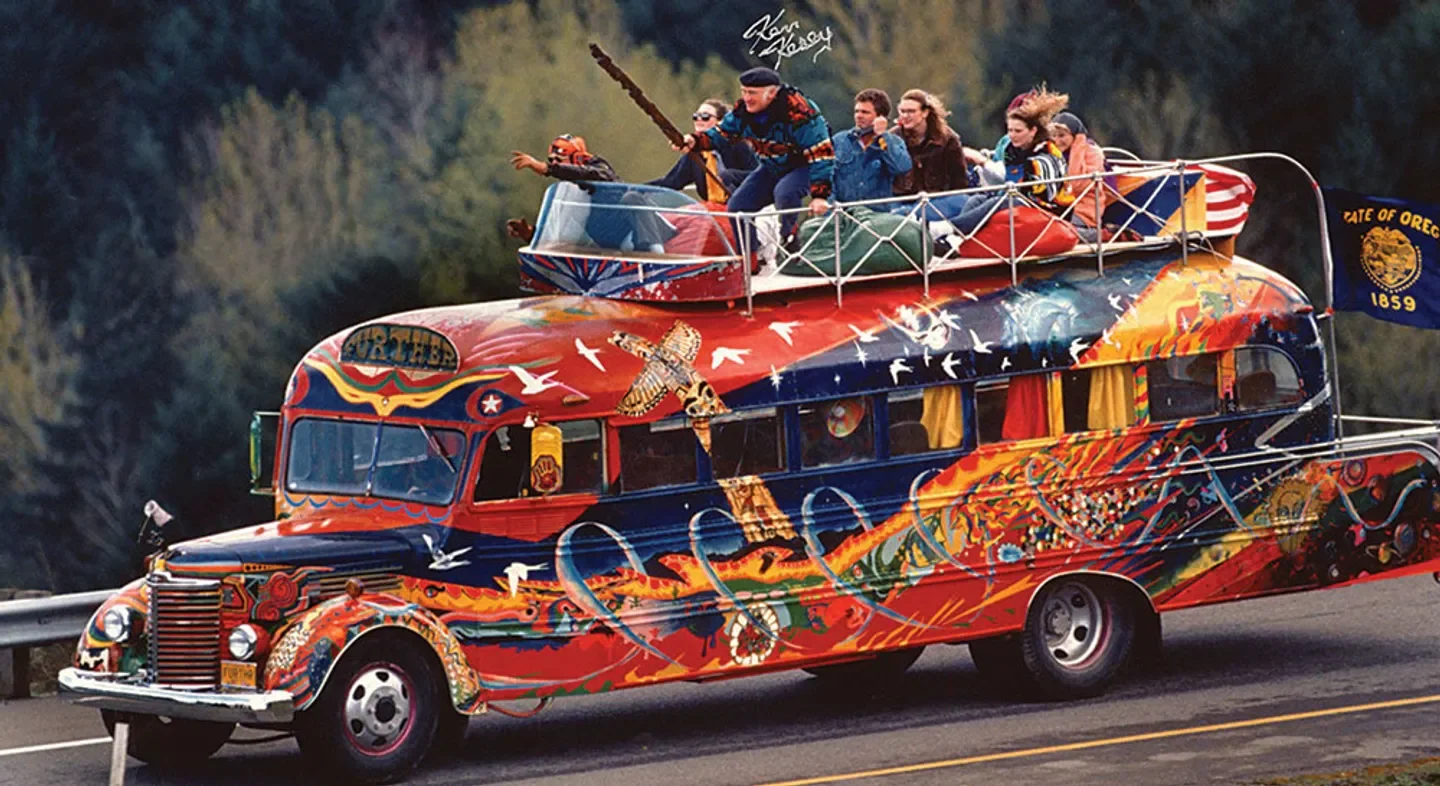
The SF doom loop is all looped out. In a year or so, Further rolls into town. "Further", a koan painted upon the prow of the Merry Pranksters' bus as Ken Kesey and Babbs and the whole glorious chaos of them roiled and pranked and did an awful lot of acid out of the Bay and into American folklore. Now it's the name of a triennial, eighty-plus nonprofit arts organizations across Northern California, coordinating exhibitions from Sacramento to Santa Cruz, March through June 2027. The all-electric vintage VW Westfalia serving as the program's mobile hub is called Furthermore. Make of that what you will.
There's something elegiac running through the best of this program, something buried and monumented before it can be named. Sophie Calle took her first photographs in Bolinas in the late 1970s — of tombstones, in the small fogbound cemetery of that coastal town north of San Francisco where poet Joanne Kyger lived and wrote, where so many poets settled into the informality of the coast. Decades later, in 2014, she purchased a plot there, next to Lawrence Ferlinghetti's, and wrote asking if they might meet beforehand, as future neighbors in death. He declined, saying he was too tired. He died in 2021. For Further, the Bolinas Museum presents Sophie Calle: PLOTS in two parts: "It would be nice to meet you beforehand...", an exhibition of works around death and gravesites drawn from Bay Area collections, and Here Lie Our Secrets, a public commission and daylong performance at the actual burial plot, where Calle will invite visitors to share their innermost secrets — committed to paper through a slot in the gravestone, or whispered directly to the artist, to be held in her memory in perpetuity, entombed there alongside her eventually.
Tim Youd's The Typewriter is Holy the Poem is Holy, presented at the Santa Cruz Museum of Art and History, sends the artist retyping The Electric Kool-Aid Acid Test and Beat poetry volumes on the same typewriter models the authors used, at their actual sites — Ginsberg at City Lights, Kyger in Bolinas, Weldon Kees at the Marin end of the Golden Gate Bridge where his abandoned car was found. Each book overwritten until illegible, the text present and completely unreadable, mounted as diptychs while Youd moves through the landscape across the full three months.
The SFAI Legacy Foundation presents The Rose in the Wall, tracing the twenty-six years Jay DeFeo's monumental painting lived entombed inside the McMillan Conference Room at the San Francisco Art Institute— students leaving roses at the wall, faculty teaching beside it as a silent witness — until the long campaign to free it carried the work to the Whitney. That this show now takes place not at SFAI but at its Legacy Foundation, the institution's own ghost, gives it an almost unbearable resonance. At Slash, Maria Silk's John and Billie Go Underground imagines the rumored tunnels connecting San Francisco's gay bars during police raids, queer memory resurfacing through speculation and performance. Whether the tunnels existed or not almost doesn't matter. The story does.
“The Bay has a particular genius for this: for not seeing what it has until it's gone, then making extraordinarily beautiful art about the loss.”
An entombed rose, secrets buried in a gravestone, hidden tunnels under the city. A book typed until it disappears into itself. Further keeps finding these images of what's buried, what's hidden, what's mourned before it's fully lost — the Bay just can't help itself. The Bay has a particular genius for this: for not seeing what it has until it's gone, then making extraordinarily beautiful art about the loss. This is not a failure of the triennial. It may be the most honest thing a Bay Area triennial could do right now. It is also worth asking what it means.
The program is genuinely ambitious, genuinely underfunded, and represents an extraordinary act of collective care. Organizing these institutions across a region that has spent years watching its infrastructure erode — art schools closed, galleries shuttered, affordable studios gone — is remarkable. The organizers have done this without a Getty war chest, which makes it more heroic and more precarious than Getty PST, whose similar loose-umbrella structure it resembles. The difference is that PST had institutional muscle behind its cultural nationalism. Further is running on belief.
And much of what it has assembled deserves the belief it's running on. The CCA Wattis brings Rayyane Tabet into conversation with Jay DeFeo across 3,626 postcards — Tabet's own collection discovered to mirror hers, shared images and uncanny resonances across the distance of death, closer in spirit to Calle than to anything we might typically call archival research. The Cantor Arts Center unearths the collaboration between Marlon Riggs and Essex Hemphill, Black queer life in the Bay as urgent history, a pairing that still crackles. Di Rosa celebrates the women who helped define Funk — Jay DeFeo, Mildred Howard, Joan Moment — artists too often footnoted in the region's own story. The Goethe-Institut traces how Northern California skateboarding culture seeped into East Germany's cultural underground, the kind of genuinely strange proposition that signals a program willing to follow its curiosity somewhere unexpected. The Museum of the African Diaspora mounts the first major retrospective of painter and muralist Dewey Crumpler. Creative Growth invites Matthew Higgs to spotlight artists including Judith Scott and Dan Miller. Kang Seung Lee at the San José Museum of Art weaves the seldom-shown work of Ed Aulerich-Sugai — cloud paintings, botanical illustrations, dream journals tended by Bob Glück — into a living international network of queer memory. BAMPFA is commissioning Marcel Pardo Ariza to celebrate art handlers, the invisible labor that keeps every institution on this list running. These are shows oriented toward the present tense, toward what's alive and still here.
But the program is conspicuously silent about the other thing the Bay Area made — the industry that took the Pranksters' language of disruption and turned it into a business model, that generated extraordinary prosperity while hollowing out the conditions under which this culture was built and called the process innovation. The affordable housing gone, along with too many galleries and two of the region's most important schools. Not tech itself but the hurry-up-and-break-shit extractivist model of it — prosperity for some, displacement for the artists. The counterculture as brand; the brand as extraction. Further throws a celebration of life for a culture displaced by that model, and the program won't quite say so. Mayor Lurie appears in the press materials talking about economic comeback. A triennial funded on belief and civic goodwill is not best positioned to name what did the displacing. But there it is. I very much want to encourage the wealthy, but not as a courtier — as what I am, a critic. The Pranksters, who knew a hustle when they saw one, might say something about that. There's money in this city that could sustain this culture for generations. The point isn't to stop being critical. It's to be critical as an invitation rather than an indictment — to say: you built something extraordinary here, now help us keep the rest of it alive.
“The point isn't to stop being critical. It's to be critical as an invitation rather than an indictment”
None of which diminishes the grandeur of what's being attempted here — a bet, made in public, with genuine care, that the Bay's art world is not a collection of isolated survivors but something layered, strange, connected, and worth the journey. The Bay is alive. Always strange, not uncompromised, but alive. The rose was sealed in a wall for twenty-six years and it survived. Further is betting the culture can too. I am sincerely looking forward, acid on my tongue, waiting for the bus.