
Soap and Water: Diedrick Brackens and YBCA
Our critic comes clean at YBCA
Nobody likes to admit they’re wrong. I was wrong.
Last year, I walked into Bay Area Then at YBCA with a chip on my shoulder.
Rather than judiciously attending to the art on display, I clamped onto my anger about the ignominious way the previous year’s Bay Area Now had collapsed: artists on strike over Gaza, the museum closing, and no meaningful response from the executive board. At the same time, some artist friends who might have actually benefited from the exhibition had their work removed because of the strident (and justified) imperatives of those more directly involved in the protest. Muddied by this clusterfuck of irresolvable demands, the YBCA seemed to have wiped its dirty hands clean with the bold political pronouncements of a few artists in Bay Area Then. So I wrote an angry, overly critical review—a poorly considered hit piece aimed at what I saw as YBCA’s institutional failures.
Of course I was wrong.
Seeing Diedrick Brackens’s gather tender night led me to recognize a profound shift—first that the YBCA had already changed for the better by Bay Area Then. And, since then, the broader conditions surrounding this dear institution had changed for the worse. Put simply: how we look at art, and what we look for when we look to art, has dramatically shifted over the past year, and I’m glad I returned to YBCA for this show.
I had been fatigued by activist art rooted in identity that felt impotent. My bugbear was Rigo 23’s Terra Nullius (2025), an updated pastiche of Francisco Goya’s The Third of May 1808 (1814). Rigo’s version posited a Palestinian family attacked by drones in the place of Goya’s suspected insurrectionists on the firing line, with the familiar spires of Sutro Tower replacing the townscape and steeple. At the time—before the inescapable catastrophes of the previous year—the work struck me as overly literal and momentary, its message blunted by its directness. My own cowardly dismissal was mistaken. What once seemed a pat gesture now reads as an ever-prescient indictment. Art, thankfully, always outlives such petulant apoplexy.
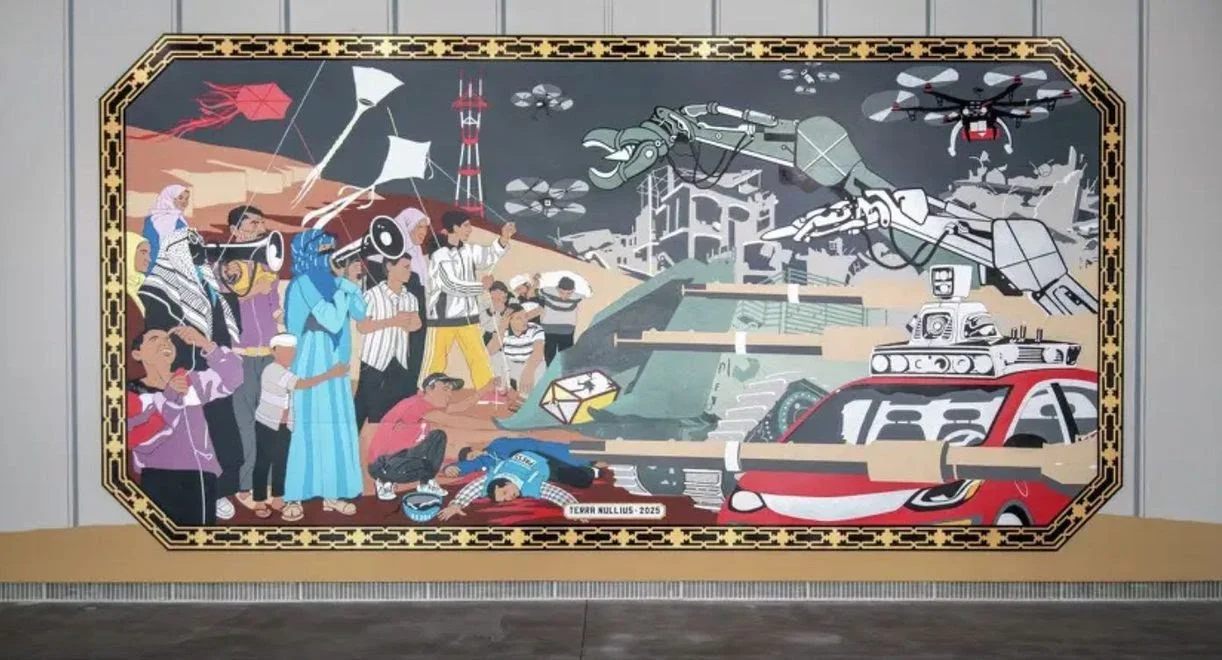
Rigo 23 Terra Nullius (“Nobody’s Land”); Courtesy of Charlie Villyard
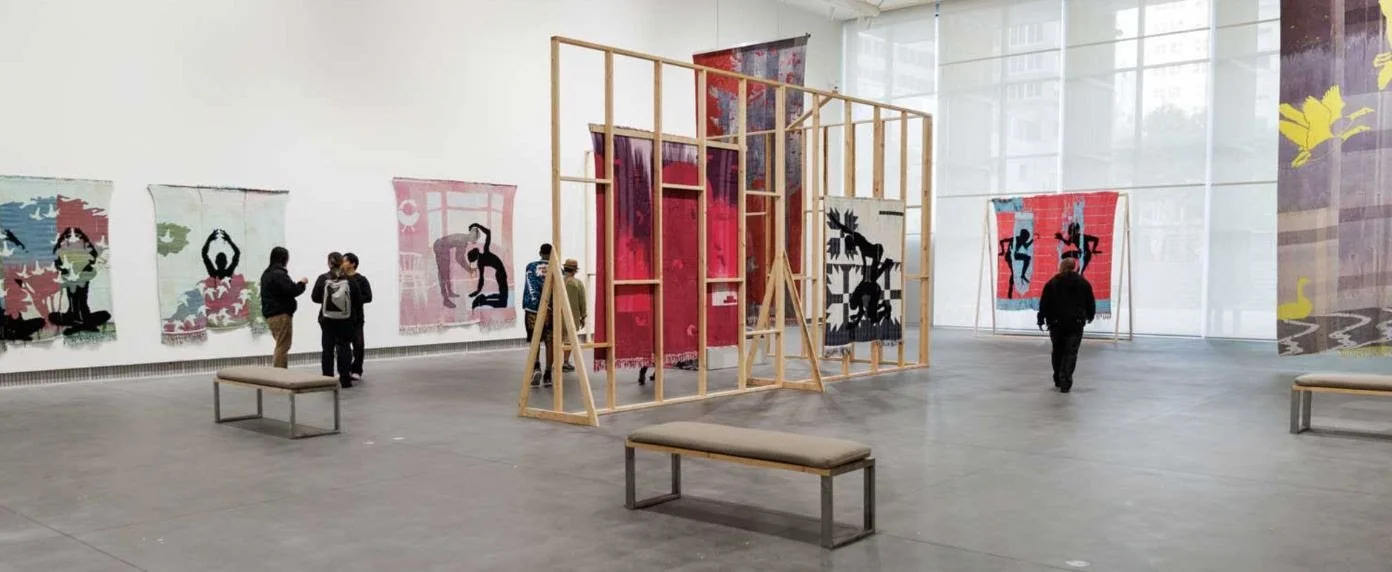
Internally, much of this good shift is to the credit of Maricelle Robles, who took over as CEO late in 2024, and Eungie Joo, who guest-curated both Bay Area Then and this urgent and poignant presentation of Brackens’s work. One of the first things you notice in this installation composed of monumental wooden supports like looms themselves, exposed two-by-fours, and large-scale tapestries suspended from the ceiling, is the instability of the figures who are not firmly held within the scene, but appear and dissolve depending on which side you see.
In Blood Compass (2023), a yellow and lavender landscape shimmers: lighthouses and geese give familiar shape to the scene while two figures move in and out of a lapping shore. Hanging black thread reads as dripping water, while also underscoring the material quiddity of the textile itself. Lavender, complement to yellow, appears in the scene like a mist, should one choose to read the tapestry illusionistically. The gracefully gangly bodies twist and turn into elongated, almost entraptured attitudes of release and longing: one looks toward the lighthouse, another up to the geese, each oriented by light and sound.
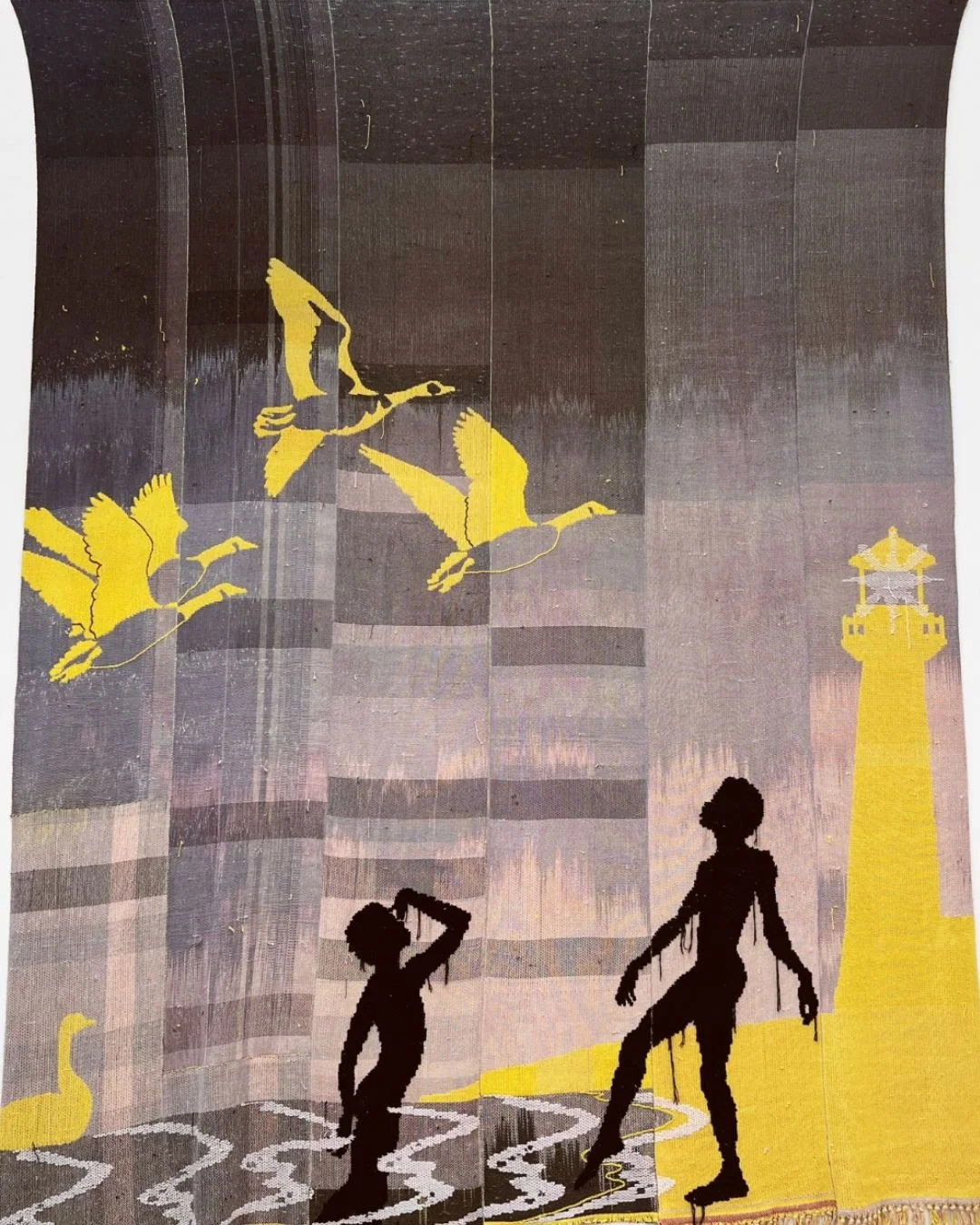
Diedrick Brackens Blood Compass (2023); Courtesy of Artforum, the artist, and Jack Shainman
Move to the reverse side of the weave, and the image inverts. The geese and lighthouse shift into negative space; lavender and yellow trade places. The figures, however, do not survive this reversal intact. What remains are horizontal bars—structural traces where bodies once were. These lines, which bind the figures to the scene on one side become abstract, redacted, almost bureaucratic on the other, marks of absence not presence. Because so much space has been given over to presenting the backside of some of these tapestries – not normally done in most installations of textile works – the scene is of transience, not fixed. These fugitive bodies are as defined by their silhouettes on one side as their disappearance on the other.
Throughout the installation, figures mirror, embrace, and kneel beside one another in intimate configurations that suggest dance, play, and care, but also a kind of atemporal suspension. Water, ever the threadbare metaphor for liminality since Huck and Jim boarded a raft, is present throughout, yet it resists cliché. Not merely symbolic shorthand, it becomes both baptismal and bath, swamp and salvation, irradiated by the layered color latent in hand-dyed cotton woven together on Brackens’s loom.
In another 2025 work, wider than feeling, a solitary figure wades, into a lake framed by trees under a ravishing sky that reads as dusk or dawn, depending. The colors—orange-flecked salmon and turquoise—refuse naturalistic reflection but they feel real. Not simply mirroring the sky as it tended to do in nineteenth century landscapes, the water/sky pattern registers as its own continuous field. Is the figure in the foreground our surrogate Rückenfigur, or are we the ones watching them? This motif recalls, in different ways, the haunted runners from Weapons, a still from Kehinde Wiley’s 2017 video piece In Search of the Miraculous, as well as Winslow Homer’s watercolors of Afro-Caribbean bathers and sea turtle fishermen in the Bahamas. A persistent, charged presence in American art, at once idyllic, precarious, and historically freighted, it is never not a good time to ponder the motif of bodies in water, menacing or otherwise.
Elsewhere, the installation turns toward vegetal density and intoxication. commitments (2025) sparked a memory of encountering the soft perfume of the Angel’s Trumpet within the first year of living in California, only to learn that the scent is toxic. That dialectical interplay between seduction and danger pervades these works. Two seated figures raise their hands skyward, immersed in lush foliage that is as much about beauty as poison. In help is available (2025), a cloud pattern looms like an ominous canopy above a figure entangled in a bush, as if they have followed sensation itself into an altered or afterlife state. The hypnotic crisscrossing diagonal weave buzzes with its own rhythmic intensity. We toggle between illusionistic draw and the wefted appeal of the dense surfaces in a push-pull dance.
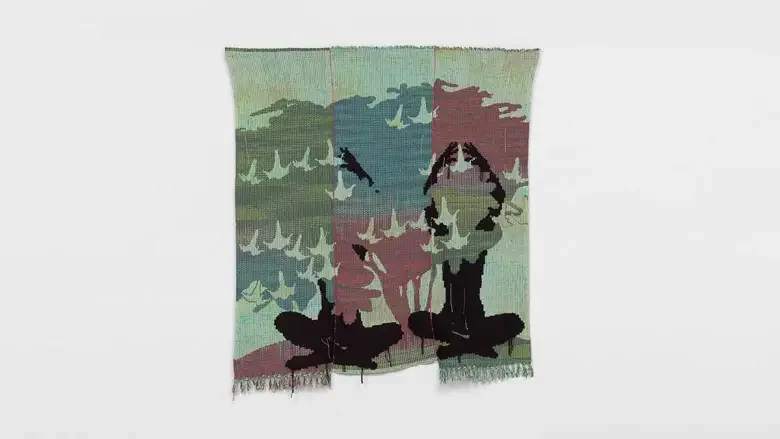
Diedrick Brackens commitments (2025); courtesy of the artist & Jack Shainman Gallery, NY
Moving through the huge space of the show, punctuated by large supports, hanging tapestries, and a 2”x4” frame suggesting a home, I kept sillily thinking of the dude’s rug, from The Big Lebowski, and how “that rug really tied the room together.” That is not at all to trivialize the power of Brackens’s work nor the lucid intelligence of Joo’s installation. What had felt cacophonous and antipodal during Bay Area Then, feels perfectly tied together here, not just because this is all the work of one artist, but more that each tapestry begs to be touched. These are, after all, giant blankets whose weight one longs to feel on their bodies. Our own haptic desire fills the room, which might have been what the dude meant back then.
Nearby, clearing (2025) presents a tapestry-laden bed and a basket bearing bars of Dial soap that spill out onto the rectilinear-patterned cover. Dial’s sharp, unmistakable scent—clean, synthetic, almost aggressive but reassuring (at least to me)—introduces another register of bodily awareness. If the tapestries evoke immersion, sensuality, and dissolution, this object suggests containment, hygiene, and control, underscored by the flat pattern of the blanket. Between absorption and purification, we find ourselves within bodies both porous and managed. This pile of soap might call back to Kilgallen’s installation at Bay Area Then, where used bars of soap scattered behind her tower, a clever curatorial gambit on the part of Joo that speaks to an idiosyncratic continuity for Brackens’s return to the Bay.
Tapestries tie together much more than rooms, art outlives the time-bound concerns of right and wrong, and there is hope in soap.