
Togetherness: ‘Hermana/Hermano/Hermanx’ at Et. al
Let’s skip the over-explanation. This is the first group show I’ve seen in a minute that doesn’t need it. But a little context won’t hurt…
In the Bay, it's been looking odd for a while… The city’s leading commercial galleries represent maybe a handful or so of Latinx artists among them, and while significant archives have found homes here, every museum collection around town lacks anything close to an accurate record of California’s recent Latinx cultural production. Within this context, and noting the show’s inclusion of more publicly recognized artists—Esteban Raheem Abdul Samayoa, Rose D’Amato, Paola De La Calle, Liz Hernandez, Arleene Correa Valencia, Marcel Pardo Ariza, and Gina Contreras—who I think still deserve more, there’s certainly a layer of implicit subtext here. An indictment, perhaps, of the myopic structures and habits that still seem to govern.
“Together, we propose what we jokingly call the Hermanx School: a movement without manifesto, held together by humor, mutual care, and the understanding that art and politics have never lived apart.” — from the press release
Okay, now back to the show. Curated by Victor Saucedo with Samayoa and held at Mission stalwart Et al., Hermana/Hermano/Hermanx gathers thirteen Bay Area Latinx artists. All have layered relationships to California, as well as broadly sharing aesthetic and political concerns, including an ethos of mutual regard and community responsibility. Though many of them have long moved through adjacent circuits (neighborhoods, schools, friendships, art jobs, and the internet), these points of contact have curiously never publicly aligned until now, under Saucedo’s convening.
For me, the organizing logic of the show is best illustrated in Samayoa’s EBT (Everybody Eat), 2022. Here, the artist reproduces in subtle charcoal grays a Golden State Advantage card bearing his own name, California’s standard card for food and cash benefits. Beneath the administrative language, a beachy California cliff drifts into a dream-like elsewhere, equal parts aspiration and myth. Symbolic as it appears, the work’s power lies more in its refusal of scarcity. Samayoa—and Saucedo—propose redistribution without permission, an ethic of putting the homies on, guided by the principle: “if I got something, you do too.”
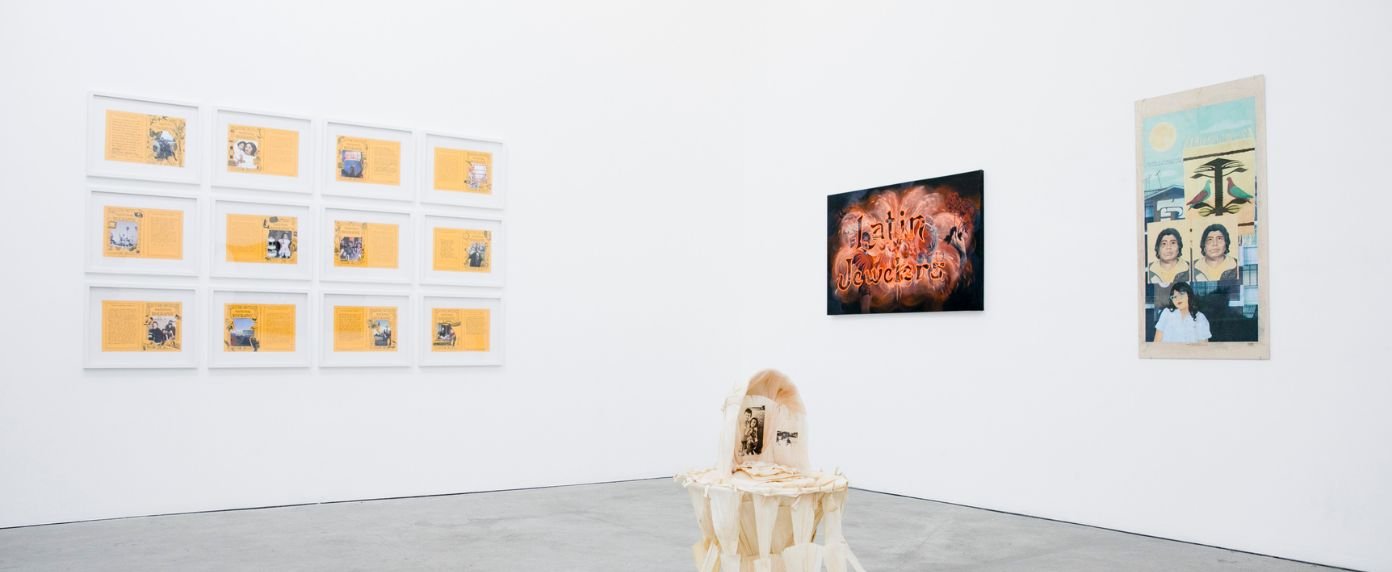
You can spot this graphic sensibility and everyday poetry in other works; Rose D’Amato and Alyssa Aviles both draw from sign-painting traditions, only to allow its rigidity to dissolve into atmosphere. The letters in D’Amato’s Wicked Lady (2025) soften into a glowing, ghost-like haze, while Aviles’ El Paved Navido (2025) gothic script veils a flickering underlayer of people and gestures, tying the “Latin Jewelers” to the store’s actual role in the Mission. (Latin Jewelers is one of the oldest family-owned jewelry stores in the neighborhood, well-known for offering credit financing to both banked and unbanked individuals with low or no credit.) Nearby, Kevin López Pardillo similarly pulls from local economies. La Pulga (2025), a mixed-media installation of cast toy replicas, airbrushed blister packs, and neon signage, leans on what I call counterfeit poetics—an exaltation of the bootleg as a fleeting, tactical freedom.
In contrast, other works pull inward. In Hanging Archive (2023), the largest and most ambitious installation in the show, Paola De La Calle builds a gorgeous constellation of digital and personal photographs of Colombia, printed on chiffon. Suspended from the ceiling and softly layered, the photos offer intimacy, a memory of home, even if mediated, even if one can’t always return. Nearby, Angela Zamora similarly channels an archival impulse through the meticulous and painstaking hand-dyeing and braiding of corn husks. In Mano de Obra and Buque de Mi (both 2025), this process resolves into devotional forms where themes of labor, migration, and childhood are held with a disarming tenderness.
Though implicit throughout, the personal-political stakes of the show are magnified in works like Hector Muñoz Guzman’s aptly titled painting, Indigenous Warrior Defeats ICE Pig (2025). Painted after Diego Rivera’s Indian Warrior (1931), Muñoz-Guzman re-casts the revolutionary figure into a contemporary struggle for sovereignty. Chosen as the show’s leading press image, it gestures toward a reality familiar to many of us: that the violence of immigration enforcement and policing is not distant, but part of how we move and negotiate visibility.
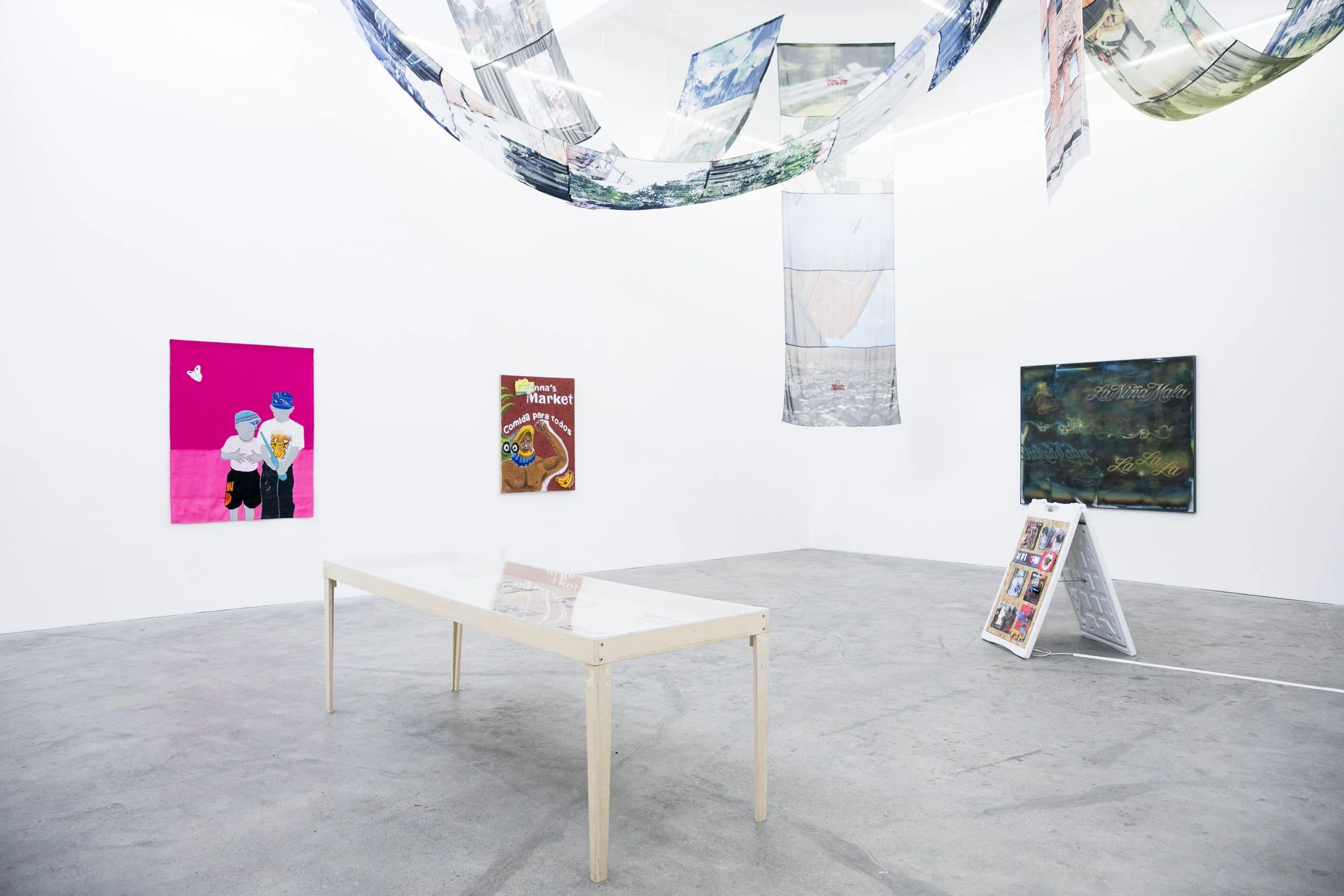
Install shot of ‘Hermana/Hermano/Hermanx’, 2025. San Francisco. photo: Rich Lomibao
It’s natural and human to continue to want to be seen on our own terms, especially amidst “erasure and exhaustion,” as Saucedo writes. But representation in the arts is fraught, and within Latinx communities, it’s even more so when we are uncritical about how ancestry, gender, class, and national identification shape our experiences. I’m often wary of claiming a kind of liberatory solidarity on the basis of the false homogeneity that is “Latinidad.”
Still, I believe there’s a fair inquiry here, one which many before me have devoted time to asking and researching: What are the conditions that marginalize Latinx art, of any kind, and what are the effects of this on cultural memory, public visibility, or perhaps, most importantly, the lives of artists (and the people that love and write about them)? Some answers that feel pertinent right now: our work is too political or didactic, we’re seen as perpetual aliens, our aesthetics are too crafty, representational, and insufficiently modernist.
It is for all of these complex and conflicting reasons that I’m interested in thinking through Saucedo’s proposal of an Hermanx “school” and this show as its first iteration, not as a stable, representational ‘gap-filler,’ nor a cohort of our heaviest hitters, but as an open, site-specific methodology that privileges care and positions our interdependence as generative. The curators name, quietly but clearly, the fatigue, fear, and precarity that shape how many of us approach work in the first place. Of course, time will tell how sustainable this all is—not because the model is fragile, but because it’s genuinely hard and tiring work to keep up with.
I’m only 29, but am starting to see how all of these moments accumulate. Though the show doesn’t claim historicity, it certainly gestures toward a future where these artists don’t become relegated to footnotes or afterthoughts. Or worse, compelled to abandon pushing form for legibility. I’m tired and only cautiously optimistic that for the well-meaning and more powerful folks who came to the opening, this will all register as much more than just the lovely evening that it was. I walked away with something simpler: a desire to keep showing up and writing about it all.
Banner image: Install shot of ‘Hermana/Hermano/Hermanx’, 2025. San Francisco. photo: Rich Lomibao