
A Roving Perspective: Mukherjee at Wendi Norris, Hoeber and Osborne at Silverman
Because we encounter so much of our visual culture through increasingly hopeless digital images, we may assume that most art presumes a screen. In your hand or upon your lap, however, too many artworks suffer as the market crunches them into those digital formats best swiped online; neutral fluorescents beaming out from JPEGs, and what you see on the screen is often what you get in the gallery. Or rather, the paucity of experience online can poison a show. Three shows recently on view in San Francisco bucked against this trend by inviting viewers to move back and forth in front of the works on view. Digital photos do these artists no favors whatsoever.
Ranu Mukherjee’s “The Long Middle” at Gallery Wendi Norris, which recently closed, presented a body of deeply layered works that soak up multiple visual systems. Layers of inkjet-printed silk stretched across a ground of crystalina and pigment, over which Mukherjee built passages of paint. She pasted floating fragments of cotton jamdani, setting painterly exuberance against technological reproduction, a happenstance that overlaps into a frisky interplay. Mukherjee’s themes teeter between collective action and environmental catastrophe: the honeycombed pixel pattern printed on silk is based on images of crowd protest, while much of the flora and fauna Mukherjee lusciously paints are endangered, or invasive, or gone.
In if I could describe my river (2026), extinct birds commingle with portraits of cats Mukherjee met on her travels, all looming like the creatures above the artist in Goya's Sleep of Reason (1797-98, published 1799), springing from a plastic water bottle. Too visually complex to be winnowed down to pat messaging, works such as rare earth dream (2026) present the motif of the window frame, which recurs both as illusionistic conceit, something we look through, and as flatbed pattern, something we gaze at. The unresolved contrast between these modes constitutes the work's haunting power: medium and message may be inextricable, but their connection need not be resolved. Let’s float rapt in the harmony of diaphanous color, whether we understand it or not.
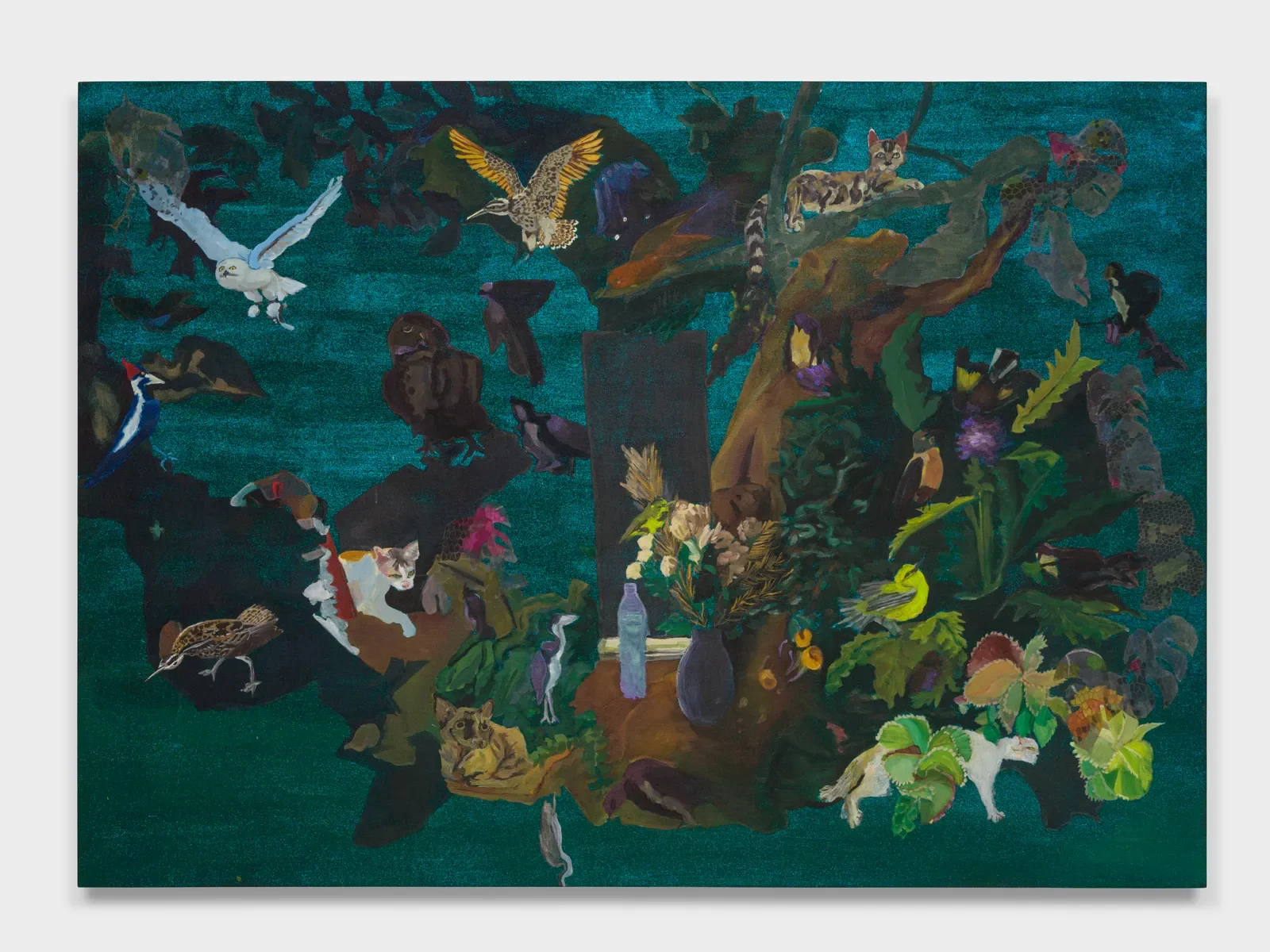
Ranu Mukherjee, if I could describe my river, 2026 | Pigment, crystalina, and UV inkjet print on silk sari on linen | 60 x 84 inches
Julian Hoeber’s “Binocular Rivalry” and Oliver Osborne’s “The Card Players” (both at Jessica Silverman, both closing July 11), though formally disparate, proffer work that also demands a roving perspective, rewarding both close-up examination and as much distance as the gallery space will allow. Take all of it.
From twelve feet away, in Julian Hoeber’s Night Studio (2026), the striped circular orbs begin to sizzle, and the painted stereoscopic view of Hoeber's studio resolves into River Phoenix’s “fucked-up-face” pareidolia. Move closer, and the subtle differences between the paintings sharpen, conjuring the Rauschenberg of Factum I and Factum II, his nearly identical mixed media combines from 1957, and Gilded Age stereographs.
While Mukherjee overlays discordant patterns that emerge and melt together, Hoeber juxtaposes precisely painted versions of cellphone photos with eddies from the history of Op Art and geometric abstraction of the 20th century, as if the old promises of High Modernism (Anni Albers, Victor Vasarely, etc.) haunt the drab quiddity of our screen-soaked reality. In Hoeber's hands, that inheritance produces wonder, not nostalgia, as the eye wanders between engaged focus and involuntary, retinal flashes. Scintillating illusory spots invade the grid in Costus Comosus (2026).
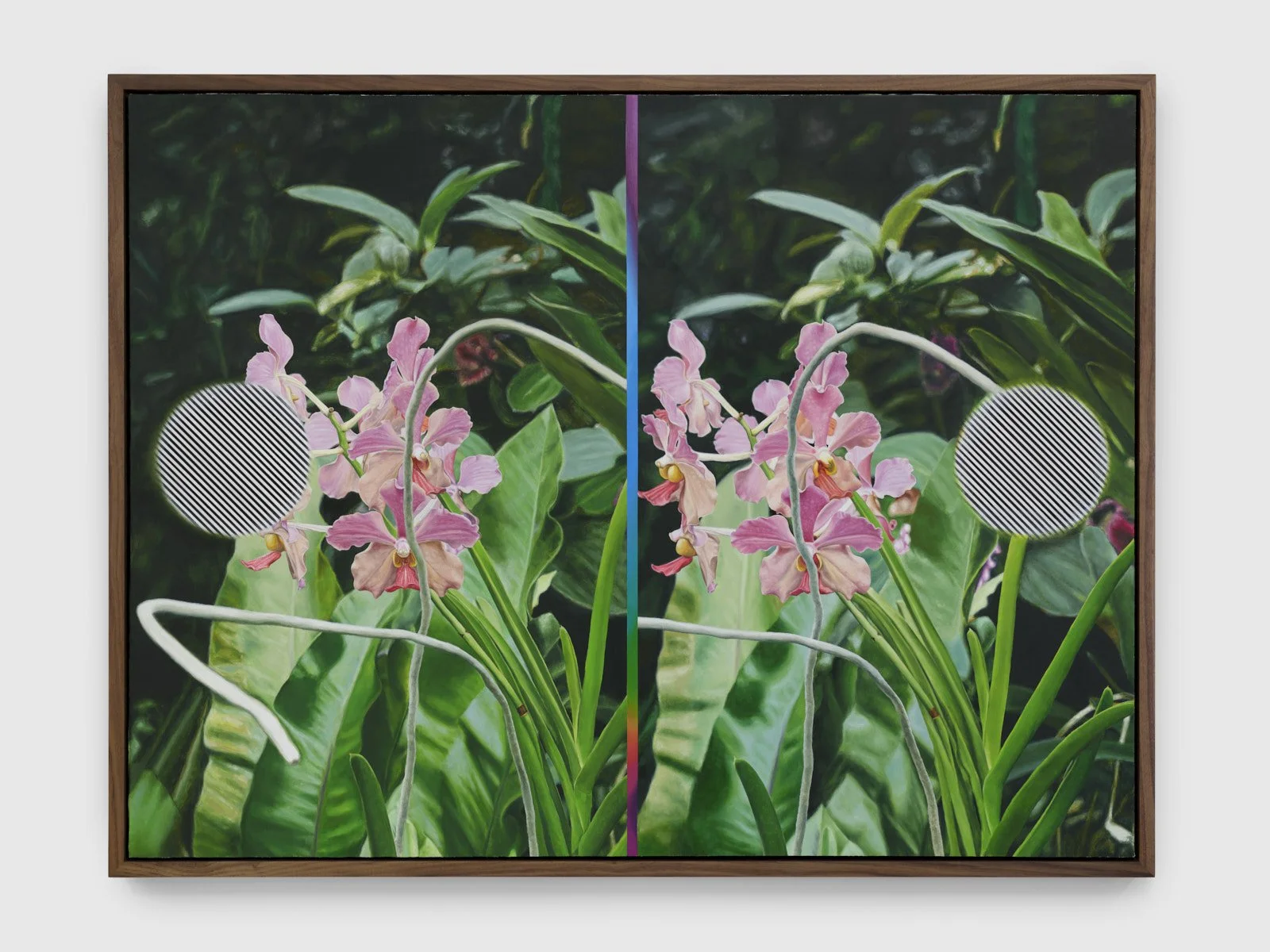
Julian Hoeber, Pink Moth Orchid Pink Moth Orchid, 2025 | Oil, Flashe, acrylic and graphite on linen over panel | 38 x 49 1/2 x 2 1/2 inches
In Oliver Osborne’s first San Francisco show, titled “The Card Players,” he reworks a canonical subject from the Renaissance and Baroque periods. In traditional versions of the subject such as those by Caravaggio, Georges de la Tour, and Jan Lievens, the drama is built up through tenebrist lighting and an underlying sense of deception.
Typically, the scenes were viewed obliquely: we’d peek the cheater's hand but not their face, while their unsuspecting opponent remained unaware of the deception. The motif’s enduring appeal lies in its asymmetry of knowledge: we know more about the game than at least one of the players depicted, even as the painting reminds us how rarely we get to enjoy such advantages ourselves.
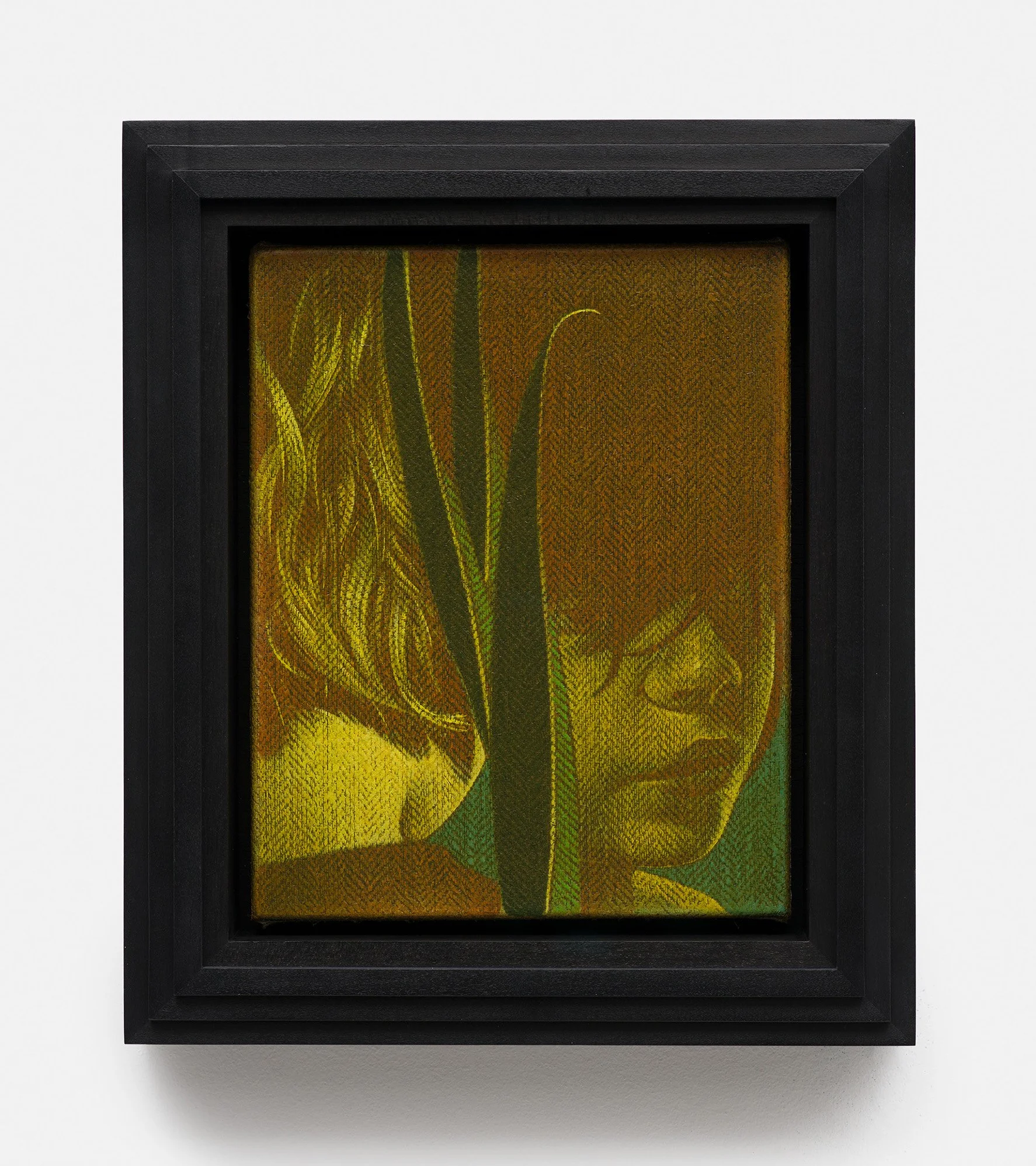
One of the recurring characters in this suite of interconnected paintings is the young boy from Diego Velázquez’s The Waterseller of Seville (c. 1622), introduced in a small square painting, Velázquez Boy (With Leaves), and later shown looking down on Osborne’s children in The Card Players and Multi-Figure Composition with Leaf (all 2026). In the latter painting, one of Osborne’s children is posed like the sleeping guard from Filippino Lippi’s St Peter Being Freed from Prison / The Liberation of Saint Peter (c. 1483-5) in Florence’s Brancacci Chapel.
_Kimbell_Art_Museum.jpg)

Oliver Osborne, Kit, Alfie, Leaves, 2025 | Oil and acrylic on herringbone linen | 13 3/8 x 11 3/8 x 2 3/8 inches / 34 x 28.9 x 6 cm
Unlike their Baroque predecessors, Osborne’s characters are bathed in a golden haze, lending each figure an ethereal, not spotlit, presence. Figure and ground dissolve within the insistently regular rhythm of the herringbone linen beneath them, whose surface accumulates graceful, extravagant ridges of oil and acrylic paint. Here, as throughout the exhibitions discussed above, figuration and abstraction remain in productive tension. Osborne's recurring characters and art-historical quotations offer one system of meaning, while the patterned support and heavily worked surface mobilize another, requiring the eye to move continually between them.
I was struck by Osborne's decision to include his own children in these scenes of chance, paintings that echo both the card games of seventeenth-century Europe and the uncertainties of the present. Not having children myself, I can only speculate about the world they will inherit. Life has always been a high-stakes game, full of cardsharps and danger, abjection, and transcendence, vague impressions punctured by sharp truths. Earlier this year, in a talk in San Francisco with Rachel Kushner about the hopelessness of our moment and what it meant to bring children into this world, the novelist Karl Ove Knausgård said simply, “I have a lot of children, so I have a lot of hope.”
Having encountered three bodies of work that offer no easy resolutions but instead encourage movement—of the eye, the body, and the mind—I rejoice to share some of that hope.