
Cloudy with a Chance of Possibilities: Inga Bard talks with Jean Nagai
The paintings of Jean Nagai swarm with color. Hazy galaxies of hot chroma, pointillistic matrices of living stone, vivid cellular rainbows, their surfaces pumiced by the artist into textured, almost sculptural skins. Like spectral sprays from spirited landscapes, Nagai’s pictures so often grow from and carry the places he paints them. On Saturday, September 12 from 6—7pm, his solo exhibition As Cloud as Possible opens at pt.2 Gallery in Oakland. ArtBae’s Inga Bard met with Nagai on Zoom to discuss Impressionism, Alaskan fisheries, Abyssinian cats dozily sunning themselves, and the possibility of spacefaring mushrooms. The interview has been gently edited for clarity and length.
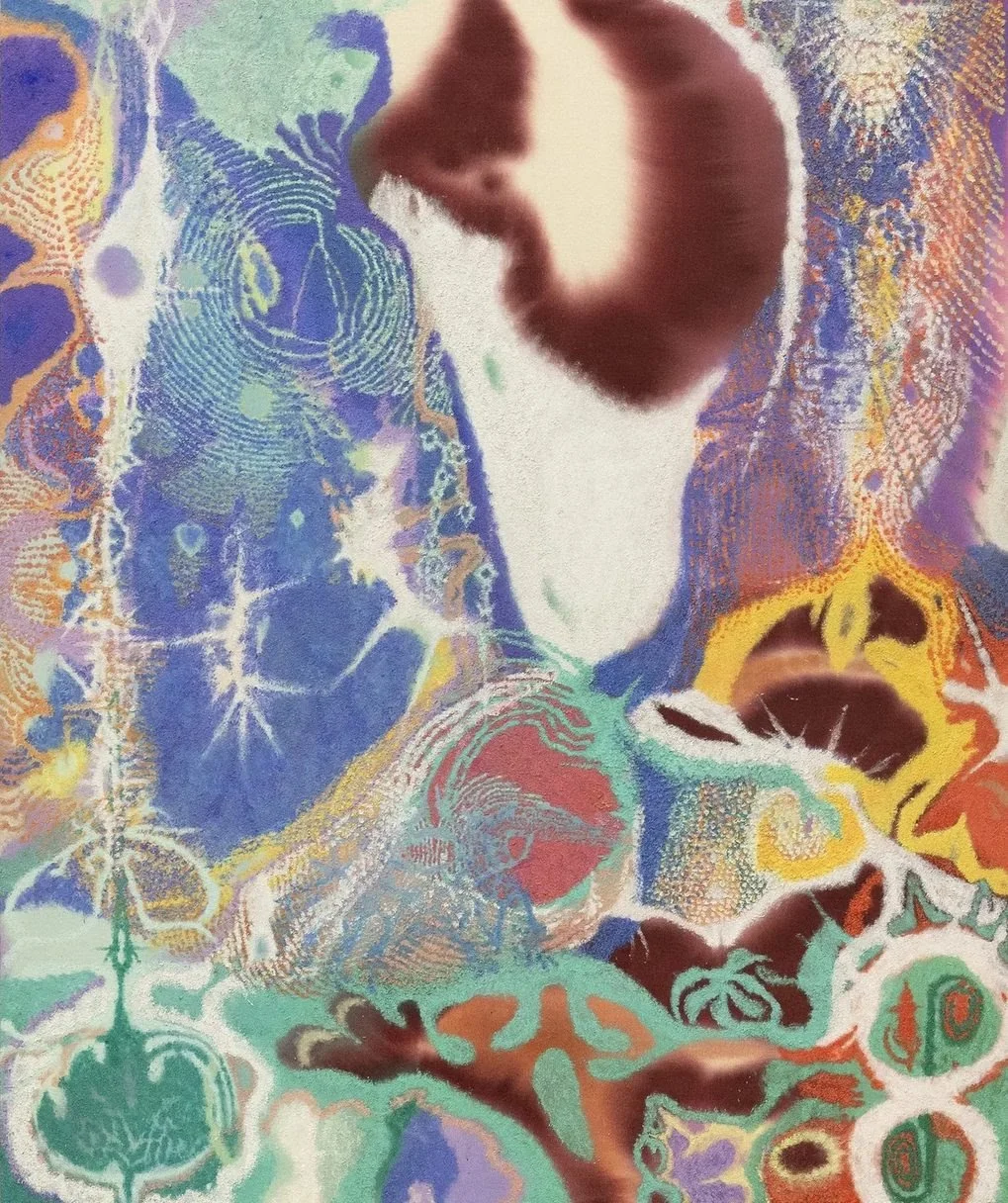
Jean Nagai, Arrange for Harry, 2026, Acrylic, pumice, calcium hydroxide on canvas, 60 x 50 inches
Inga Bard:
I'm curious for people that are encountering your work for the first time, what do you want them to know?
Jean Nagai:
I hope people can see that there is a lot of care involved, and even though I'm working mostly from an intuitive process, there's a lot of thought. I know that art is not always about that, but for me, I think it's important for people to have a warm or positive experience of my work.
The press release didn’t mention my interest in Impressionism. When Japan was forced to open its borders in 1854, France really fell in love with Japanese art and furniture. That shifted how people saw art there.
Although I'm genetically Japanese, I've lived pretty much my entire life here in the States. I see how Europeans encountered Japanese art and how that helped create this new movement, and how I'm doing something similar, but from a slightly different perspective. I'm Japanese American and see Impressionism as a new kind of hybridization of painting.
IB:
Who or what do you feel like your current body of work is in dialogue with?
JN:
Artist-wise it's hard to say. And it's not just Impressionism. I love petroglyphs. I love cave paintings. I think it's important to not be in dialogue with just modern art, but with the history of humans creating. I want painting to compress time on a surface from 100,000 years ago till now. Humans have been creating for so long, and we've endured so many millennia of hardship. Not to say what we're experiencing now is not shitty, but we'll get through this. Of course, I want less suffering for people.
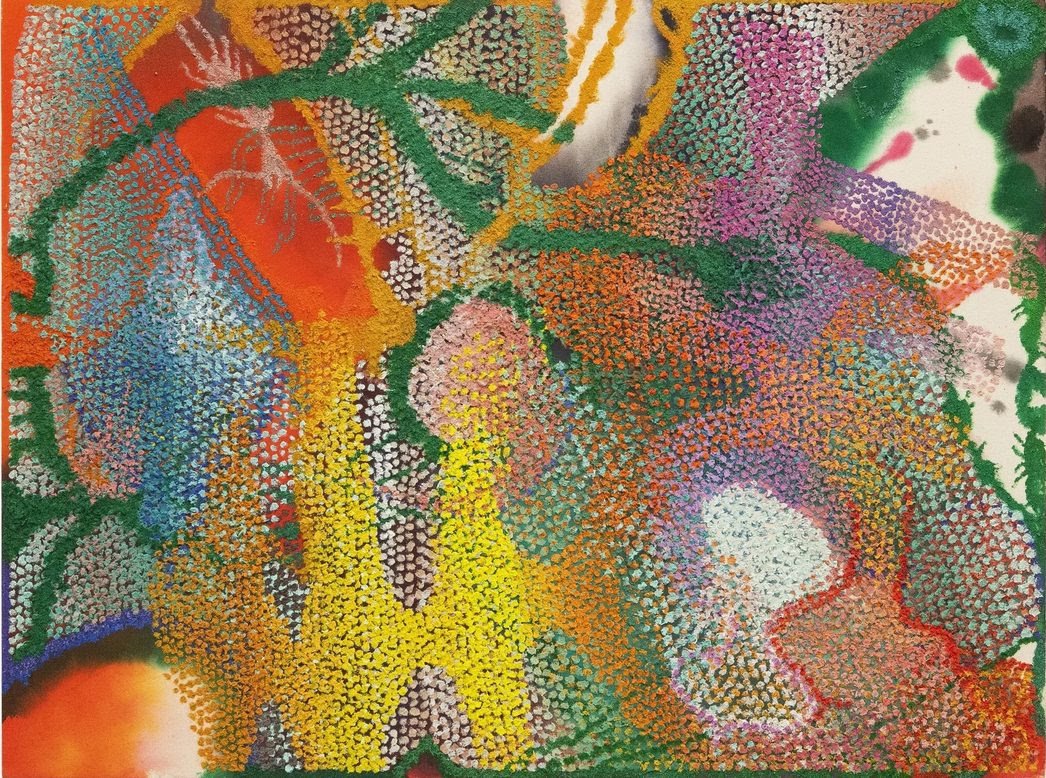
Jean Nagai, Landers Bloom, 2026, Acrylic and pumice on canvas, 30 x 40 inches
IB:
I'm curious, what was something beautiful that you saw recently in your life?
JN:
Just yesterday morning: the sun's hitting the balcony, all three of my orangish Abyssinian cats are outside, just kind of sunning, just laying on their backs. That always gives me joy, even if I'm tired or whatnot. I just look at these guys. They're so happy in the sun. I don't have kids but I have three cats.
IB:
Are you a full-time artist now? What's the last job that you had outside of being an artist?
JN:
Yes, I've been full-time since I've lived here in LA.
I used to work in a salmon cannery in Alaska. It was absolutely brutal work, 100-hour weeks. Part of me misses it just because you're forced to push your body to that level, and it's also so beautiful up there. The wildlife, the brown bears and eagles are a daily occurrence. It's like seeing crows or something. And of course, the salmon.
At first it's definitely shocking because it is like a slaughterhouse for fish, some of these bins are the size of my studio. There were 14 bins in the plant, the boats would come in and hook up these hoses which would fill the bins up. They say that during the peak, it's a million pounds of fish per day. And then these tanks sometimes get clogged with the fish. So it was my job to jump into these tanks of fish and slime and blood, and you have to push the fish down so they can keep traveling through the factory.
It’s so disgusting. I also had long hair then, and you'd get all this slime just coating your hair. It was like hair gel, except it was fish slime and blood. And then you work 20 hours a day. So you just don't care, you fall asleep. You wake up the next day, and you do that every day. It's like maniac behavior.
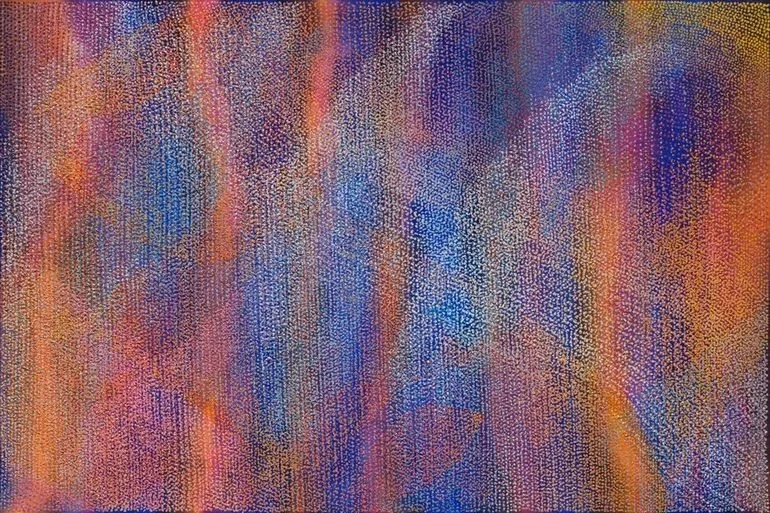
Jean Nagai, Infinity Friend, 2026, Acrylic, pumice on canvas, 48 × 72 in
IB:
I’m interested in what led you to work with pumice?
JN:
So originally, when I was in the Pacific Northwest, I was making just these blue and white paintings, and my girlfriend at the time was really into mushroom foraging so she learned about this kind of mushroom called cyanescens, a bruised blue.
There’s a theory that life on Earth was kickstarted by meteorites that hit the Earth and had specific elements needed for life. Some people think there's a probability that mushrooms came from space.
I started putting mushroom spores into my painting, thinking if people took these paintings and were inclined to, they could compost them and grow their own mushrooms, creating the cycle of life for these mushrooms. But when I moved to New Mexico, it was a different landscape. So making these blue and white paintings didn't make any sense to me anymore. I thought "How can I connect the painting to this landscape?” Then I started using sand. When I moved to LA, I wanted to connect the paintings to the landscape again and I chose pumice because of LA being such a big earthquake zone. It's not just LA, western Washington is also a big earthquake zone with active volcanoes.
Pulling back further, scalewise, Japan also is riddled with earthquakes and volcanoes, as is much of the Pacific Rim. They call it the Ring of Fire. So it was a way for me to tie these landscapes that I'd been part of onto the canvas, and maybe not just for me, but also my ancestry.
Inga Bard is an artist in the Bay and a founder of ArtBae. Her paintings and multimedia actions grapple with humanity’s fraught relationship with technology, surveillance, and disinformation.