
Back View: All This Every Day at Bolinas Museum
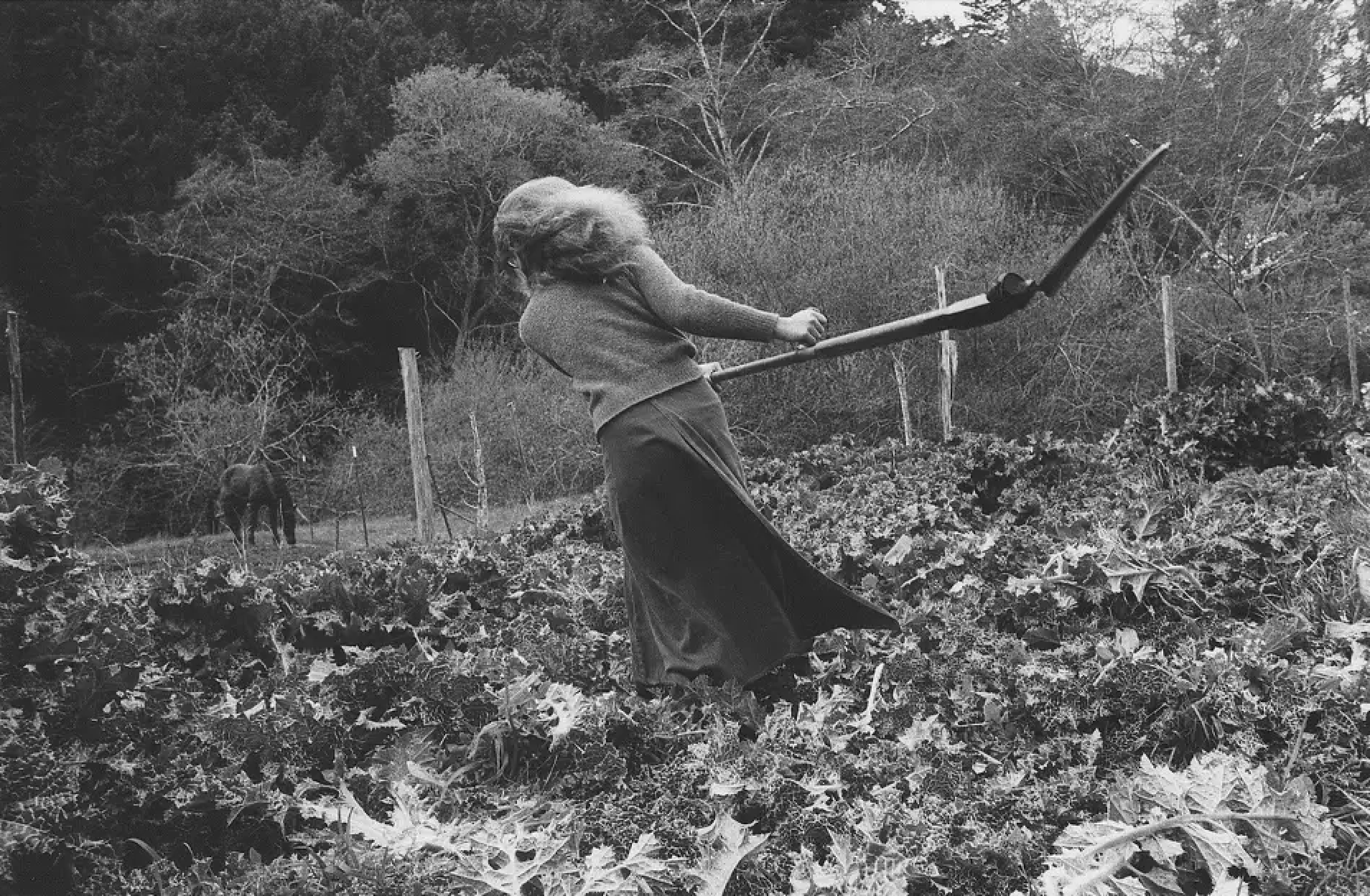
Ilka Hartmann, Leah [sic] with Scythe, 1975
“Bolinas and San Francisco,” wrote poet, critic, consummate connector and former resident of both, Bill Berkson, “have in common their disappointing close-ups, ameliorated by distant views that take your breath away.” It’s impossible for me to be objective about a show celebrating Bolinas, where I was a baby, in the 1970s, that is bookended by a Philip Guston (Berkson’s) and a photograph of my own mother by Ilka Hartmann. I don’t think an objective assessment of Bolinas is possible anyway. All This Every Day is a small but deeply rich archival exhibition that elucidates the cross-pollination of art, poetry, and environmental activism that begat what makes Bolinas unique: cool and cosmopolitan, attuned to nature as only a town on a fault line can be, and thus sharply parochial.
Bolinas is a beautiful lens through which to examine how urgent organizing, resplendent natural beauty, and a stunning output of text strengthened the threads within the community but also hardened the boundaries around it.
Besides the unprecedented polyvalence of this moment in Bolinas’s history, perhaps one of the legacies is that the utopian ideas introduced then have fed the world we live in now, even if we don’t live in Bolinas. From a distance it’s a dream, reality is the switch.
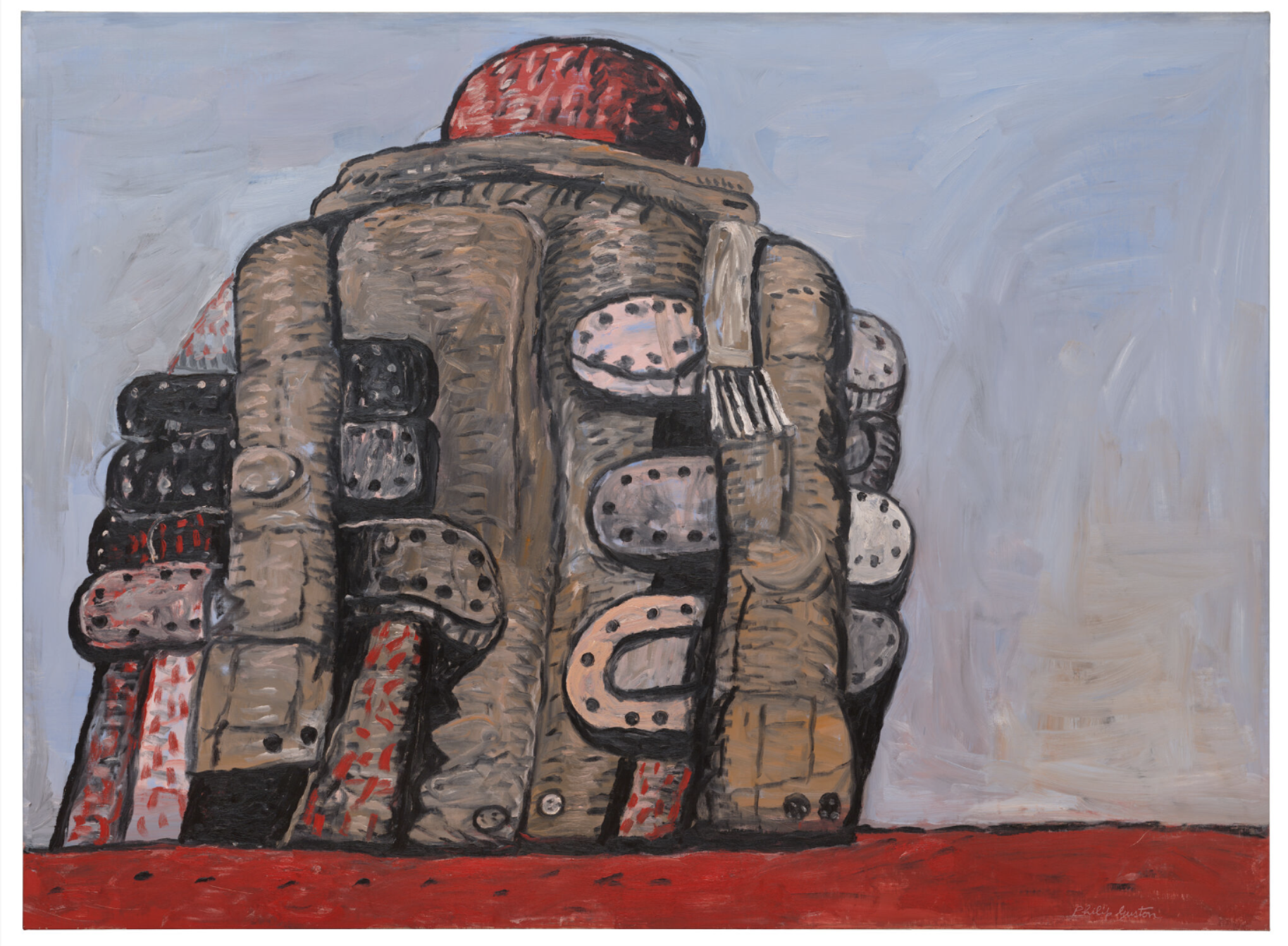
Philip Guston, Back View, 1977, Oil on canvas, 69 × 94 in. (175.3 × 238.8 cm)
I myself the victim of a major bait-and-switch, sparked by Philip Guston’s 1977 Back View at SFMOMA, I moved back to the Bay Area in 2020. Having lived in New York City for 18 years, I was bummed and burnt out by then: crammed into a 450 square-foot apartment, in an endless graduate program for a degree that seemed, with each passing semester, ever more pointless, and claustrophobic in a way that made a once-expansive place like Manhattan feel, by the time I travelled back to California for Christmas, like a toy box crammed with haunted relics from an accursed childhood.
Guston’s painting, encountered on the second floor, was an emblem for exactly how I felt: a red-hatted figure (is that a hat, or an extremely agitated head?), wearing a khaki overcoat whose armless-sleeves bind Guston’s signature hobnail shoes, at least three of which sprout bloody legs. There is a jaunty scarf. Though the horizon has a sickly smoky haze just above the bloody line of land or sea, the sky is big and blue, breathtaking. I was baited by that Guston to move to San Francisco, which I did on February 15, 2020. The pandemic closed SFMOMA for 8 months, and I haven’t seen that painting since, hence the switch. But I ended up going back to Bolinas a lot and still do.
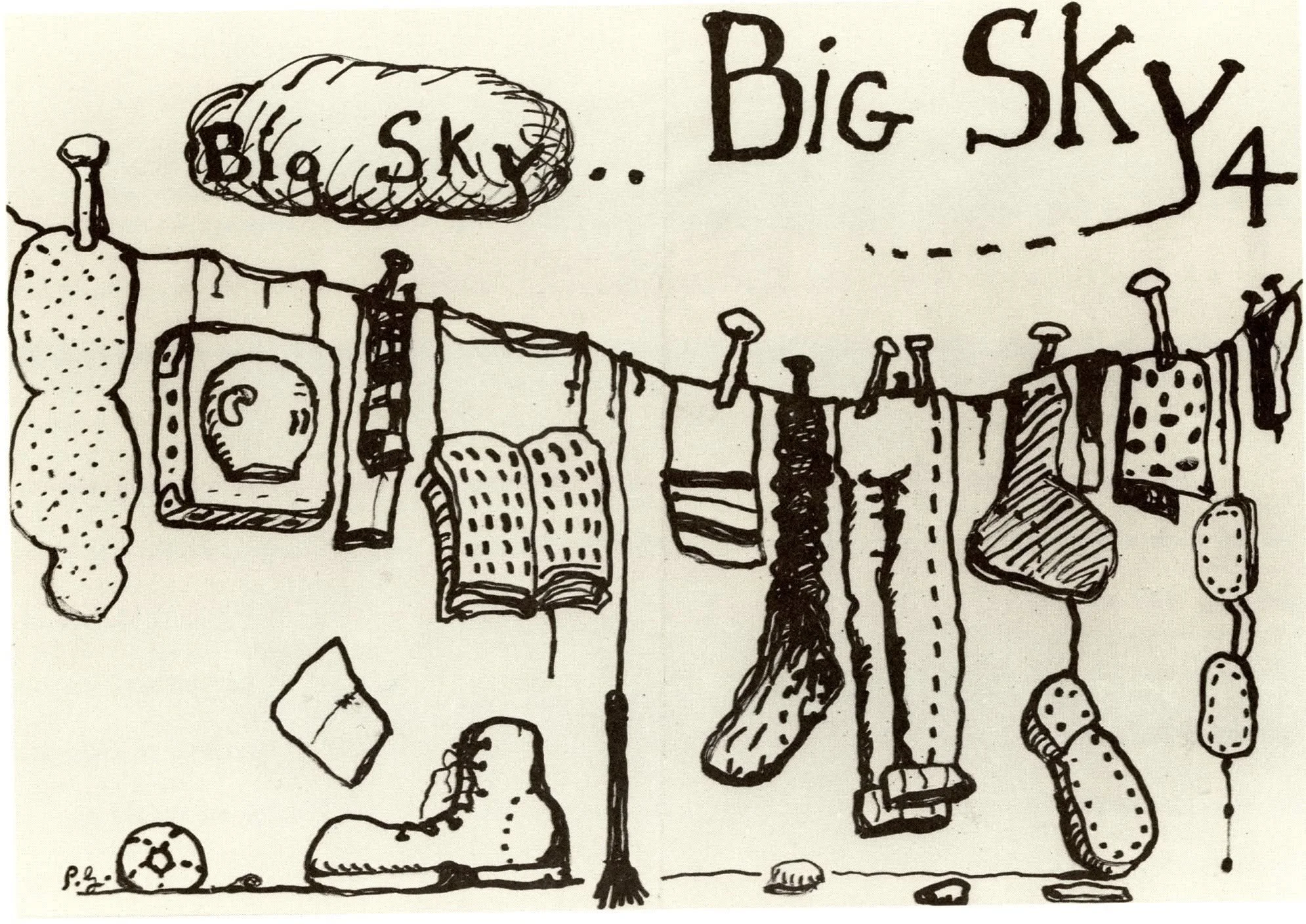
Philip Guston, Cover for Big Sky 4, 1972. Ink on paper. Edited by Bill Berkson, published by Big Sky, Bolinas, CA 1972
The Guston drawing currently on view at the Bolinas Museum is a cover he did for Big Sky, a poetry magazine founded by Berkson in 1971, shortly after he moved to Bolinas. Guston’s cover is from issue 4, published 1972. It shows a clothesline from which hangs household crapola (a word Guston liked to describe everyday things): dirty laundry, intimate things, pants, a brush, a canvas with a single head on it, an open book, from which a page flutters to the ground, where a boot and a beach ball sit, along with a few other doodads.
Above the line, which droops with the weight of the pants and a soiled stocking, the words “Big Sky…Big Sky 4” float, one in a cloud, the other adrift in said sky. The irony of the image is that the sky isn’t that big. Though the horizon is low, everyday things clutter that big sky. Those everyday things took and continue to take an outsized valence in a place like Bolinas; this is probably the most space given to septic tanks in any museum show I’ve encountered. To me, Guston’s clothesline resembles the top of the Bolinas ridge seen looking east from the mesa, though I’m sure that’s not correct, as Guston didn’t visit Bolinas until 1979. Guston didn’t have to go to Bolinas to know that the big sky is blocked by our own hang-ups.
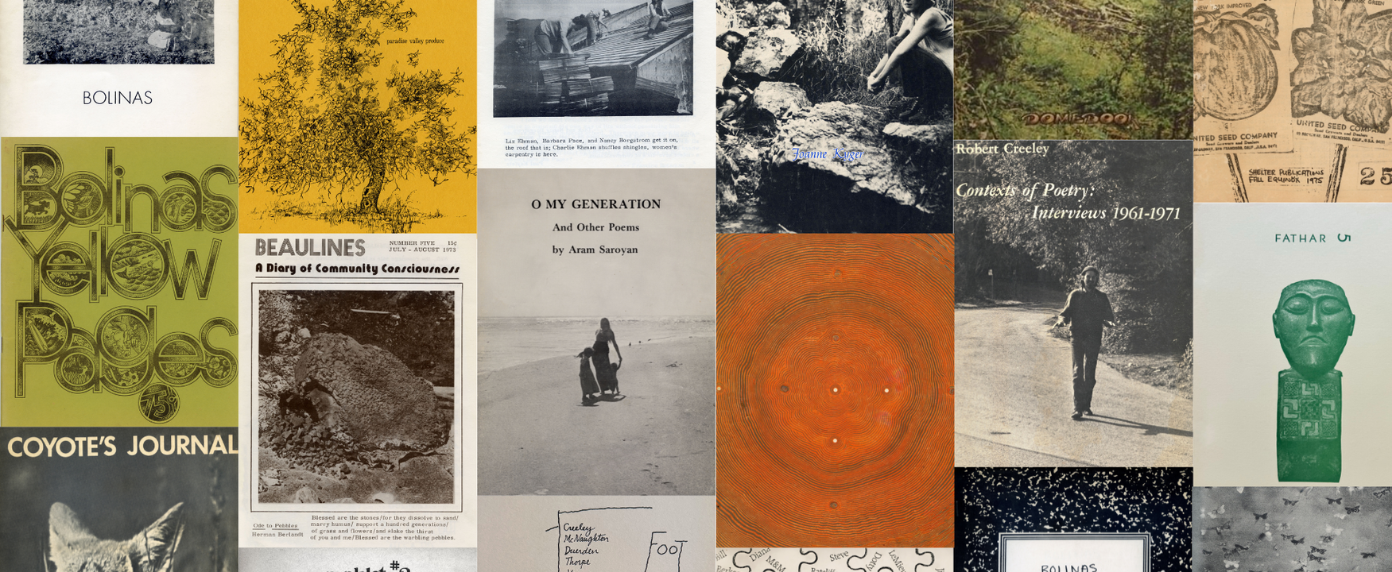
‘All This Every Day: Bolinas Community Publishing in the Seventies' features books, poetry collections, class lists, newsletters, magazines and town directories. (Courtesy Bolinas Museum Archive)
Of Ilka’s photograph, Leah [sic] with Scythe (1975), I have my mother Lea’s account. She and my father John (he carved the Bolinas Community Bulletin Board in front of the store) were part of the community at Paradise Valley, a back-to-the-land collective organized around an organic farm that was very much off the grid, utopian and grounded. Lots of meetings, thorny interpersonal dynamics weaponized as politics. At one of these meetings, which according to my mother were often dominated by men holding forth – there is also a great photo by Hartmann where my mother sits in the lower right corner, looking pissed – she got up and went out to the field of thistles and Ilka followed her and the result is that photo. It might look utopian but, at least in this instance, it was often angry and full of stickers.
In both cases, art comes out of the provisional muck of the immediate and into something transcendent. Years later, on a visit back to Bolinas, an old girlfriend recognized the photo on the wall and excitedly said to a group of women in the Museum “that’s his mom, you know,” pointing to me and pointing to the photograph. “Yeah, we know,” said one of the women, without even glancing at me, before turning back to her conversation.
I want the show to run longer, just as I wish that I never turned 5 and the 1970’s ended. I will study the very long exhibition booklet, heroically assembled by archivist Kirston Lightowler and curator Noelle Hiam, like catechism. And I will continue to look longingly at Bolinas from Land’s End when in San Francisco, and at the city impossibly hugging foggy hills from Brighton Beach, the gulf across the water between these two poles being roughly the length of Manhattan.
The exhibition closes September 27th. Come for the close-ups whose disappointments may have dulled over time. And then walk down Wharf Road to the beach and gaze at San Francisco and the foothills of Tam, ignoring Stinson Beach. It will take your breath away.
Then split.