
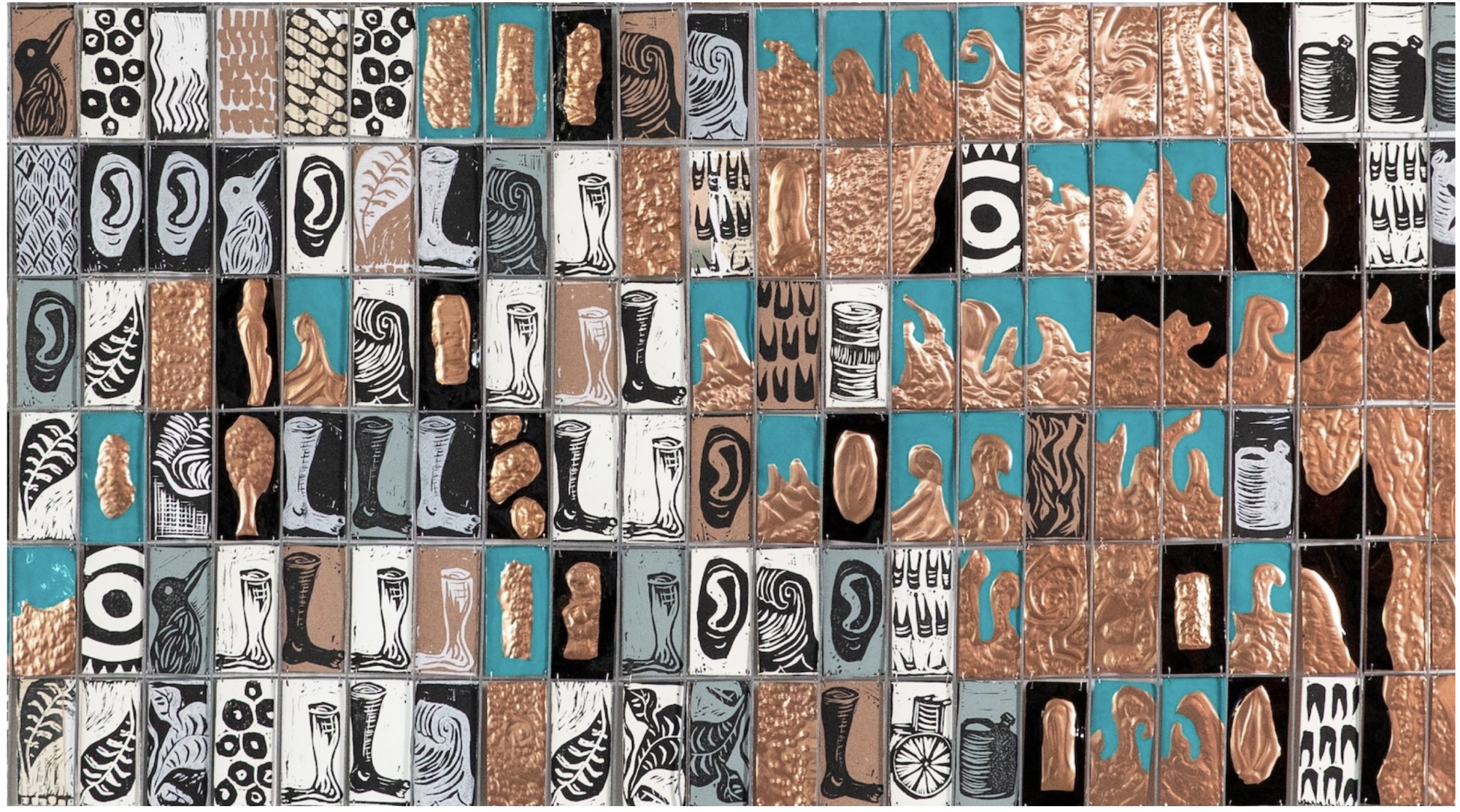
Untitled Map With Bodily Annotations, 2025, Relief print, copper, steel fencing,aluminum wire, enamel, paper, railroad board, 58 x 58 in, Detail
In a video on a curved monitor framed in salvaged mahogany, a leg rests among orange chrysanthemums and white blossoms. Someone else’s hands enter the frame, using blocks to stamp miniature legs and ferns onto its skin. Across two more screens, other sequences unfold. The leg is adorned with glittering planets and a little deer. Then the touch changes: gloved hands hold it beneath projections of flooding water.
There’s something liturgical about the attention given to this leg, a body part made to bear our weight, here relieved of it and laid out like an offering. The flower-strewn performance, featuring Gonsalves Schild and collaborator Jeunée Simon, appears in the video A Verb Meaning to Wash One’s Wounds in an Ocean (2026), which lends its title to Zedekiah Gonsalves Schild’s exhibition in /room/ at Slash. The press release says Gonsalves Schild is interested in how a flood or a disabled body becomes “unruly only in relation to a specific norm,” and he draws that parallel by projecting one on to the other.
Inside the narrow intimacy of /room/, the work is always at your shoulder. The leg—and other body parts—reappear in other materials: printed, hammered into copper, enlarged behind glass, dispersed among the ceiling lights. Having worked as a laborer and builder until a debilitating spinal cord injury in 2019, Gonsalves Schild brings together sculptural videos and mixed-media works that dwell on the considerable labor of being alive, finding unlikely affinities among bodily fragments, domestic materials, salvaged goods, and landscapes.
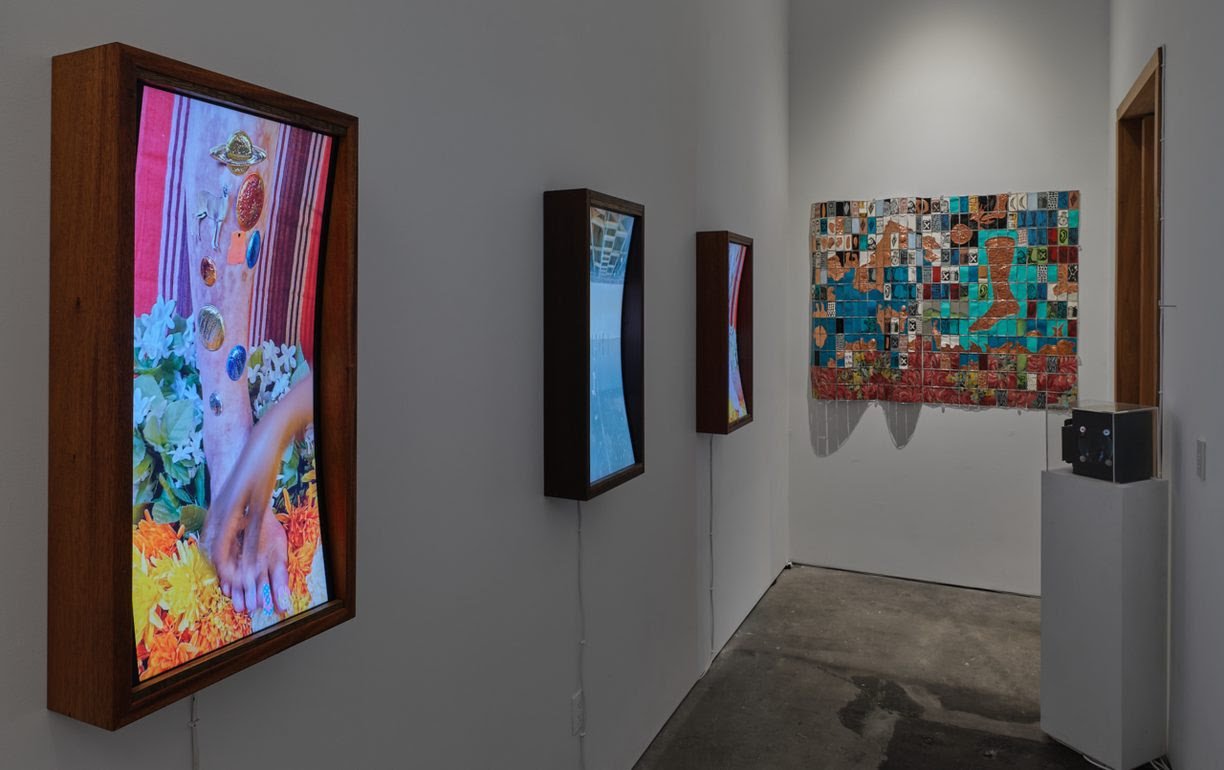
Installation view, A Verb Meaning to Wash One’s Wounds in an Ocean, /room/ at Slash, 2026
Anchoring opposite ends of the space are two large wall assemblages. Referred to in the press release as “maps of the artist's own debility,” they’re assembled from tons of small relief prints, copper impressions, and recycled materials. In Untitled Map with Bodily Annotations (2025), ears, legs, waves, wheelchairs, six-gallon water jugs, and other symbols recur across a grid. No two repeats match exactly, from the uneven pressure of the ink to the way the copper interrupts and catches light.
Across the room, Untitled Map with Bodily Redactions (2026) gives much of its turquoise field over to a large copper leg, with faded floral linoleum across the lower rows. The steel fencing holding this one together curves and buckles away from the wall, as if recoiling from touch.
Annotations and redactions are opposing operations, though both mark evidence of interference. A map works similarly, making the world readable through omissions and distortions. Gonsalves Schild’s maps are almost indecently full, crowded with whirling forms that become harder to tell apart the longer you stare. Rather than clarifying the body, the maps seem to register the difficulty of making it legible in the first place.
A key to the map might help. Overhead, a different arrangement of symbols is printed on the ceiling’s light panels in Illuminated Index of Redactions (2026). Huh. This index sits where it can’t easily be consulted. I read it with my head tipped back, neck straining.
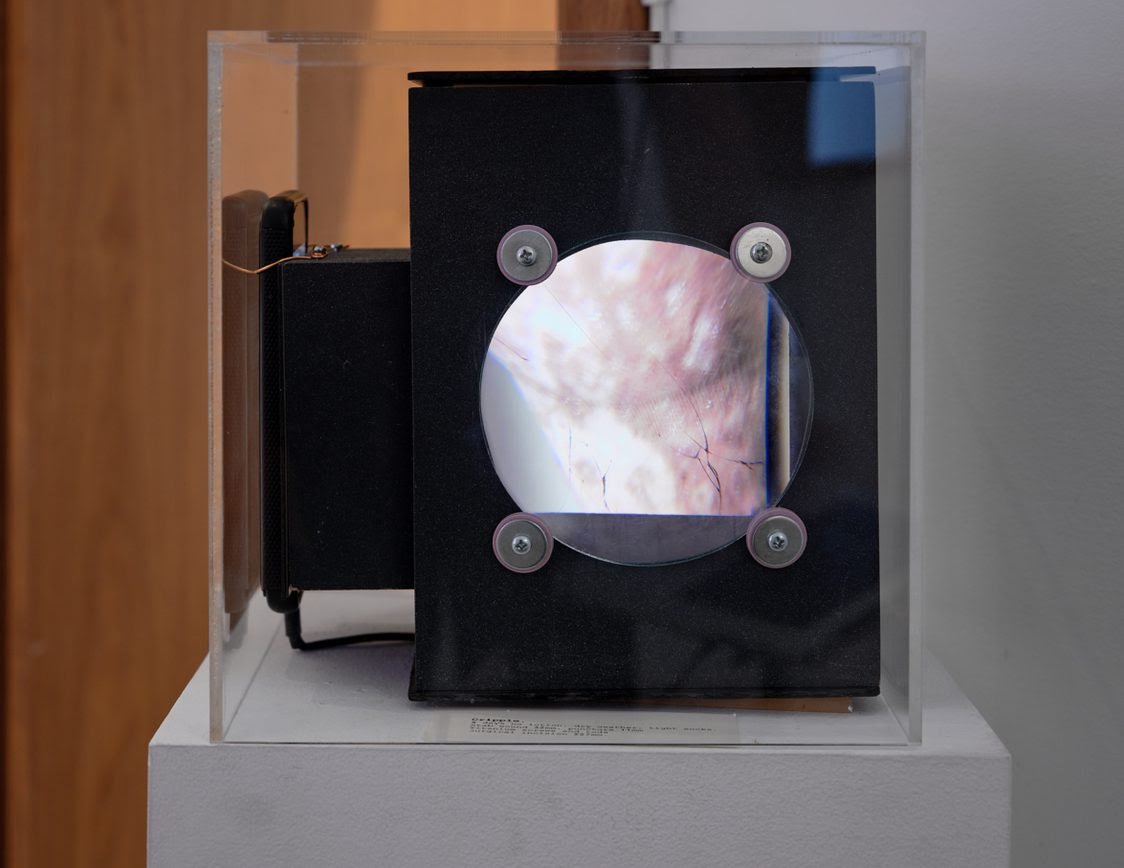
Cripple, 2026, Video on broken cell phone (03:18), acrylic, glass lens, various hardware, plywood, 12 x 12 x 12 in
I have to bend down to experience Cripple (2026), a cracked cellphone playing video footage zoomed in behind a glass lens. The little aperture has something of a peephole about it, and I lean in to see something maybe I shouldn’t. But there is no thrilling scene to discover; at first, only an expanse of mildly cracked skin. Pores, hair, scales, and wrinkles arrange into an abstract landscape, and fractures appear on both phone and flesh.
A small label on the pedestal begins with an inventory: days without lotion, dry weather, tight socks. Then, the measurements of a stab wound, punctures, titanium screws, an incision. By the time I’ve finished reading, my forehead is against the plexi, and I feel no less a voyeur than a nurse, a doctor, a therapist, an officer, a well-meaning stranger.
Elsewhere, This Is Not Bio-luminescence (2026) plays on a prison-approved TV made of clear plastic, its circuitry exposed in a way that looks retro and cool, but is really there for easy inspection.
A sticker on the TV screams, “DON’T TOUCH!” and a green light blinks in the corner as if to say, hello. I’m watching you. In the video, Gonsalves Schild, in orange scrubs, plastic slides, and a white beanie, repeats mundane actions as he takes on the absurd task of explaining jail to a houseplant.
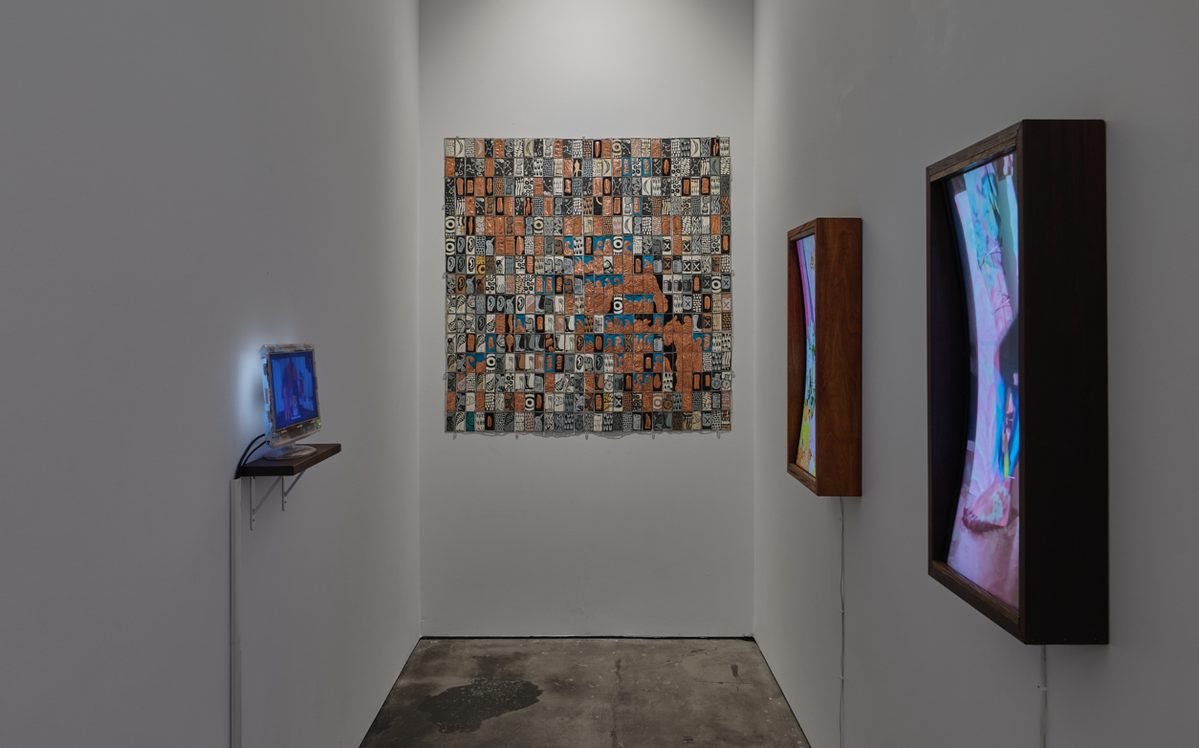
Installation view, A Verb Meaning to Wash One’s Wounds in an Ocean, /room/ at Slash, 2026
In the dark, the blue glow that spills onto the wall could pass for a tide pool, but the title refuses the illusion. This is not bio-luminescence, this is toxic e-waste, and federal prisons have employed incarcerated workers to recycle electronics like it.
For now, it’s all being kept out of the pile. Throughout the exhibition, things are continually being held together, adapted, put to good use. But this isn’t a story of recovery, in which everything damaged finds a new purpose. This work is closer to what the writer Sunaura Taylor calls disabled ecologies: injured bodies and injured landscapes caught in the same web. Gonsalves Schild adds another strand to that web, bringing the work of documenting, tending to, and adapting into view. A looking and a looking after, and I end up doing both.
A Verb Meaning to Wash One’s Wounds in an Ocean is up in /room/ at Slash through December 19th. Bend down for the phone, tip your head back toward the ceiling, don’t touch the TV.