
The Water or the Waves? I See Every Wave @Berkeley Art Center
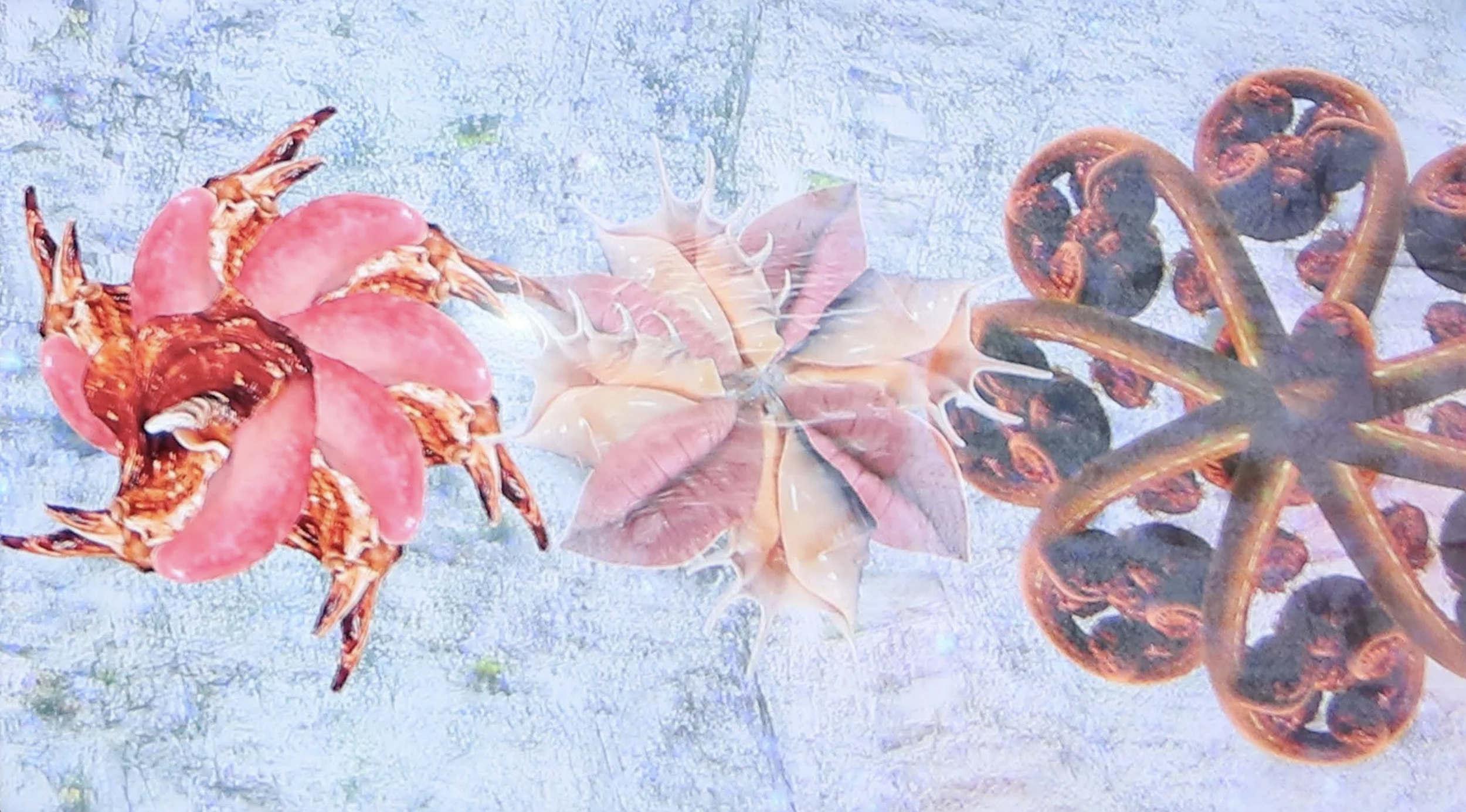
Annie Albagli, This Long Long Line of Water, 2026, with music by Brian Chase; HD video, stereo sound; 16m 41s; still image
When Aay Preston Myint was looking out at Lake Michigan, a friend asked them: “When you look out at the water, do you just see...water? Or do you see every wave?” Myint sees every wave. I realized, listening to them tell this story, that I see the water.
At the Berkeley Art Center, I See Every Wave is refreshing, unforced, and gently disinterested in announcing its own significance. Instead, Myint brought together artists whose works range in scale: from the cellular to the bodily, from landscape to the cosmic, and sometimes back again. As I moved through the exhibition, I began to wonder whether seeing the whole and seeing its smallest parts are really opposing ways of looking at all.
I had worked with artist Annie Albagli curatorially on her exhibition Milk Teeth at 500 Capp Street in 2024, where she covered a dining table with limestone carved into the lunar cycle and poured breast milk across its surface. I knew already that Albagli could collapse enormous distances. She once told me of a theory she encountered through Rachel Carson: the Moon and the Pacific Basin share a common material origin. In Milk Teeth, that enormous distance between the lunar and the corporeal suddenly felt very small.
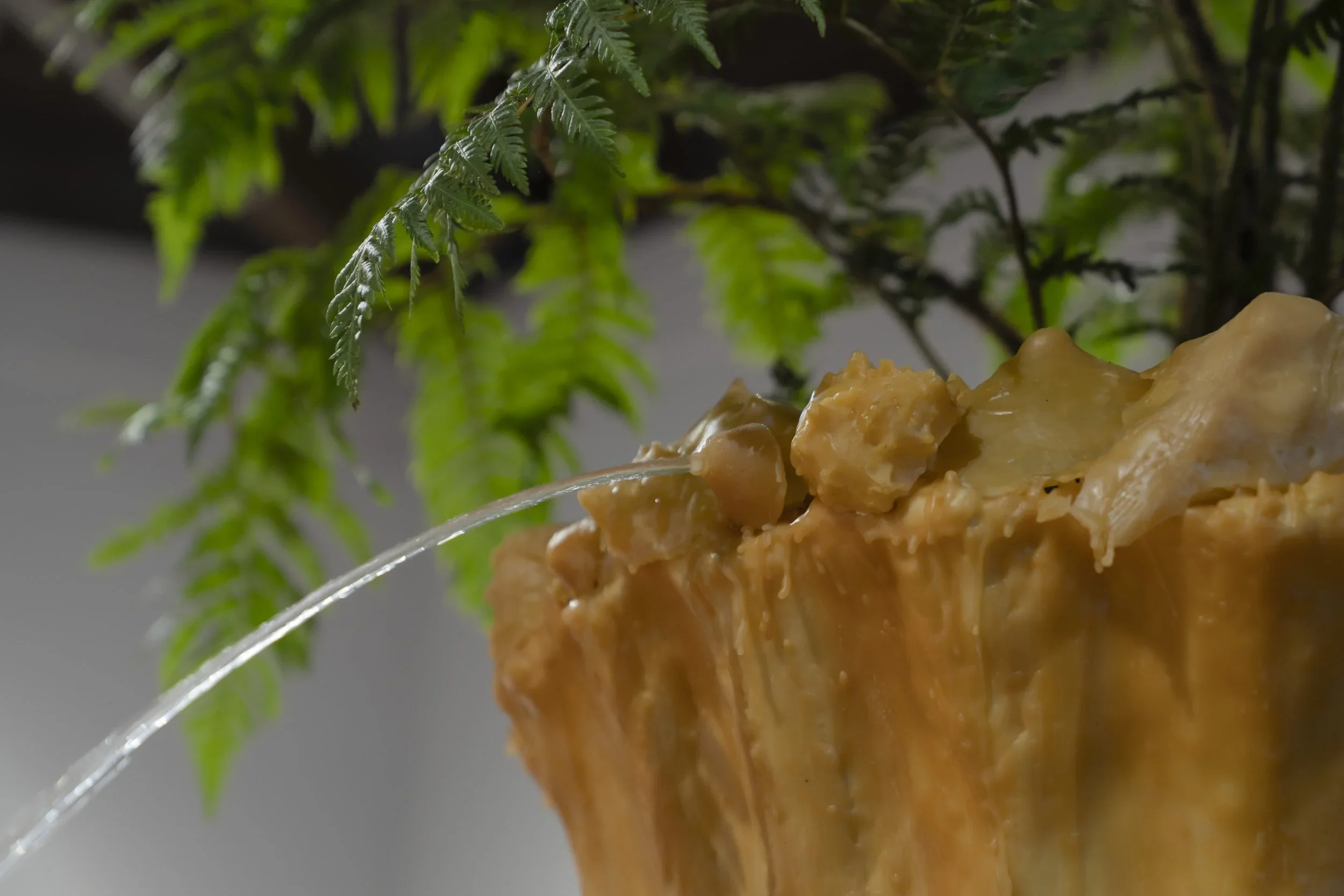
Annie Albagli, This Long Long Line of Water; a Body of Water, 2026; Beeswax, plaster, water, copper, ferns, postpartum hair, and latex; Dimensions variable; Detail
Here, Albagli takes us again from what Myint described to me as the “cellular” toward the cosmic. Albagli has a way of taking the monolithic (museums, celestial bodies, histories) and returning it to the substance of bodies. In one video, objects from different periods and civilizations, from Mesopotamia to ancient Egypt, slowly rotate before us. Across them, a gesture repeats: the figure of a woman carrying a child. Separated by centuries, the objects begin to speak to one another through this recurring bodily form, collapsing historical time into something intimate and familiar.
The movements are tender, but also strange: the institutional object and the human body briefly borrowing one another’s weight.
Water sounds through the room. Elsewhere, a video of abstracted anatomical, watery particles seems to foreshadow an anthropomorphic fountain carrying the sweet scent of beeswax. Looking becomes mixed up with listening and smelling; the body doesn’t simply stand outside these works and interpret them but becomes implicated in their atmosphere. That bodily logic carries into the paintings of Ruby T., which Myint walked me through, at one point describing something in the work as a kind of “Sapphic rage.”
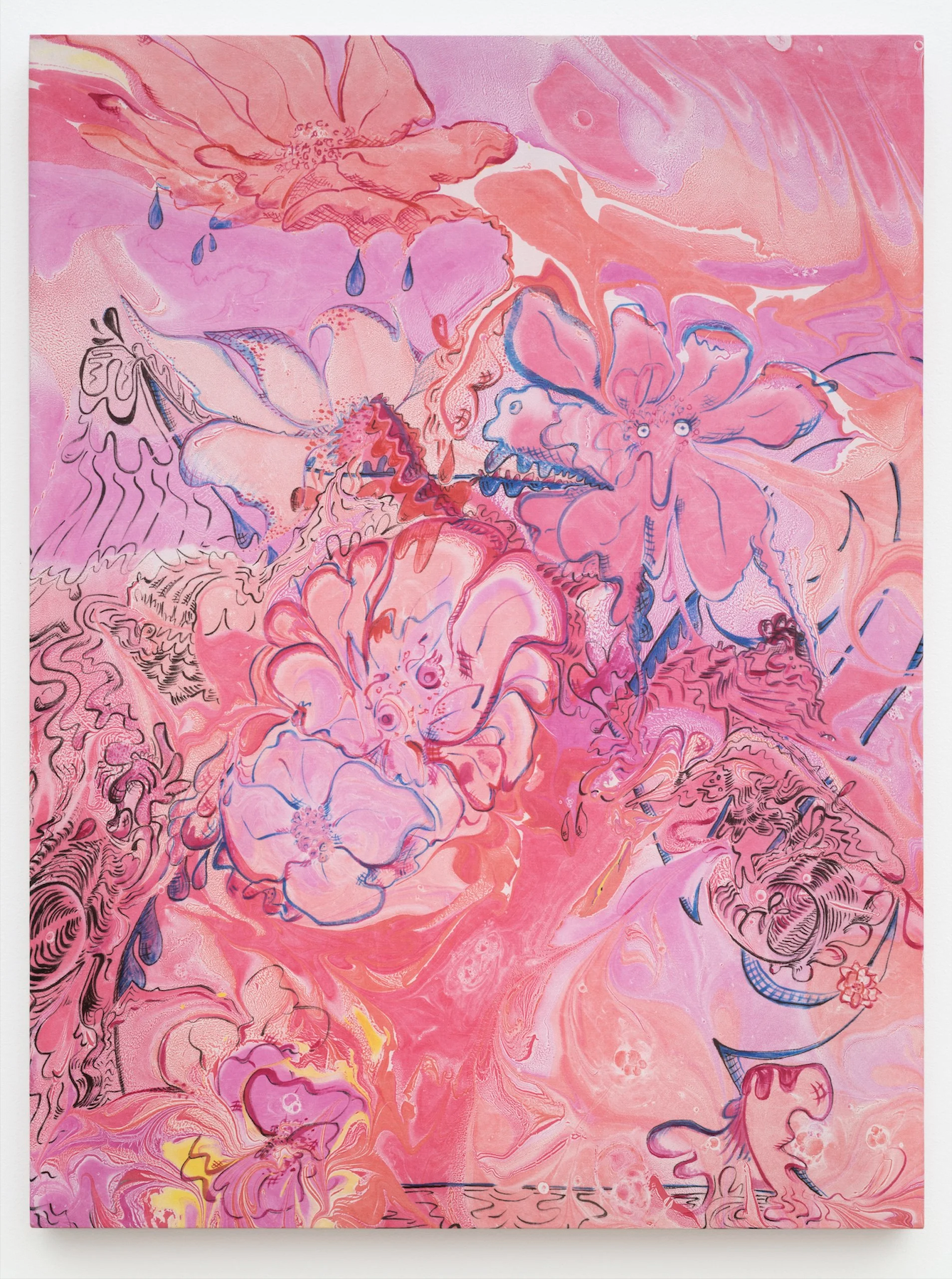
Once said, it was difficult not to see it. The paintings can feel like heaven and hell colliding: organic formations, orifices, eruptions, openings.
At times I felt as though I were looking through an opening in a floor that could eat me alive, but the threat is beautiful. Ruby T. works frequently on hand-marbled paper, and Myint extends the paintings outward through the colors of the walls around them. These are small decisions, but exact ones. Painting, paper, and wall begin operating together, as if the artwork has leaked beyond its given edge. One particularly audacious work, Pussy Drug Flowers (2019), is painted in acrylic on hand-marbled silk. Even the title seems to understand the exhibition’s pleasure in refusing distinctions between the bodily and botanical, vulgarity and beauty, desire and danger.
Outside, on the wooden deck of Berkeley Art Center, I was happily surprised to discover that what looked at first like confetti scattered across its surface was Joshua Moreno’s work, Everything Falls Eventually (2026). Leaves trace and map their own activity there, registering light, movement, accumulation, and time. The work is almost nothing, and then suddenly it is everything happening around it. I had been looking for artworks and instead found myself looking at leaves. Fall had arrived.
This is where Myint’s exhibition became clearest to me. I See Every Wave does not demand that we decide between the whole and its parts. It asks what happens when we change the scale of our attention. A cell can contain a universe; an opening in a painting can become an underworld. A museum object can return to the gesture of a person carrying another body, while a handful of leaves can record time.
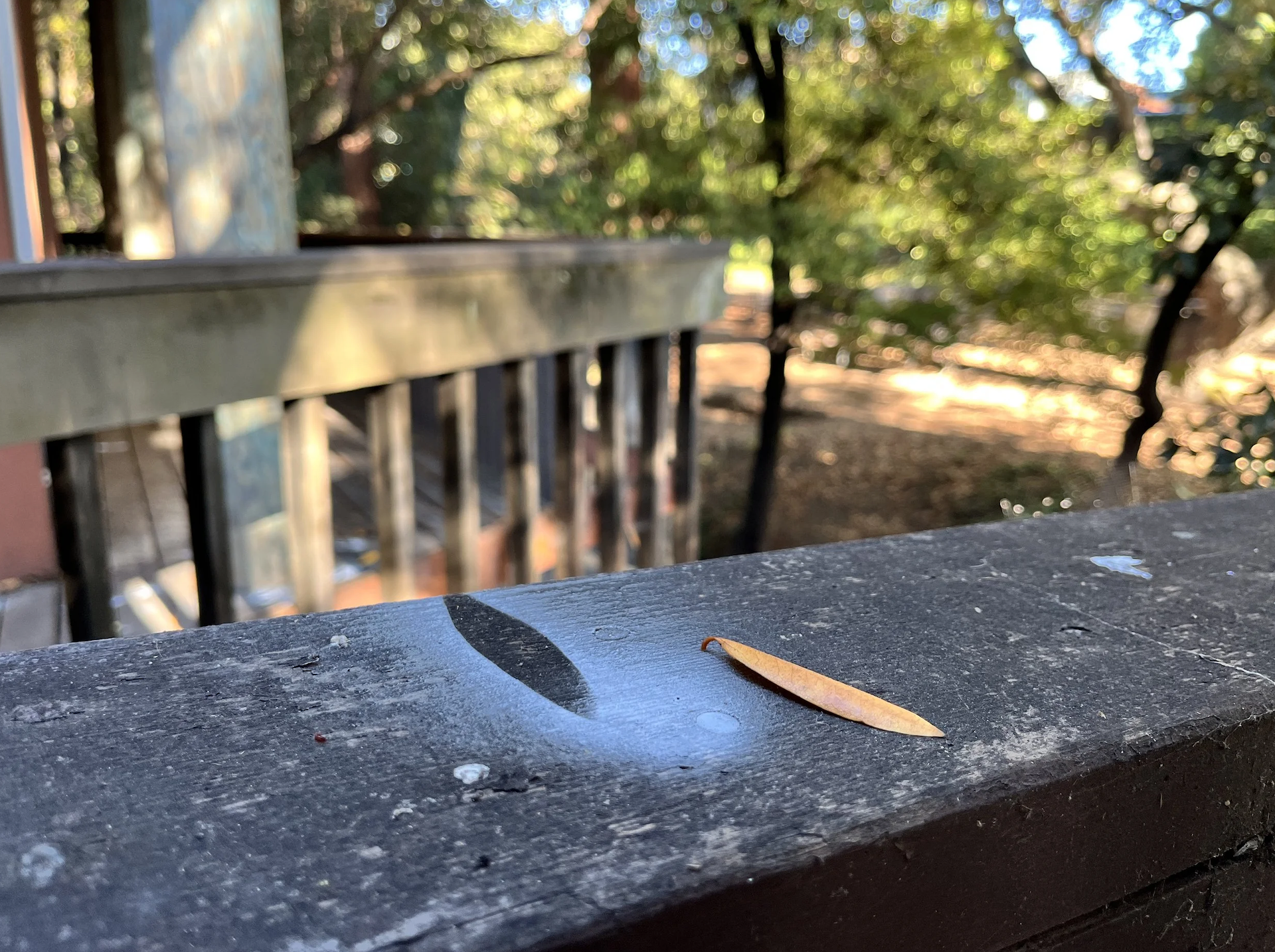
Joshua Moreno, Everything Falls Eventually, 2026 (site-specific installation detail); spray chalk and leaves; Live Oak Park
The Berkeley Art Center is particularly suited to this kind of looking. It is less a monumental museum than a cottage enveloped by nature, and Myint resists the temptation to overwhelm it. The exhibition gives us relatively little and somehow produces abundance. That restraint matters. Myint is both an artist and a curator, and you can feel an artist’s understanding of when to intervene and when to leave something alone. Colors are placed precisely, works are allowed air, and the landscape outside is not treated as scenery but permitted to enter the exhibition’s thinking.
There is a lot of labor inside something that feels this unforced. Perhaps that is what I initially mistook for effortlessness: the sensation of encountering decisions so carefully made that they no longer insist upon themselves. In a moment when exhibitions can feel compelled to explain themselves before we have even had a chance to look, I See Every Wave trusts the intelligence of looking and smelling, listening, wandering outside, coming back in.
I left thinking about scale differently. Not as a movement from small to large, or from detail to whole, but as something less stable. A gesture can persist for thousands of years; a painting can open into a space larger than itself; the accumulation of leaves can make time perceptible. In I See Every Wave, no detail is ever only a detail. Each carries something beyond itself, an opening where the small and the vast can exist at once.