
The Minor Chord and the Major Lift at the 2026 Venice Biennale
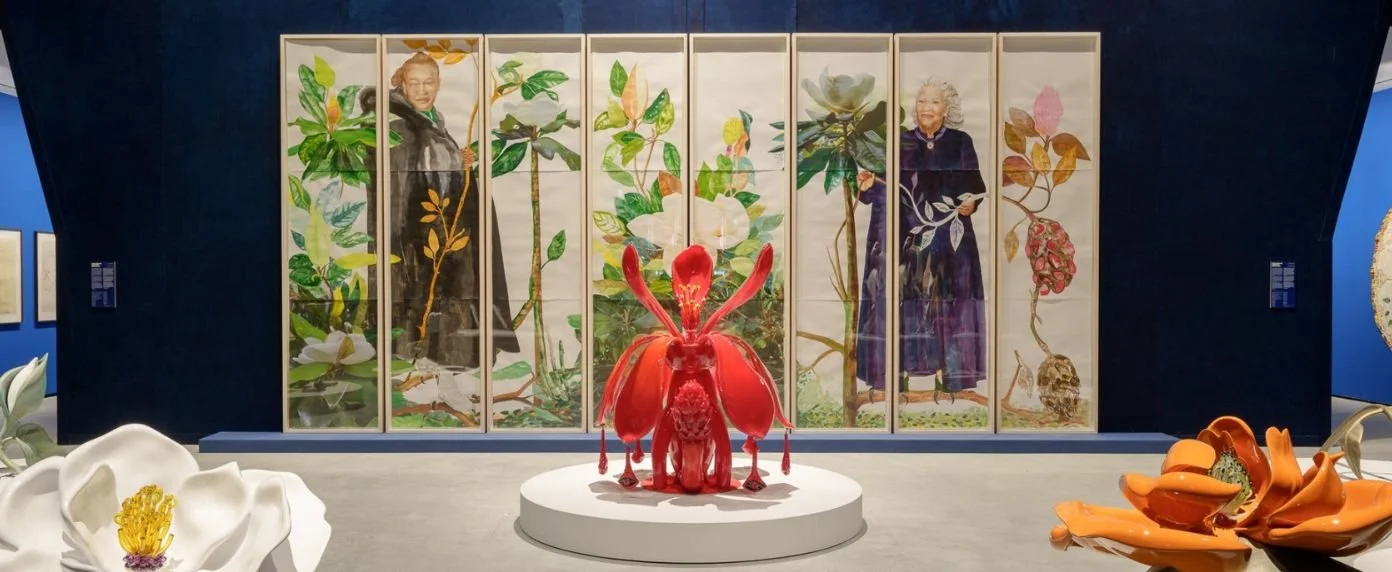
In Minor Keys, 61st Venice Biennale, 2026, installation view. Photo: Andrea Avezzù. Courtesy of La Biennale di Venezia
A conversation between Andrew Berardini and Inga Bard for Art Bae Agenda
The 61st Venice Biennale's International Exhibition, In Minor Keys, was conceived by Koyo Kouoh and executed by her team after her death in May 2025. The show stakes itself on slowness, atmosphere, listening as method — inside a Biennale whose jury resigned days before opening, where most of the national pavilions struck in solidarity on opening week, and whose Italian culture minister skipped the opening for the first time in recent memory (maybe ever). Andrew Berardini and Inga Bard sat down by phone — Andrew in New York for the fairs, Inga onward to Berlin— to talk about what stuck.
Andrew Berardini: I don't know how anyone did this twenty years ago, because I'm so soaked by the sheer amount of art that to pick any one thing is to choose a drop from the ocean I just went swimming in. But we have photographs now — you walk past something, it hits, you take a picture of the work and a picture of the nameplate, and later, in some moment of repose with loved ones, you can recall the things that you saw. So let's just start there. What were the things you were really glad you traveled a long distance to a beautiful city to witness?
Inga Bard: The speaker boxes in the group show at the UAE pavilion. Taus Makhacheva. You walk in and there's all these speakers hanging from the ceiling like a willow tree, and at first it just sounds like a cacophony. But if you put your ear up to one of them it goes: “Hello, dear. Sorry for the delayed response, I was down with covid and I’m just catching up on messages now.” Thirty or forty excuses like that, layered. So relatable. So of our time.
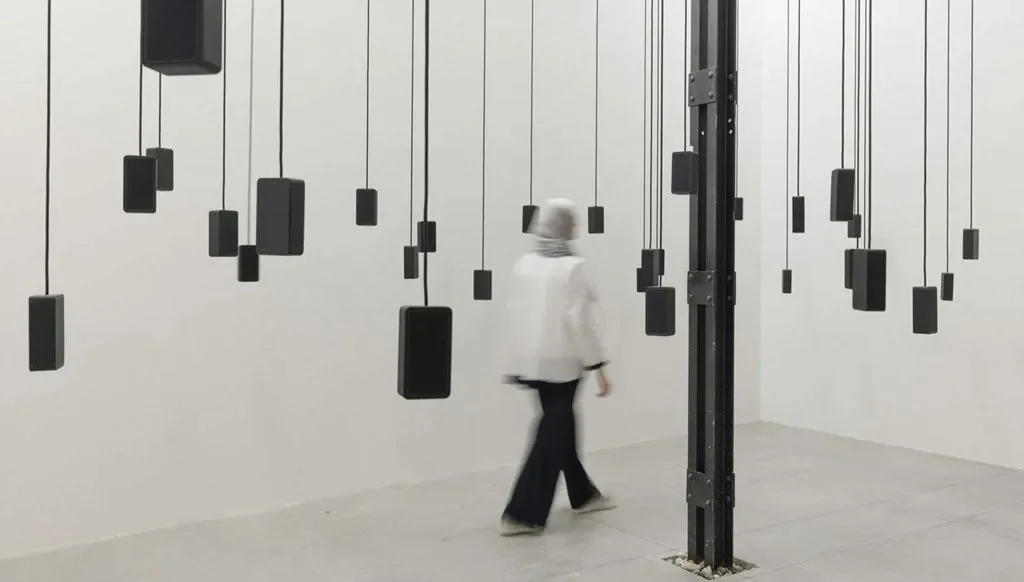
Dear R., R., K., S., M., A., C., S., K., I., G., L., A., A., L., P., G., E., J., D., M., C., B., O., F., F., R., D., M., E., L., I., F., L., A., M., T., K., K., L., P., F., V., A., L., L., (2018/2026) by Taus Makhacheva, installation view. Photo: National Pavilion UAE - Venice Biennale. Courtesy of La Biennale di Venezia
A: I love that you went the step further and actually put your ear to the speaker. The whole show is called Washwasha, an onomatopoetic word for whispering in Arabic. We're all making tender excuses for our failure to answer emails, which is very human and very of our time and well done. I treat emails like they came by Pony Express, as opposed to instantaneous electronic communication.
I: I wouldn't even call it a failure. We have this unnatural expectation of replying very quickly and it feels inhuman to me. Time should be slower. Humans are expected to communicate unnaturally fast these days.
A: What else hit?
I: Upstairs in the Central Pavilion, a set of soft pastels on paper by Sohrab Hura, an artist I'd never heard of. Small, naively done, quoted moments from life. One is “Sixteen and in love” and it's just a young girl with green flesh from crying her face out. Another, “Stranger Things, season 4, episode 1” — a human wrapped up in a blanket like a burrito, nesting with their laptop, propped up on its side, bingeing a show. A crowd of people wiggling in ecstasy under fiery lasers shooting out of a disco ball, titled “How parents remember things”. “Snorkeling”: fish staring at you looking rather silly. The grandmother dying, the grandfather mourning. The full spectrum of human existence. All around the wall the titles were scribbled in pencil, and above it said: “Things felt but not quite expressed.”
The best kind of artwork creates a psychological space between the image and its title — the best titles aren't illustrative of what the thing is, they pull the viewer's imagination out into the gap between the words and the work. Those drawings did it hard.
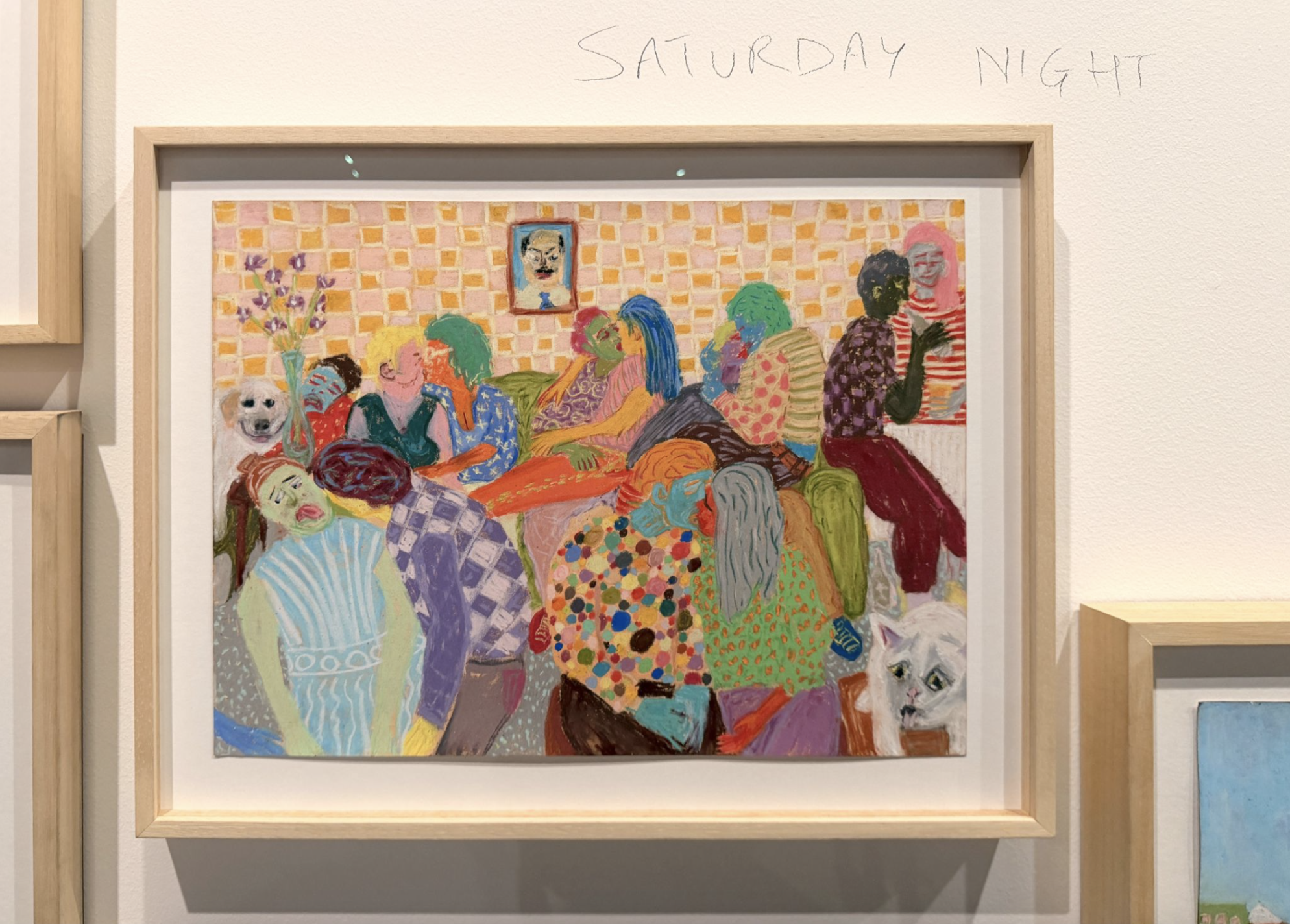
Saturday Night (2025) by Sohrab Hura, installation view. Photo
A: Hura does photographs too, more polished work — these are him deliberately working in this softer, slower, quasi-naive register. Which is, I'd say, very In Minor Keys.
I: Downstairs in the same pavilion — Sabian Baumann's small unfired clay relief sculptures, Horizontales Paradies (2024), do a similar thing. Little creatures having little orgies, just piled up on top of each other in funny ways. Same kind of humanness. Very different, but with that silly, heartfelt quality.
A: I have a suspicion about Baumann, who I really loved — that the really funny, weird things in the show were not part of any agenda. Koyo lived in Switzerland; I'm sure she met Baumann, maybe they were even friends. The unexpected things in In Minor Keys came out of human relationships rather than curatorial-ideological process, if that makes sense.
I: It does. And at the same time — the theme. The Giardini had the full scope of human experience: humor, joy, grief, sadness. So if the theme of the minor key was really being extrapolated, the Giardini’s curated show worked for me on a lot of layers. I hear what you're saying about Koyo just being friends with Baumann, but also — those small sculptural reliefs were small and subtle, kind of like in minor keys so felt very much on theme.
A: Fair. Although I'd push on what the theme was. The ideological position that got pitched to me was: not from the center. Not superstars. Often artists from minority groups, from the margins, from the Global South. I felt that as an overriding undercurrent. The other minor keys — the actually minor ones, the quiet, sweet, idiosyncratic ones — those happened too, and maybe they came from human relationships rather than the brief.
I: Wangechi Mutu was another favorite. Total rock star. Brilliant. Genius. Magical, exquisite things.
A: I don't even register it anymore. I know what she does. I've seen it enough to know what it's doing, and I think she does it excellently, but it doesn't lead me anywhere new personally. The many-titted mermaid-sphinx-Kongo-spirit bronze in the Arsenale harbour — SimbiSiren — I turned my head for a moment and thought, well, that's an authentically weird sculpture. But I got its style as hers immediately. On to the next thing. I don't want to talk shit. I think it's good, just familiar.
I: It's only my second time seeing her live, after the Legion of Honor in SF. So maybe I'm just not where you are.
A: Maybe. Although for me, good art doesn't necessarily have to be surprising, though very often it is. There's no such thing as a spoiler in art. I still listen to The Beatles. I was listening to Queen today. I don't care if I know the punchline — if it's good, I want to see it, hear it, feel it again. Good art lasts. I'm a re-reader: I read the same thirty books fifteen times each and they still surprise me, I still find something new, that's why I return to them. Mutu — I've processed what she does. Surrealistic sculptures from a feminist perspective with an African modernist classicism. I get it, I see it, I like it, but it doesn't enchant me I think as it does for you.
I: Another thing about the Giardini — walking into the Central Pavilion, our friend (and Art Bae colleague) Lucas Foglia said “it just feels so coherent. Visually, thematically. You walk into a group show and it's usually like, oh, here's something, here's something else. But the Central Pavilion — you walk in and it feels like a well-put-together bouquet”. Part of it is the wall colors, the way different colors resonate across the room. Part of it is the theme. Part of it is so much of the work being from an African perspective. It's rare to walk into a group show that feels this whole.
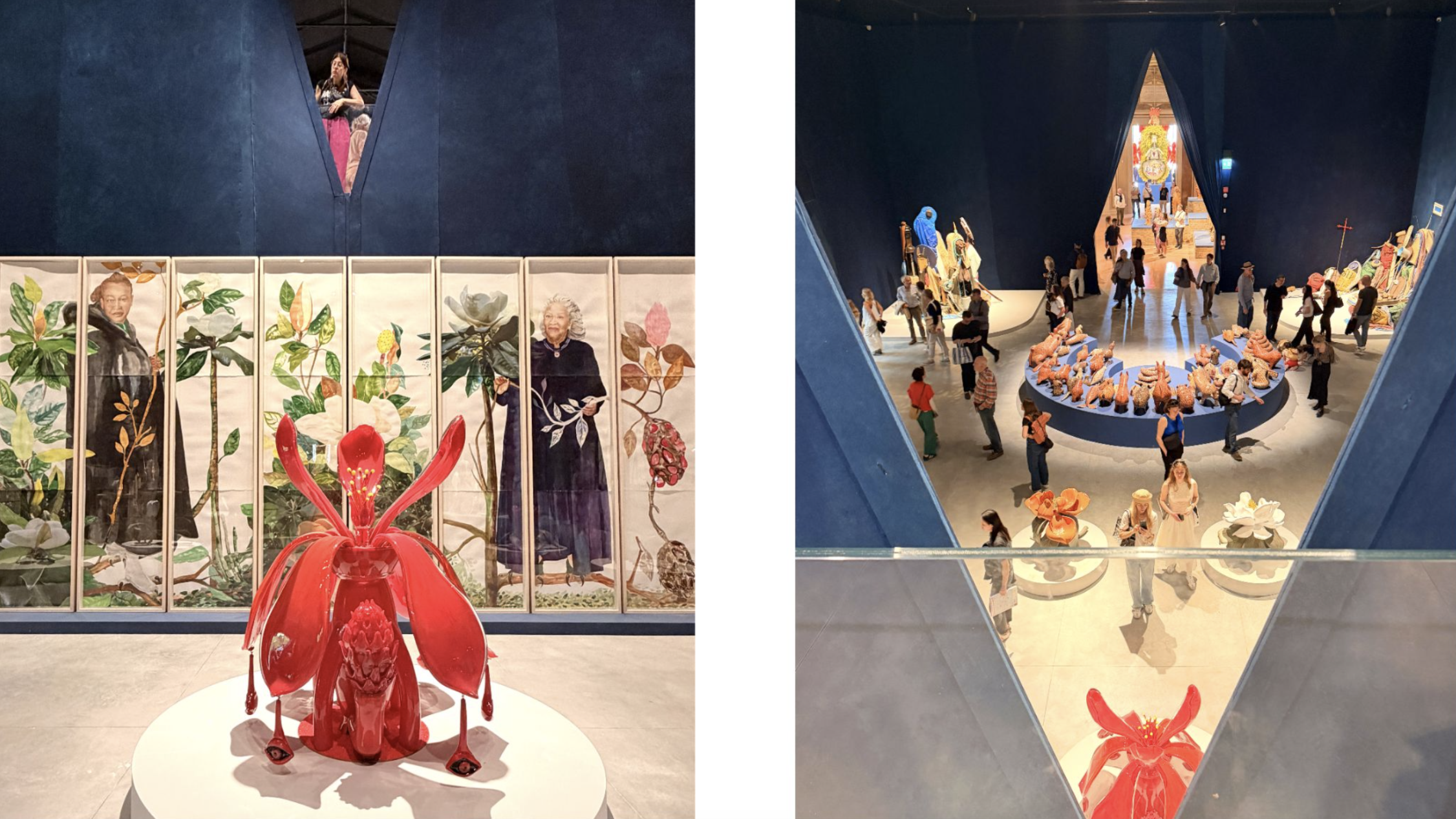
Image 1: Anatomy of the Magnolia Tree for Koyo Kouoh and Toni Morrison (2026) by artist María Magdalena Campos-Pons, installation view. Photo: Inga Bard.
Image 2: In Minor Keys, 61st Venice Biennale, 2026, installation view. Photo: Inga Bard.
A: I judge a group show by how I feel walking out of it — the collective feeling, because there will be high points and low points. Walking out of In Minor Keys, I felt mildly pleasant. Nothing offended me. A few things made my heart beat hard. Nothing turned my head around. But coming out of the last edition and biennials at large of late, where the position about the margins had become pretty strident and exclusionary in a way that didn't feel good — this one felt totally affirming. I didn't love it, but I walked out feeling like it was not attacking anyone. It was affirming something that was important.
I: I had a very different emotional experience of the two main shows. The Giardini felt life-affirming, resilient. The Arsenale felt doom-and-gloom. All week I kept coming back to something an artist, Kateryna Aliinyk, said to me at the press preview for the Pinchuk Foundation's Still Joy : “Here I see so much work around fear, the apocalypse on the doorstep. But in Ukraine the apocalypse has already happened. We're used to it now. We're finding ways to experience joy within war. I'm proud of Ukraine for bringing this exhibition to Venice when the rest of the world is living in fear”.
A: William Gibson is famously quoted as saying "the future is already here—it's just not evenly distributed," and if the future also means the apocalypse — which, if the doom-and-gloomers are right, it might — then for some of us, it has already arrived.
When I say ‘us’ I mean humanity. I don't mind facing into the shadow. It's part of our existence and to refuse it’s kitsch. But nowhere in this show did I feel a Lars von Trier level of cynical darkness. It all felt pretty soft, gentle, a little mournful.
I: That softness is where I started to get stuck. The cultural insistence on acknowledging the pain and humanity of those forced to leave their homeland — the show is full of it — while a lot of those people are not actually being welcomed in Europe. The biggest dissonance I felt the whole week was that. There's something deeply performative about the way the art world keeps highlighting trauma. The show makes a choice to focus on individual stories to humanize the experience. But doesn't it continue to feel performative when it's at odds with the actual political weather? Far-right exclusionism, deportations, the surveillance state. Did it feel weird to you to be forced into a biometric database when you arrived in Frankfurt?
A: It always feels weird.
I: It feels to me like the show is demanding political action that larger and larger segments of the European and American population are simply not agreeing with. Open borders. And I don't really know what to do with that.
A: Neither of us is properly European at this stage in our lives. You were born in Ukraine and I have Italian ancestry, but we live our adult lives in the United States, where the migrant situation is its own kind of shitty. Strangers are not welcome there either (at least not by all). The show is saying look, listen, attend — to the wrong-side-of-history voices, to the marginal frequencies, to the people the surveillance state would prefer to remain unheard. But the audience for that argument is largely the audience that already agrees, while the political coalition that could actually act on the show's implicit demands is fragmenting in real time. There's a long tradition of arguing that art's job is precisely not to be efficacious — that it does its work over a longer arc, slowly, by changing how we attend. In Minor Keys leans hard into that defense. Whether it earns the defense or just dresses up in it depends on what you think slow attention can actually do in this moment.
I: And whether the biennale at large actually enacts the slow attention it claims to. I went into the Russian pavilion. As a Ukrainian, part of me was hoping to see something from Russian artists that was human, inclusive. Instead — bouquets of flowers, shamanic throat singing. And this very strange thing: the wall text appeared in three translations, Russian, English, Italian. In English, for some reason, the last sentence was cut off. A third of a sentence. Just stopped, no period.
A: What did the Russian say?
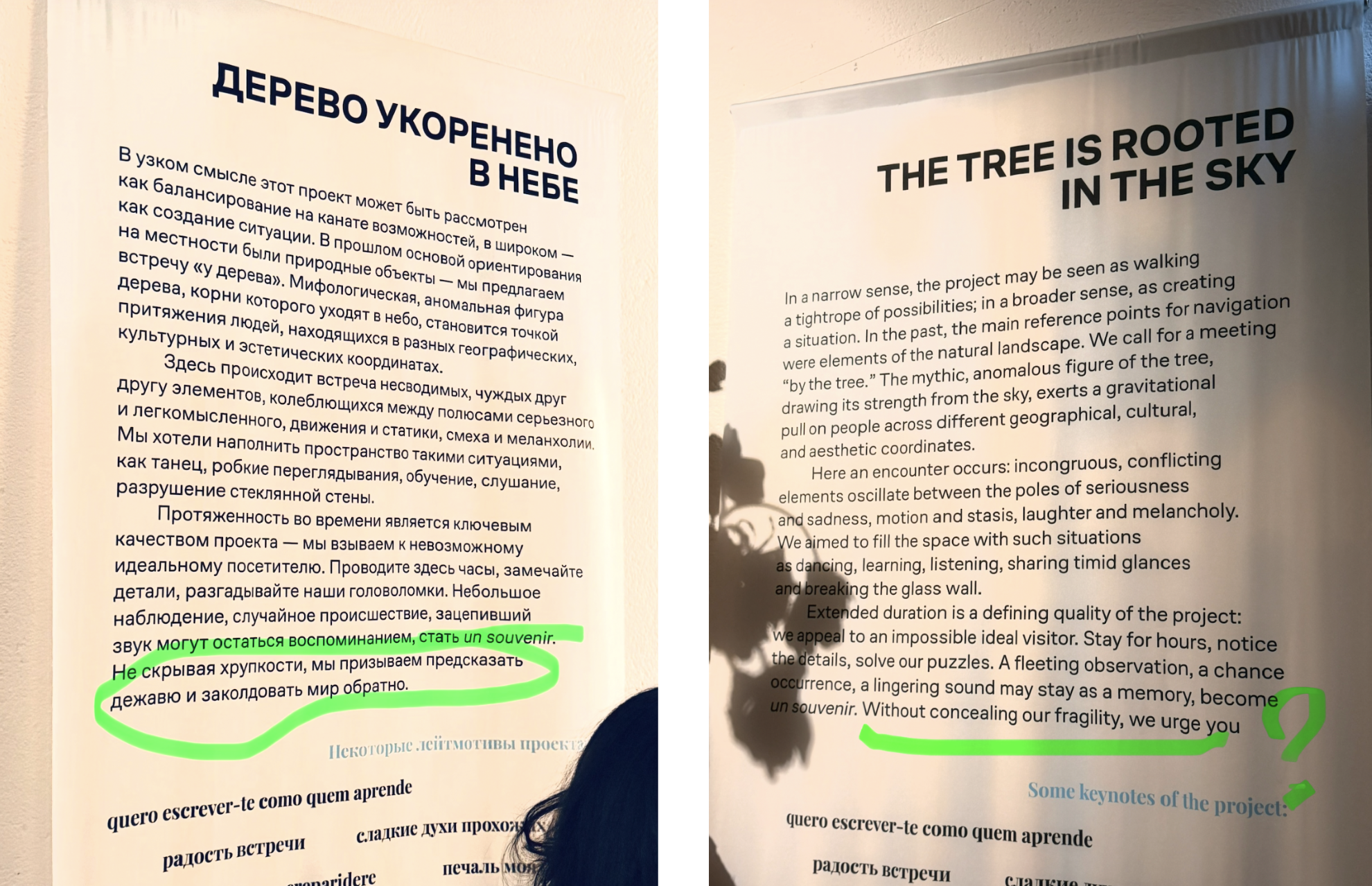
The Tree is Rooted in the Sky (2026), installation view. Photo: Inga Bard.
I: “We urge you to predict déjà vu and bewitch the world anew.” That last clause — bewitch the world anew — wasn't translated into English. It was only said to the Russian speakers, and the Italians for some reason.
A: That's chilling. And such a small, specific detail to catch. You're a braver woman than me. I couldn't go into that pavilion.
I: Well, I'm Ukrainian. I felt allowed to do whatever the hell I wanted in there. I got some free water and a gin and tonic from them, the lines everywhere else were very long. It’s the least of what they owe my family for destroying our property, putting my two grandmas in exile and drafting my uncle and friends into the military. I’m sad that I missed the Pussy Riot and Femen occupation, I would have absolutely ripped my shirt off and scribbled anti-war slogans on my chest. I did get a tattoo that says “Joy” at the Pinchuk exhibition as a part of an art piece about resilience by Alevtina Kakhindze. I guess we all have our ways of dealing.
A: Walking out of this Biennale, the thing I struggled with the most — and eventually made my peace with — was the jury. The Biennale is a symbolic international institution, not a load-bearing one like the UN or the World Court, but it's still an important part of what holds us together, and for a person who's devoted their life to art, it is a fundamental part. I give the jury their conscience. We all have the freedom to do or not do things. Although I wish they had never agreed to be jurors in the first place. There was a way for them to say we thoroughly disapprove of countries committing war crimes and do not believe countries whose leaders are indicted should be considered, but our remit is to judge an artwork for its qualities, that said nothing exists in a vacuum, these things are also shaped by politics, but we are here to judge art.
The way they quit damaged a really important international institution that is about us all gathering together. There are so few places left where we can. I don't want to sit at a table with Putin. I really don't. But I still want a world where we can all sit at a table together somehow. I walked out thinking that globalization — which is cracking all over the place, the good along with the bad — cracked again here. It bugged me out, because I really love a world where artists, writers, art workers can come together and make the world a little bit smaller in a good way. People from far-flung countries become our neighbors. I remember wandering around Venice this time and thinking let's go to Ireland, let's go to Zimbabwe. I could connect with people from all over the world by walking fifty steps. I felt the actions of the jury damaged that. I know it was an act of conscience and I don't fault them for that. But I wish it had gone down differently.
I: I hear that.
A: One more thread. In Minor Keys is almost entirely silent on AI — the defining cultural-economic question of the moment, the technology actively reshaping authorship, attention, and labor in real time. Koyo's framework explicitly rejected spectacle and acceleration, which makes the silence read as deliberate. Is refusing to engage with AI a form of slow-attention resistance, or an evasion dressed as a stance? A show about listening that won't listen to what's loudest in the room.
I: So much of the show was burying its head in the sand. So much art interested in botany and sound and poetry that has nothing to do with technology. And yet here we are — already directly affected, or about to be hit in the guts with it.
A: Though AI as a subject wasn’t central to the main show, some artists addressed it well.. Taiwan'sLi Yi-Fan’s Screen Melancholy (2026)— an hour-long animation that was disturbing, funny, repulsive, beautiful, a meditation on screens, on how animation actually works, on how AI actually works. It explained incredibly complex things we are already living inside in a way that was readily understandable, and filled you with a self-awareness about human perception in relation to bodies in a really gross, funny way. It spoke to the world to come.
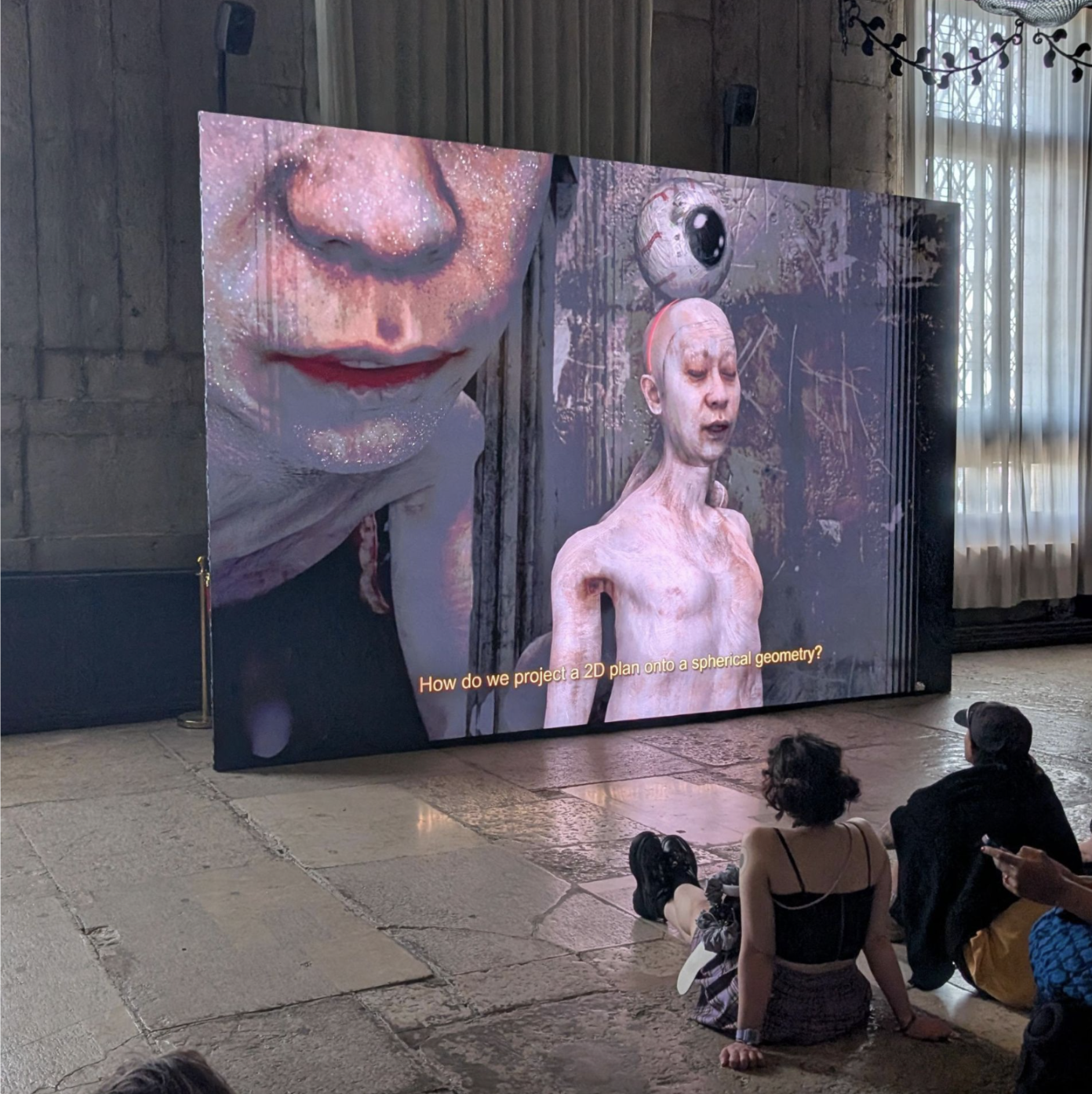
Screen Melancholy (2026) by Li Yi-Fan installation view. Photo: Inga Bard.
I: Trevor Paglen's Voyager (2026), a hypnosis in Strange Rules at Berggruen’s Palazzo Diedo was the best thing there. Chaise lounges, headphones, eye mask, pulse reader on your finger. You choose a journey. An AI voice apparently making things up in response to your spoken choices and pulse. Mine seemed to draw from Buddhist philosophy about learning to flow through life like the river, like water. A friend did a different journey — developing new neural connections. She couldn't really communicate what exactly happened, it sounded very abstract. But she walked out crying. Makeup pouring down her face.
A: That sounds like the piece earned the trip on its own. Overall though I'm walking out of this Biennale thinking about the abandoned fort island of Sant'Andrea, where the last war for Venice was fought, where Napoleon captured the city. Organized by Andrea Bellini from the Centre d’Art Contemporain Genève, Hannah Weinberger had a piece out there called Tidal Listening— after a boat ride you wander a crumbling fort in the middle of the water, and there's this ethereal voice whipping like the wind through tunnels and broken doors and overgrown forests. A place of war, now verdant. One hears about Chernobyl, where it's actually a beautiful wild forest again now, without humans to disturb it — I felt something of that there. In the same breath as the apocalypse is already here: maybe if human beings aren't playing well with their toys, the universe will take them away and give them back to the rest of the species, and it won't be so bad.
I: Overall I was drawn to work that forefronts humor and joy while acknowledging how difficult and heartbreaking life is. There was an above-average amount that hit that marker.
A: That's also the most generous read of what In Minor Keys is trying to do. Humor and joy that acknowledge how difficult life is. If that's the bar, the show clears it. And falls short of it in exactly the places we've been naming.
I: Just barely.
A: Just barely.