
Yiming Clara: Looking for Sculpture @ Recology Art Studios
Written by Weston Teruya
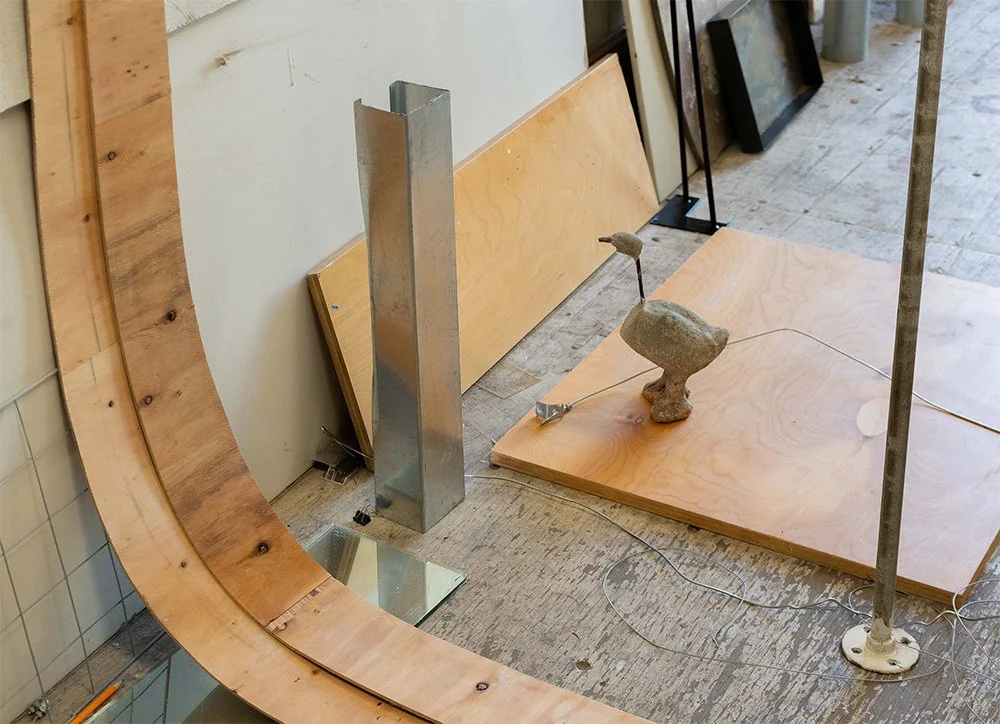
Beyond any set of discrete objects, Yiming Clara’s Looking for Sculpture is a social environment: she presents the conditions for connection with the audience, between materials, and across languages. In it, we are asked to consider the artist’s experience of being in-residence, reflecting on not just finished artworks, or even the labor of materiality and craft, but the expansiveness of everyday life in the studio, and the questions that compelled her conceptual process. Leading into the exhibition, Yiming Clara and I had a conversation amongst these gathered materials. This transcript of the dialogue is included in the gallery, not as an authoritative guide, but as another element to be considered in relation to many others–another point in the constellation of her installation.
Weston Teruya: There’s a strong undercurrent of language in how you approach your work. Can you talk about how that plays into this reflection on process, everyday life, and material?
Yiming Clara: That’s a really nice point. Language is a strong undercurrent. And I think it began with speaking and growing up between two languages. I didn’t just grow up speaking two languages—I grew up between two languages, between two places. And that duality of language makes you realize early on that there’s another way to say or think about anything; nothing is fixed.
Our engagement with the world is shaped by language and we behave according to the structuring of language. The same goes for art, right? In thinking about a question like “what is sculpture?” Isn’t it in some ways linguistic first, as well? It’s of course also visual and experiential, but it is language that structures and polices our vision and our ability to form meaning. So then, within that structure and our sensory experience, we make meaning, understanding, or confusion about this thing we are encountering, right? So this confrontation with language is unavoidable and inevitable.
I felt an immense confrontation with this question my first weeks at Recology because, really, first and foremost you’re tasked with confronting the essence of sculpture: material. Usually, you have a limited amount of material and that can be very generative. But here you have an infinite amount of material. The challenge is not only the material thing or the ideas, but the task of making sculpture; that confrontation with sculpture.
And that was a horrifying thing. At first, I couldn’t make anything. I was really arrested by this task for the first month or so because I couldn’t answer the question of “what is sculpture?” Only two weeks ago I arrived at this idea of moving the entire studio into the exhibition space as the work. And that released me. I realized I don’t have to present these pristine, perfect pieces where every cord is hidden perfectly, and every smudge is erased––or at least intentional––where all traces of life have been removed. That mode of presentation is itself part of art’s disciplinary logic: the necessity of the object’s formality to detach it from life. It’s looking at art in this disciplinary fashion, where the formality of the object is detached from life. And I think that separation is largely how the aura of the object is produced: there’s a disconnect from the person who made it, but also from the viewer. There’s a mystery that’s crafted––and that’s how we’re able to produce that inflation of meaning and value, right?
So, I decided to put everything that you don’t usually see into the gallery space. I want that question of “what is sculpture?” or “where is sculpture?” to be this ongoing task to be answered.
WT: What you’re describing feels like this engagement with the long history of process-based artworks. Like what you said about breaking away from the seamlessness of certain kinds of works to leave visible the evidence of making and the conditions of labor. In some sense it feels like you are interested in maintaining the human-ness in the installation?
YC: It’s not just a human-ness, it’s reconnecting to life. It’s about going through the world and going through time–the everydayness of it. And it is about labor, right? There’s a lot of work in the process. Going into the pile looking for materials, you come away physically and mentally exhausted. And then entering into this material-based lineage of sculptural engagement requires a lot of practice and making so that something emerges out of that work.
I want to present all of that in its provisional, potential state, where the tools and materials will be side-by-side. To me it’s this open field of potential. For example, you might have this saw and this thin piece of wood. And in my head, I’ve already formed it into something, but I’m not presenting it as that thing yet. And a viewer can see it and make a similar connection or absolutely not. Maybe it’s completely different.
The potential can be activated by ideas, by the mind, and by the preconceptions we bring with us. That might be our ideas about sculpture–what it is, what tools and materials are supposed to do. And it is shaped by our disposition and experiences. Someone with an architectural background might imagine these building materials in a particular way that differs from someone else. Or a fine cabinetmaker will engage this plank of wood in another way. So, in laying out all of this material potential, I want to keep things open for those experiences. It’s open for the ongoing of life.
WT: One of the common experiences of being here in-residence is the sensory overload of salvaging materials from the Public Reuse and Recycling Area. By necessity, it becomes this filtering process because you’re just bombarded with sounds, smells, and things. So you have to narrow that down as you decide what to gather, and then you might have this huge pile in your studio, where there’s another editorial stage where you are further selecting and utilizing materials for exhibition. Amidst that open potential, there’s also a filtering. Is there a way you want people to understand your particular approach to thinking about these material connections and your editorial approach to what is included here?
YC: Most of the work that artists do here is this editorial process, right? To bring a full, finished work of art into being, it takes a lot of time. And time in a residency is limited. So, I think the most exciting thing you can do is this editorial work and see the potential emerge out of it. When I thought my task was to present a certain idea of finished sculptures, it completely arrested me. I think it’s because I knew that wasn’t the most I could make of my time here. Instead of closing things that way, I realized my job is to open up the vast potential that can be birthed by these editorial, artistic processes.
Sometimes it’s hard to pinpoint where the work resides in this process. The common way we’re taught is that the work is lodged within this singular object that holds all of our thoughts, ideas, disciplinary practice, and time. But for me, in my practice, the work could often reside elsewhere, not just within the singular object. It could be between objects. It can be in the whole act of putting together this project. It might take the form of an exhibition, an event, a performance, but the work is ultimately in the relationships beyond or between the discrete thing. Traditionally in painting, the emphasis is in the gesture, the mark that gives meaning and uniqueness. And I think in contemporary art that gesture can lie elsewhere, beyond the object. So, this is my proposal to see where that mark might exist outside the material thing.
WT: Are you envisioning including evidence of some of those relational elements or documentation of your process? Pieces that reveal life beyond or around the specifics of the Recology studio?
YC: I’m framing this as everything within this period of my life, within the duration of the residency. So maybe my bike will be in the exhibition. Because it was a huge part of this time. A lot of the thinking that I’ve done in these past months has been on my long commutes here on my bike and on BART.
This is a part of the exhibition I haven’t really started to work on yet, these particularities of what I’ll include. It’s exciting to be asked about these details. I’d like to put food in the exhibition, but I don’t think that’s allowed. But that gesture feels important–the everydayness of thinking about, “I need to eat, so what do I eat?” That’s a big part of daily life, right? And that need really penetrates the working process. Our day is fractioned by mealtimes and commute times, these processes and interruptions. I’m hoping to bring in elements of that routine, these elements of the everyday. And I need to think of the best way to present this evidence so that it’s not just apparent to you and me, but to other people as well. Because it’s relatable, right? Because that’s humanness.
I’m interested in art as a conduit for this relateableness–it’s so inherent in art. There’s so much work put into detaching art from everything, to put it in a rarified position. But what’s most interesting to me is the life in it, the people in it. It’s always going to be the product of the specific social, cultural, and historical conditions that the artist and viewer are situated in.
WT: I’m struck by the impulse that you were just talking about. I could also sense it threaded through what you were saying earlier. You have this real desire for connection and for people to be in your shoes, to be confronted with this question of sculpture, and to join you in walking through their parallel process facing this material. How does that search for connection fit within your broader practice?
YC: I can answer this in a few ways. The first way is that–if we use the language of your question–to me, art creates unforeseen connections. And those new connections allow us to imagine different ways of being.
The radical or political potential of art is opening up different modes of seeing how we can exist in this world and how we navigate the structures and the structures that police us. I say police here in the broadest sense; how unspoken rules structure how we walk into a space, how it structures society and the world. But art has the potential to reorient, to see with a different lens, because it gives us a language that is beyond the structures of words; that’s beyond linguistic barriers.
And it doesn’t have to be relatable in terms of mirroring a shared history and story with the audience. Art can have a language that is grounded in the senses. And these senses are something that can be universal, right? That capacity to reach different people is the most important and radical site and potential of art.
And the next thing goes back to what I was saying about where the artistic gesture lies. A lot of my work has been collaborative in nature: I set up a structure within which a collaboration can occur. I create these conditions where collaboration between different languages can take place. And here, by language, I mean disciplinary languages. I’ve been really interested in working with people who are not artists or who don’t live under the label of capital-A “Artist.” We can use the format of art to leverage its vast social potential; the kind of democracy of the senses that it allows.
We also have the potential in the formalities of how art operates in the world—the opening reception, the closing—where people get together. It can be really hard for people to get together in person nowadays. Especially in this urban environment where there is no social serendipity–there’s so little chance for unexpected interactions. Everything is designed to be controlled. You get in your car, you go from here to there, you know what you’re passing through. The biggest chance you’re going to incur is maybe traffic. You know exactly what you’re going to see, where you’re going, and what you’re going to do. But growing up in a different urban context, my sense of life was shaped by serendipity, chance, the things out of your control. And that’s what’s most interesting about life and also most interesting about art.
A lot of my work has been to borrow the forms and formalities of art that have been established and negotiated–from the way we talk about work using art language in exhibition texts, to the form of the opening and the dance of it. I want to use these forms to a different end and to incorporate different people in these spaces. For instance, in one of my ongoing projects, Apartment 19, I work with people in different fields and ages through the format of exhibition making and performance; where those forms are the outputs of something very social.
I spent the whole last week writing trying to craft the language around this side of my practice because I couldn’t pinpoint what it is doing. I was framing it as a “project space” for a long time. But that’s not really it. It takes place in my apartment–that’s where I’ve been making the project public–but really it’s a project; it’s a practice. The heart of this practice is this urge to connect.
WT: It speaks to your desire to create the conditions for connection, like you said.
YC: Oh! That is what this exhibition is doing. Your articulation made me realize that it is exactly that: the conditions for connection. You can connect this object to that thing over there, or that idea, or something else. Opening up that field of connection is the work.
Yiming Clara is an artist raised in Beijing, living and working in Berkeley where she is studying art and rhetoric at the University of California. Working across sculpture, installation, performance, and social engagement, she is interested in how we move about in the world traversing between surfaces of material and of social construction. Her recent solo exhibition, 似曾相识 | Dance, in Theater with Window, was presented at /Slash in San Francisco. One of her ongoing projects, Apartment 19, takes the form of a nomadic project space for exhibition making, collaboration, performances, events, and publications.