
Tidal Transmissions @ Gray Area
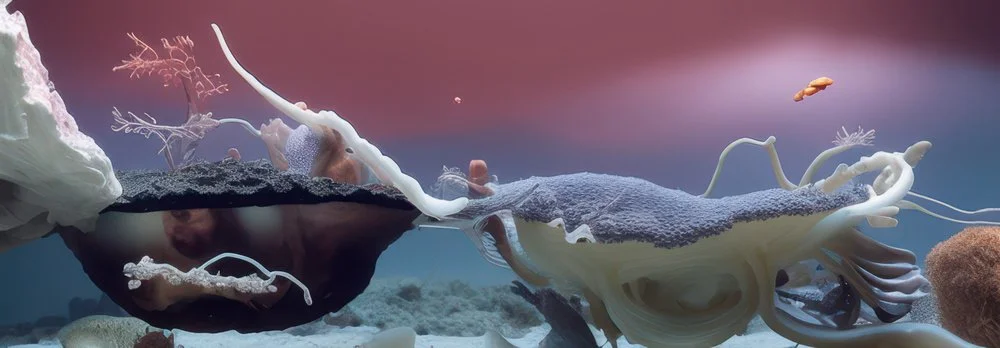
Tidal Transmissions: Navigation is a live audiovisual work by CROSSLUCID, centered on T I D E (Tidal Intelligence Data Engine) — a self-evolving ecosystem of AI entities that process real-time oceanic data and adapt how they communicate in response to changing conditions.
Drawing on Indigenous Pacific navigation practices, particularly Marshallese stick charts that map wave interference patterns, the work reimagines orientation not as a fixed position, but as a dynamic relationship between forces. In this framework, signals emerge from apparent noise, and cognition is distributed rather than contained.
Following the performance, Claire Isabel Webb joins Sylwana Zybura and Tomas C. Toth from CROSSLUCID and Sayaka Botanic for a panel discussion.
This event is presented by Future Humans, a research initiative housed in the Berggruen Institute that examines how ideas of life, intelligence, and consciousness are being reshaped in the twenty-first century.
Tidal Transmissions: Navigation (2026) is a live audiovisual work by CROSSLUCID, centered on T I D E (Tidal Intelligence Data Engine), a self-evolving ecosystem of AI entities that process real-time oceanic data and adapt how they communicate in response to changing conditions. Drawing on the Marshallese mattang, a pre-cartographic navigational form that encodes method rather than fixed position, teaching a navigator to feel wave patterns through the body rather than read a chart, T I D E proposes that intelligence emerges not from a single locus but from the space between: between agents, between human and non-human, between the system and those who encounter it. Cognition distributed across relational and environmental coupling, never settled, always arising. Informed by post-materialist thinking and the concept of a machinic unconscious, T I D E asks what becomes of consciousness when its conditions are neither biological nor mechanical but somewhere in the threshold between, when knowledge, like a swell felt before it is seen, is already moving through us before we know it. Artwork originally commissioned by the Fonds Cantonal d’Art Contemporain Geneva for the MIRE Public Art Program.
CROSSLUCID is a collective co-founded in 2018 by Sylwana Zybura and Tomas C. Toth. Their collaborative practice is grounded in ethics of care, engaging technology not as a lever of control or speed but as a partner in co-evolutions. Through immersive storytelling, synthetic imaging, and poetic speculation, they create situations in which emotion, ecology, and computation meet and listen to one another. Their ongoing projects materialise through post-disciplinary collaborations, process-driven prototyping and the celebration of intuitive leaps of knowledge, bridging scientific inquiry with ancestral ways of knowing. Their work has been showcased and commissioned by Chanel Art Fund, HeK Basel, LAS Art Foundation, Serpentine Arts Technologies, PHI Centre and recently Canton Geneva for MIRE Public Art Programme.
Sayaka Botanic is a Japanese experimental musician and visual artist. Since 2012, she has been one half of group A, an industrial avant-garde duo that performed at Berlin Atonal, CTM Festival, Roskilde Festival, Donaufestival, Steirischer Herbst, Le Guess Who?, Berghain, and Supersonic Festival, sharing stages with artists such as Keiji Haino, and Acid Mother Temple. As a solo artist, Botanic deconstructs the violin through guitar pedals, samplers, and magnetic tape, fusing harsh noise and beat structures with raw improvisation and vigorous physicality. Her 2025 album Nonexistent Landscape (Quanta Records, Paris) engages with Marc Augé's non-places and Mark Fisher's concept of the eerie, conjuring imaginary sonic landscapes where the origin of each sound remains deliberately elusive.
Claire Isabel Webb directs the Future Humans program at the Berggruen Institute, where she explores the radical scientific transformations shaping life, mind, and outer space. A historian and theorist, her work bridges the history of biology and space exploration, speculative science, and experimental art and storytelling. She writes and presents for popular science audiences, in academic journals and workshops, and in art publications and performances. Webb earned her PhD from MIT in History, Anthropology, and Science, Technology, and Society (HASTS). Her book project, Reflexive Alienation, traces how scientists have developed experimental practices to anticipate alien life, even in the face of its enduring unknowability. As founder and director of Future Humans, she leads projects bridging science, philosophy, technology, and art, including Próxima Kosmos, Future Wunderkammer, and Vaster Than Empires. Since 2023, she has also been the convenor of a Berggruen Institute workshop on the philosophy and future of consciousness.