
Opening Day Symposium: New Perspectives on the Etruscans @ Legion of Honor
Join us to hear about the Etruscans and their lasting contributions to the Western world. In this opening day event, leading international scholars will examine Etruscan civilization and its influence on present-day architectural, engineering, and artistic achievements.
Schedule
Session 1: 10 am–12 pm
Introduction and welcome remarks
Renée Dreyfus, George and Judy Marcus Distinguished Curator and Curator in Charge of Ancient Art, Fine Arts Museums of San Francisco
Etruscan Pasts, Present, and Futures
Lisa Pieraccini, lecturer, History of Art department, and director, Mario Del Chiaro Center for Ancient Italian Studies, University of California, Berkeley
Etruscans in Full Color: The Painters and Their Techniques on Walls, Terracottas, and Pottery
Daniele F. Maras, director, National Archaeological Museum, Florence
Session 2: 1:30–4 pm
Myths, Mirrors, and Matrons: Reflections on Etruscan Art and Society
Alexandra A. Carpino, PhD, associate dean and professor of comparative cultural studies, College of Arts and Letters, Northern Arizona University
About the speakers
Renée Dreyfus, George and Judy Marcus Distinguished Curator and Curator in Charge of Ancient Art, is known for her scholarly achievements, her role as a respected curator, and her long-standing institutional commitment. Dreyfus has enriched the Museums’ collection of ancient art with rare and significant acquisitions and has organized more than twenty successful exhibitions. She holds a PhD in Near Eastern art and archaeology from the University of California, Berkeley; an MA in Mediterranean studies from Brandeis University; and a BA in philosophy from Boston University.
Lisa Pieraccini is a lecturer in the History of Art department, a faculty affiliate in the Ancient History and Mediterranean Archaeology program, and director of the Mario Del Chiaro Center for Ancient Italian Studies at the University of California, Berkeley. She is an elected member of the Istituto Nazionale di Studi Etruschi ed Italici in Florence, Italy. Dr. Pieraccini has published a variety of articles and book chapters on numerous aspects of Etruscan visual culture and is co-editor of the series, Cities and Communities of the Etruscans, published by University of Texas Press.
Daniele F. Maras is director of the National Archaeological Museum, Florence and a government archaeologist at the Italian Ministry of Culture. As an Etruscan scholar with an international profile, he is the secretary of the Pontifical Roman Academy of Archaeology, member of the National Institute of Etruscan and Italic Studies and corresponding member of the Archaeological Institute of America. He is a prolific author in the field of pre-Roman Italy, with research interests including Etruscan religion, epigraphy, painting, pottery, terracottas.
Alexandra Carpino is associate dean and professor of comparative cultural studies at the College of Arts and Letters at Northern Arizona University. She earned her MA in art history from the University of Iowa and a BA in classical and Near Eastern archaeology at Bryn Mawr College. Her publications include Discs of Splendor: The Relief Mirrors of the Etruscans (The University of Wisconsin Press, 2003), A Companion to the Etruscans (Wiley-Blackwell, 2016), and Collecting and Collectors: From Antiquity to Modernity (Archaeological Institute of America, 2018).
P. Gregory Warden has served as the Mark A. Roglán Director of the Custard Institute for Spanish Art and Culture at the Meadows Museum since June 2022. Previously, he was president of Franklin University Switzerland. He taught at Bowdoin College, the University of Pennsylvania, and then at Southern Methodist University for thirty years, where he is now professor of art history emeritus and professor of practice in arts administration.
P. Gregory Warden, Mark A. Roglán Director, Custard Institute for Spanish Art and Culture, Southern Methodist University
About the Exhibition
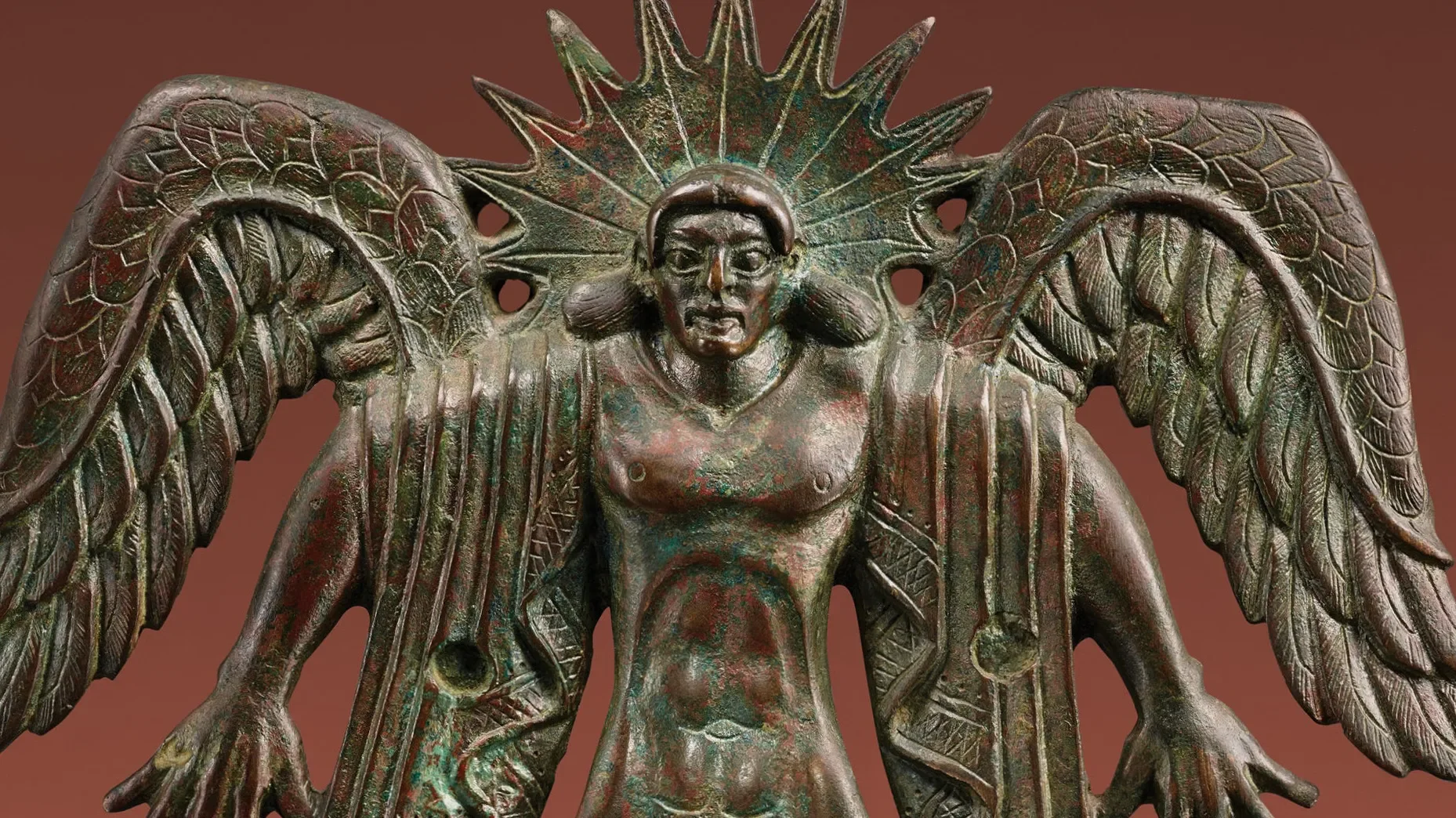
Togas, temples, hydraulic engineering, winemaking, and even “Roman” numerals, all widely credited to the Romans, were actually Etruscan innovations. The Etruscans thrived in what is now Italy for almost a millennium, from around 900 to 100 BC, before the rise of the Roman Empire. They laid the foundation for present-day architecture, engineering, and artistic achievements. Yet their culture remains overshadowed by ancient Greece and Rome. Drawing on the latest archaeological discoveries and cutting-edge scholarship, this is the most comprehensive exhibition on Etruscan culture in the United States to date. Over 150 exquisitely crafted and well-preserved examples of bronze and terracotta sculpture, gold jewelry, ceramics, and architectural features, as well as the longest-surviving piece of Etruscan writing, reveal a legacy that continues to captivate today.