
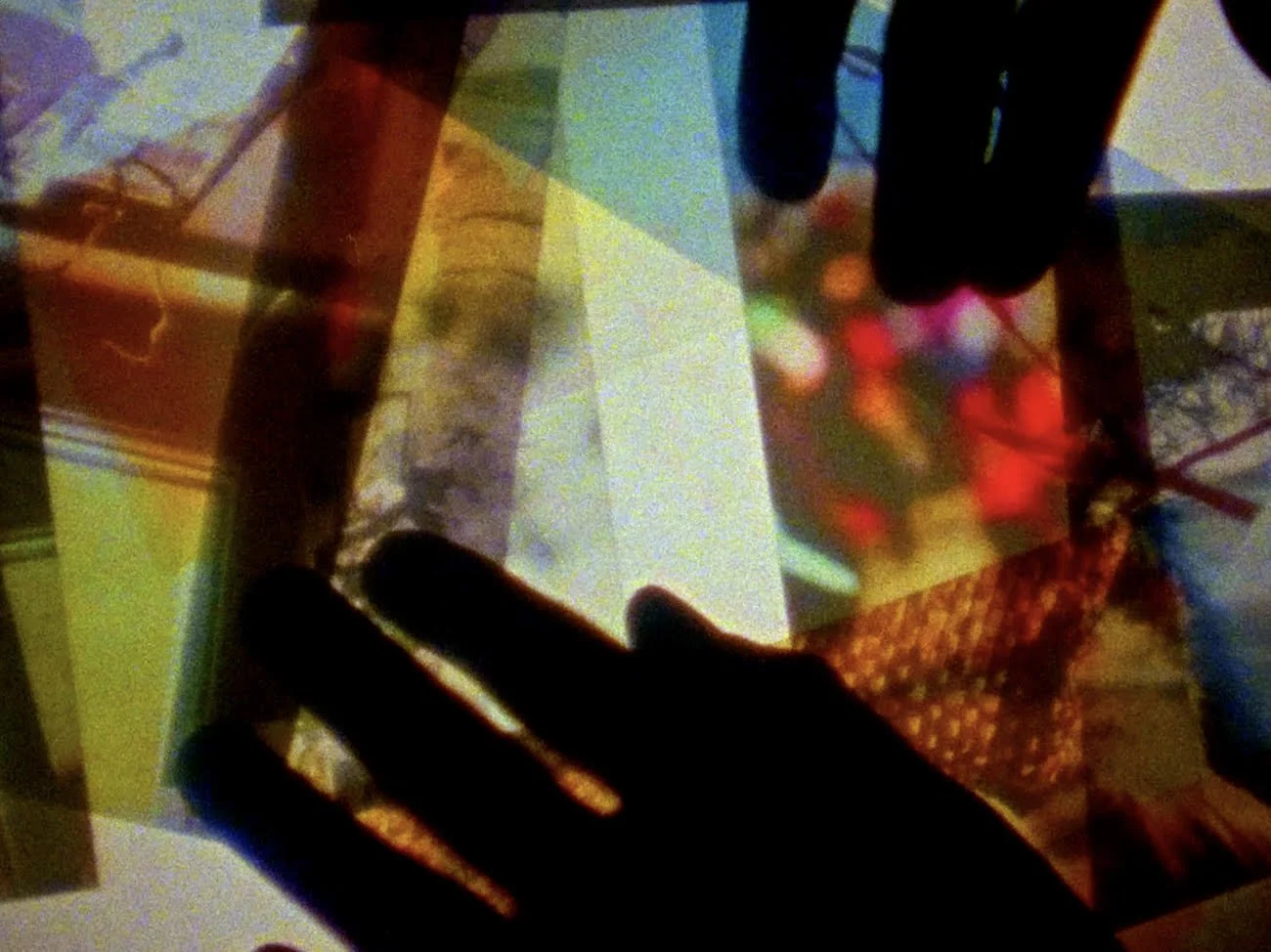
Slash presents Sky Hopinka: Sonic Transmissions curated by Gina Basso. Join Slash for the opening reception on Saturday, January 10, from 5 to 8pm, which will begin with remarks from curator Gina Basso at 4:30pm.
“I make work for an Indigenous audience. You can watch if you're not part of these communities. But just know that I'm not going to be doing a lot of explaining. And I don't think it's a lot to ask a non-Indigenous audience to try and keep up a little bit, or to try and ask questions later on, or to just stop and listen.”
- Sky Hopinka
“Sky Hopinka’s (Ho-Chunk Nation/Pechanga Band of Luiseño Indians) cinematography gives the feeling of floating, as if led by an unseen presence through spaces permeated by sounds and echoes—rhythmic, vocal, choral, musical. This momentary look through Hopinka’s viewfinder is not a chance to walk in his footsteps or step into his experiences, but to be in observance, with ears attuned to his frequency. We are guided through powwows, down forest paths, through stretches of lonely highways, and towards the land’s end. Each scene unfolds in a collage of moving images and sounds as if tuning a radio that vacillates between the diegetic and the external. We feel a sense of immersion and of being there, or having been there, even if in a dream (or hallucination). But remember: we’re just passengers.
While film and video are mediums through which Hopinka creates and conveys his visual world, sound provides another channel for the transmission of meaning. Hopinka is a musician and collector of sound, and a master of the mix. He incorporates elements such as archival recordings sourced from historical documentation, resurfaced family tapes, language lessons, songs by friends, re-played conversations, and his own narration into his films and videos. The intersection of sound, text, and imagery surfaces memories, elegies, and dreams.
“Saith the ghost,
‘Dream, oh, dream again,
And tell of me, Dream thou’”
It also invites ghostly conversations to shape and reframe understanding of the Native American experience away from the ethnographic power that, in the artist’s words, “fixes our cultures and makes them into traditions, so they’re not contemporary.” Sonic Transmissions explores and highlights the sonic aspects of Hopinka’s practice. Sound allows for a different encounter, distinct from the act of seeing, and is, perhaps, more wholly personal, requiring a curious participation. Hopinka blends audio and sculpts aural tapestries not to function as a soundtrack to accompany his films, but to open up an entirely new sensorial dimension as a key to the present.
For example, in I’ll Remember You as You Were, not as What You’ll Become, an elegiac work in tribute to the Native poet Diana Burns that includes archival video of her reading, Hopinka extends her voice onto time-lapsed footage of a car driving along a dark highway, placing her within the journey. Powwow performances are colorfully rendered into abstraction and come together fluidly with the Sacred Harp folk song 318 Present Joys, embraced by Irish and Southern American music traditions. The aural traces do not signify what is gone, but honor what is living and thriving today.
Such mixing in and out of temporalities pulls aside the veil separating time and space, and allows the elders’ voices and arrays of musical styles to become a collective continuum, a layered present not out of step with Hopinka's contemporary footage.
In this site-specific exhibition, designed in collaboration with the artist, visitors are encouraged to pay attention to sounds as they require—even demand—a deeper listening, or a (re)listening to the confluence of what is audible: spoken, sung, drummed, unearthed, and intertwined. This exhibition brings together videos spanning 2016 to 2025 that share the space with text and a playlist made by the artist for this exhibition. Sonic Transmissions is a conversation with ghosts, passengers, viewers, passersby, the unsuspecting, and for tribal communities. Stop and listen.
– Gina Basso
Sky Hopinka (Ho-Chunk Nation/Pechanga Band of Luiseño Indians) was born and raised in Ferndale, Washington and spent a number of years in Palm Springs and Riverside, California, Portland, Oregon, and Milwaukee, Wisconsin. In Portland he studied and taught chinuk wawa, a language indigenous to the Lower Columbia River Basin. His video, photo, and text work centers around personal positions of Indigenous homeland and landscape, designs of language as containers of culture expressed through personal, documentary, and nonfiction forms of media. Hopinka’s work has played at various festivals including Sundance, Toronto International Film Festival, Ann Arbor, Courtisane Festival, Punto de Vista, and the New York Film Festival. His work was a part of the 2017 Whitney Biennial, the 2018 FRONT Triennial and Prospect.5 in 2021. He was a guest curator at the 2019 Whitney Biennial and participated in Cosmopolis #2 at the Centre Pompidou. He has had a solo exhibition at the Center for Curatorial Studies, Bard College, in 2020 and in 2022 at LUMA in Arles, France. Hopinka is the recipient of the Infinity Award in Art from the International Center and the Alpert Award for Film/Video and fellowships including The Radcliffe Institute for Advanced Study at Harvard University, Sundance Art of Nonfiction, Art Matters, The Guggenheim Foundation, and The Forge Project. In the fall of 2022, Hopinka received a MacArthur Fellowship for his work as a visual artist and filmmaker.
Gina Basso is an independent film curator based in San Francisco. She has organized film and video programs for San Francisco Museum of Modern Art, Roxie Theater, McEvoy Foundation for the Arts, Yerba Buena Center for the Arts, Alamo Drafthouse New Mission Theater, California College for the Arts, Northwest Film Forum, Design Within Reach, and San Francisco Cinematheque. Her video work has been shown at CROSSROADS Festival, Antimatter Festival, Artist Television Access, Roxie Theater, and Public Records NYC. By day, she works in public media.