
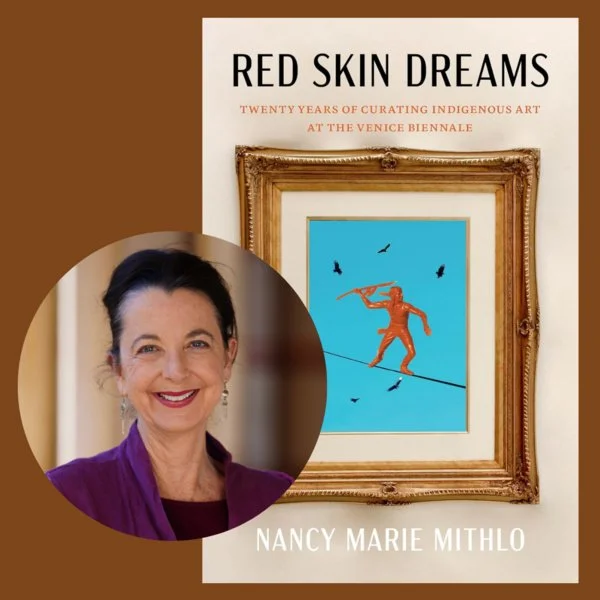
Nancy Marie Mithlo | Red Skin Dreams @ Cantor Arts Center
In Conversation with Jennifer DeVere Brody
Professor Nancy Marie Mithlo (UCLA) discusses the emergence of Indigenous arts in global contexts from 1997-2017 drawing from her work curating nine exhibits at the Venice Biennale. Mithlo’s archival papers are housed at Stanford University Libraries’ Special Collections. Red Skin Dreams documents and theorizes the presentation of contemporary American Indian art through memoir and storytelling. The improbable and messy business of staging international exhibits that were non-institutional, non-commercial and anti-hierarchical involved hundreds of collaborators from across the globe—Canada, Australia, New Zealand, Switzerland, England, Norway, Germany, as well as Italy. These connections were made through Indigenous networks, institutions, and relationships, not the prestigious galleries, museums and art collectors that typically decide who is represented and where. Questioning the very notions of margin and center and asserting alternate frames of reference besides simple inclusion, this is a story that asserts that the world belongs to Native people. As Canadian First Nations arts professional Jim Logan stated, “We are a part of this world; we are a part of the human story. We are worth it.”
Dr. Milthlo will be joined in conversation with Professor Jennifer DeVere Brody (Theater and Performance Studies and African and African American Studies at Stanford University; Guggenheim Fellow in Fine Arts Research; recent curator of Edmonia Lewis: Indelible Impressions at Cantor Arts Center).
Books will be for sale at the Stanford Campus Bookstore and through the publisher, the University of Nebraska Press. Please preorder a copy and bring it to the event. Dr. Mithlo will be available for book signing at the end of the event.
All public programs at the Cantor Arts Center are always free! Space for this program is limited; advance registration is recommended. Those who have registered will have priority for seating.
This program is co-sponsored by the Native American Studies, Cantor Arts Center, Center for Comparative Studies in Race and Ethnicity, and Native American Cultural Center.