
Hidden Layers: AI Infrastructures and Hallucinations @ UC Berkeley Worth Ryder Art Gallery
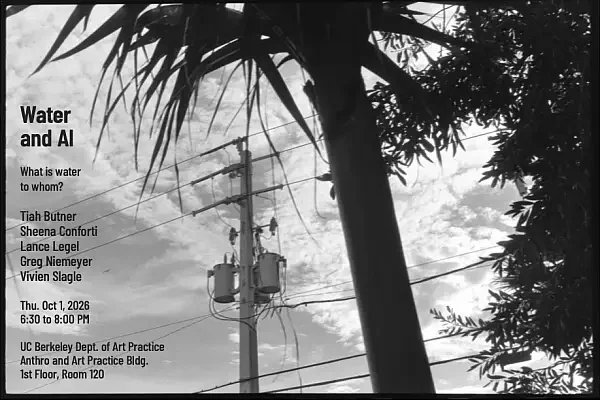
The Water and AI panel brings together four speakers with different answers to a simple question: What is water?
For Tiah Ross-Butner, a UC Berkeley student and enrolled member of the Yurok Tribe, water is family. For Sheena Conforti, a Stanford researcher who studies wastewater and public health, water carries information about community health. For Lance Legel, a UC Berkeley visiting scientist who uses AI to study ecosystems, water is a resource we need to understand more deeply. For Greg Niemeyer, a UC Berkeley professor and data artist, water is circulation. For Vivien Slagle, a UC Berkeley student studying art, anthropology, and law, water is a shared resource under competing demands from agriculture, data centers, and living systems.
Water also helps make AI possible. Many data centers use water for cooling, and producing the electricity they consume can require additional water. Together, the panelists will explore how their cultures and practices shape the ways we understand and talk about water, and how these conversations can support sustainable water management. What is water? How can we talk across our differences? And where can we find common ground?
This event is sponsored by the UC Berkeley Environmental Arts and Humanities Initiative.
Panelist: Tiah Butner
Panelist: Sheena Conforti
Panelist: Lance Legel
Panelist: Greg Niemeyer
Panelist: Vivien Slagle
About the Exhibition
The Department of German and the Department of Art Practice are excited to announce the opening of Hidden Layers: AI Infrastructures and Hallucinations, curated by Antonio Somaini with Hannes Bajohr, Sonja Thiel and Elena Yu, in dialogue with the France–Berkeley research initiative The Latent Spaces of Culture, and on display at the Worth Ryder Art Gallery.
In neural networks, the “hidden layers” are the intermediate strata of transformation between input and output — the computational structures where data are transformed, weighted, and recombined into increasingly abstract, distributed representations that no human eye can read. The exhibition Hidden Layers: AI Infrastructures and Hallucinations takes this term as its conceptual frame, bringing together seventeen international artists and researchers working at the intersection of contemporary art and machine learning to make visible what artificial intelligence keeps out of sight: its planetary infrastructures and computational latent spaces, its colonial and ideological underpinnings, its misrecognitions and hallucinations, and its transformation of our relation to the past through the silent reprocessing of pre-existing cultural forms. The exhibition is organized in four sections: “In the Latent Spaces of Culture,” “Material Infrastructures,” “Colonial Imaginaries: From Misrecognition to Generative Slopaganda,” and “Hallucinations and Psychedelia.”
Featuring works by Nouf Aljowaysir; Gašper and Nina Beguš & Metahaven; Grégory Chatonsky; Kate Crawford & Vladan Joler; Asma Kazmi & Jill Miller; Andrea Khôra; Occitane Lacurie & Barnabé Sauvage; Greg Niemeyer; and Mario Santamaria & Alex Saum-Pascual.
Hidden Layers is a collaboration between the Department of German and the Worth Ryder Art Gallery at the Department of Art Practice. It is part of the France–Berkeley research initiative The Latent Spaces of Culture: a collaboration between UC Berkeley, the Université Sorbonne Nouvelle in Paris, and the French National Center for Scientific Research (CNRS).