
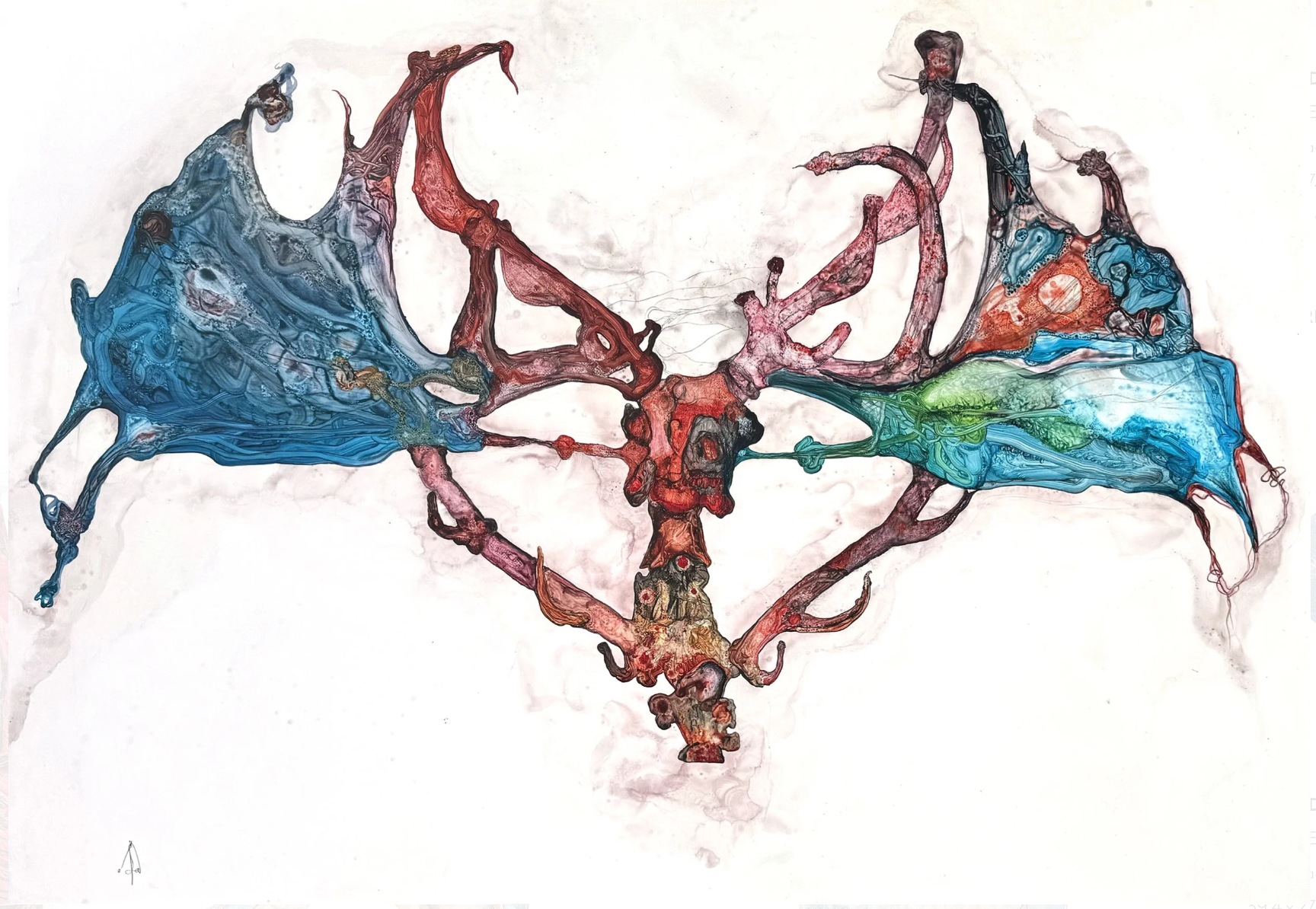
Belgian artist David DeWeerdt’s work centers on the innate condition of the human being and what it means to be endowed with the agony and ecstasy of bodily sensation, mind, and emotion. With his singular technique, DeWeerdt’s painting reveals the tenebrous inner landscapes of the body and soul, the textures of pain, sensuality, and heartbreak. His figures, often languishing in a blank void unmoored from time and space, function as conduits for the visceral, turbulent electricity of a tormented feeling or psychological state. They are stripped down to the bare studs of their humanity, bereft of external identifiers and emotional armor, devastatingly raw and alive.
In his work, serpentine sinews coil through troughs of gauzy ink, filling the contours and craters of anguished, angular forms displayed like autopsies of living beings. Simultaneously sensual, vulgar, cosmic, and repellent, the excessive physical shaping of tissue and flesh transcends dissection, seeking instead to awaken something spontaneous and instinctual in the viewer. Confrontation is the point. Through the roiling, eviscerated forms of naked figures, the viewer reckons with a paradoxical aestheticism that inspires equal parts awe and disgust, attraction and repulsion.
DeWeerdt’s painting fundamentally questions Western aesthetics and notions of physical difference, deformity, and embodiment in an age of increasingly disembodied values and technology that repudiates discomfort, ambiguity, nuance, and imperfection. At times decorative, at times medical, at times erotic, his figures defy categorization, establishing a new approach to pictorial representation of the body that defiantly embraces the horrors/wonders of our organic envelopes and audaciously channels the existential nausea, primitive fears, and carnal fantasies of the human experience.