
Al Farrow: It's Not Dark Yet @ Catharine Clark Gallery
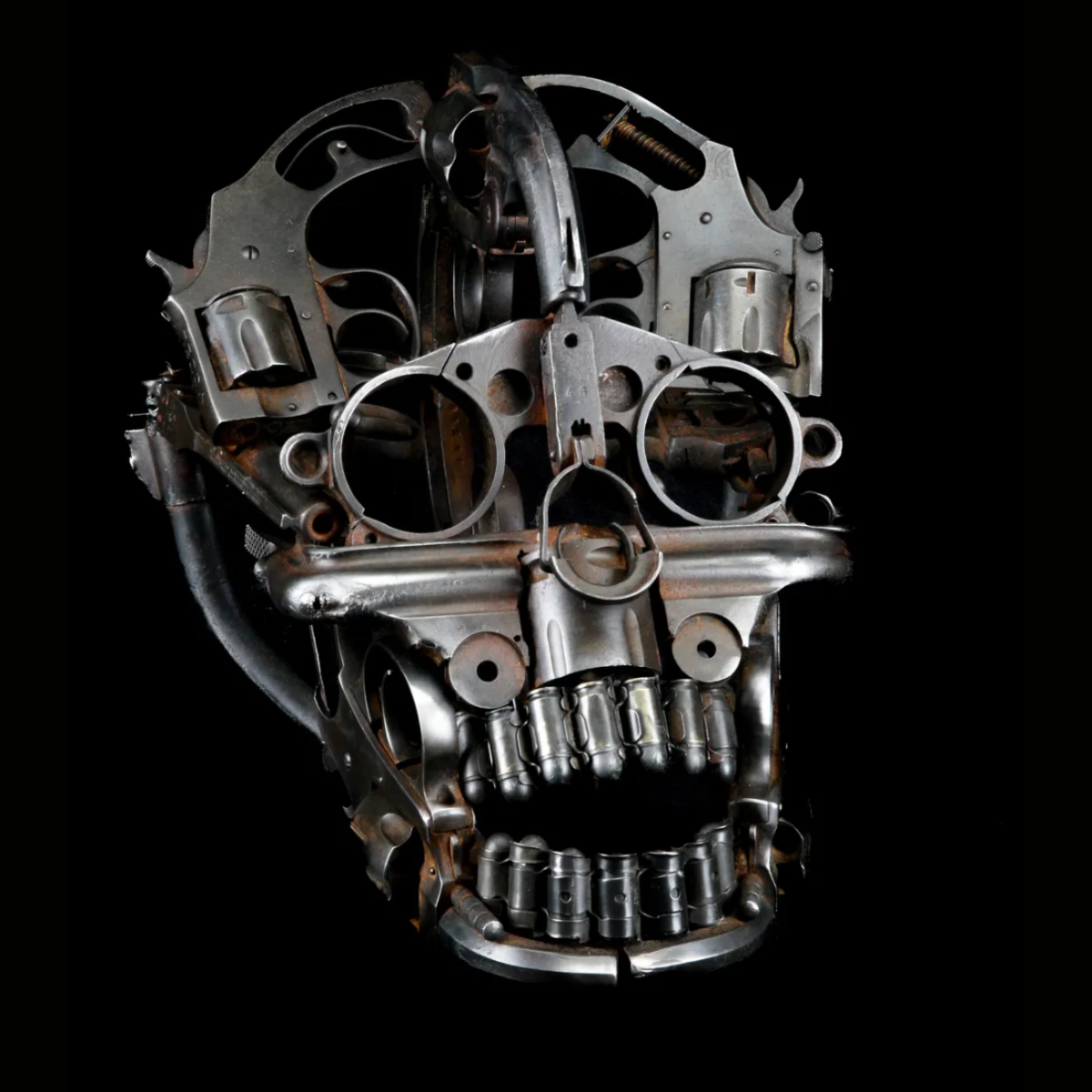
It’s Not Dark Yet, Al Farrow’s solo exhibition, features a sculptural bestiary of animal skulls made from Farrow’s signature guns, munitions, and bullets. Throughout the North Gallery, these sculptures sit atop pedestal and wall mounts like hunting trophies, but with a darker edge.
Farrow writes: “After deciding to end my ‘Reliquary Series’ a year and a half ago, I found myself with a lot of leftover materials. I have always been playful with whatever materials I work with, so I decided to play with these leftovers—creating whatever they suggested without buying anything more. Just like being creative with leftovers in the kitchen, I combined elements in new ways to create things I had never thought of before. I started by making gun heads, but soon after, I began making skulls; first human, then animal. I had fun creating these odd pieces, but after several were done, I realized that for me they were memento mori (reminders of death). This aligns with a couple of thousand years of tradition in art, from the ancient Romans through the Renaissance and Medieval periods to contemporary times. I have a large table in my studio on which I put hundreds of guns and gun parts. Coming to work every day, I would look at the materials and start moving them around to create various juxtapositions, changing them until they suggested something interesting.”
The resulting sculptures mark an important new body of work for Farrow, which the gallery presents alongside his last reliquary—named accordingly—which is a towering Gothic chapel housing the fibula and tooth of Santo Guerro, Farrow’s imagined “god of war,” amidst a pile of bullets and shells.
Farrow’s exhibition also features two important musical instruments made from the same materials—a full-scale cello and violin, inspired by Violins of Hope. Violins of Hope is a poignant collection of over 70 Holocaust-era string instruments recovered and painstakingly restored by Israeli luthiers Amnon and Avshalom Weinstein. The project was catalyzed in the late 1980s when an Auschwitz Men’s Orchestra survivor brought a damaged violin to Amnon’s workshop, asking him to restore it for his grandson. Overcoming the immense grief of losing 400 relatives to the Holocaust, Weinstein lovingly repaired it, realizing these instruments bore vital witness to the concentration camps. There, music existed in a harrowing duality: weaponized by the SS yet seized by prisoners for survival and spiritual resistance. By returning these restored instruments to global concert stages, the project ensures that voices once silenced by tragedy now resonate as a monument to human resilience