
Zedekiah Gonsalves Schild: A Verb Meaning to Wash One’s Wounds in an Ocean @ Slash
A Verb Meaning to Wash One’s Wounds in an Ocean is an installation by Zedekiah Gonsalves Schild exploring the ways ecological upheaval connects to bodily vulnerability and unruliness. The exhibition’s title came to the artist after seeing an image of a man, his arm gravely injured, instinctively rushing to hold his wound in the sea.*
The installation includes a series of sculptural videos exploring healing, labor, incarceration, and the natural world. They bring together footage of flooding in Oakland and rural Arizona shot by the artist between 2023-2026, bodily wounds, and site specific performances. Gonsalves Schild is interested in how a flood or a disabled body become unruly only in relation to a specific norm. The videos are embedded in sculptures made of Batu mahogany, a dense hardwood traditionally used in maritime construction, or displayed on the only TVs allowed in prisons, encased in transparent polycarbonate.
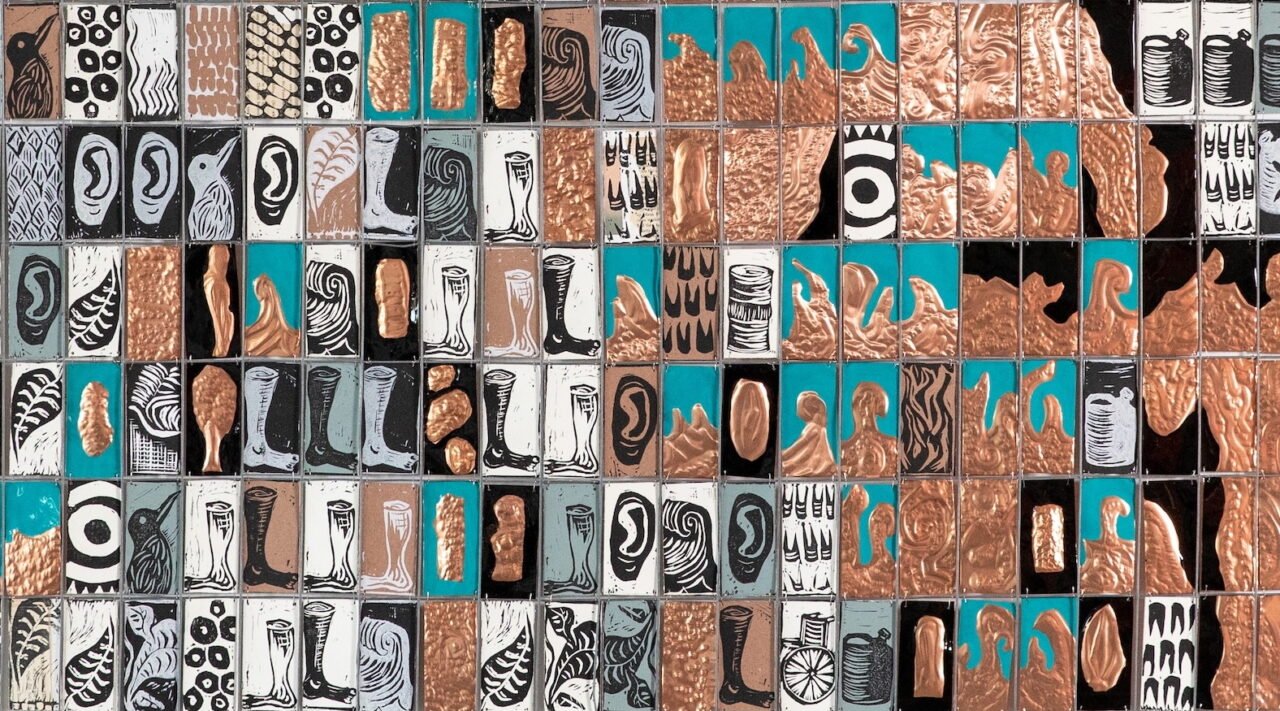
Accompanying the videos are multimedia wall works—grids of symbolic information that function as “maps” of the artist’s own debility and as navigation aids to the exhibition. Made of relief prints, hammered copper, and found materials, they feature recurring motifs, narrative keys including a wave, a leg, a wheelchair, and a six gallon water container. Their repetition mirrors the artist’s material process, the elusiveness of healing, and the way harm to human bodies is an extension of the systems that harm the earth.
*Image in Dionne Brand’s A Map to the Door of No Return, p. 11.
Zedekiah Gonsalves Schild is a disabled, post-disciplinary artist and writer who lives and practices in Oakland, CA. He worked as a laborer and builder until 2019, when he was debilitated by a spinal fracture and spinal cord injury. His artistic work interrogates disability aesthetics while exploring the politics of laboring bodies, debilitation, and the natural world. His art, research, and writing on disability aesthetics are situated at the intersections of disabled ecologies, debilitated bodies, and identity.