
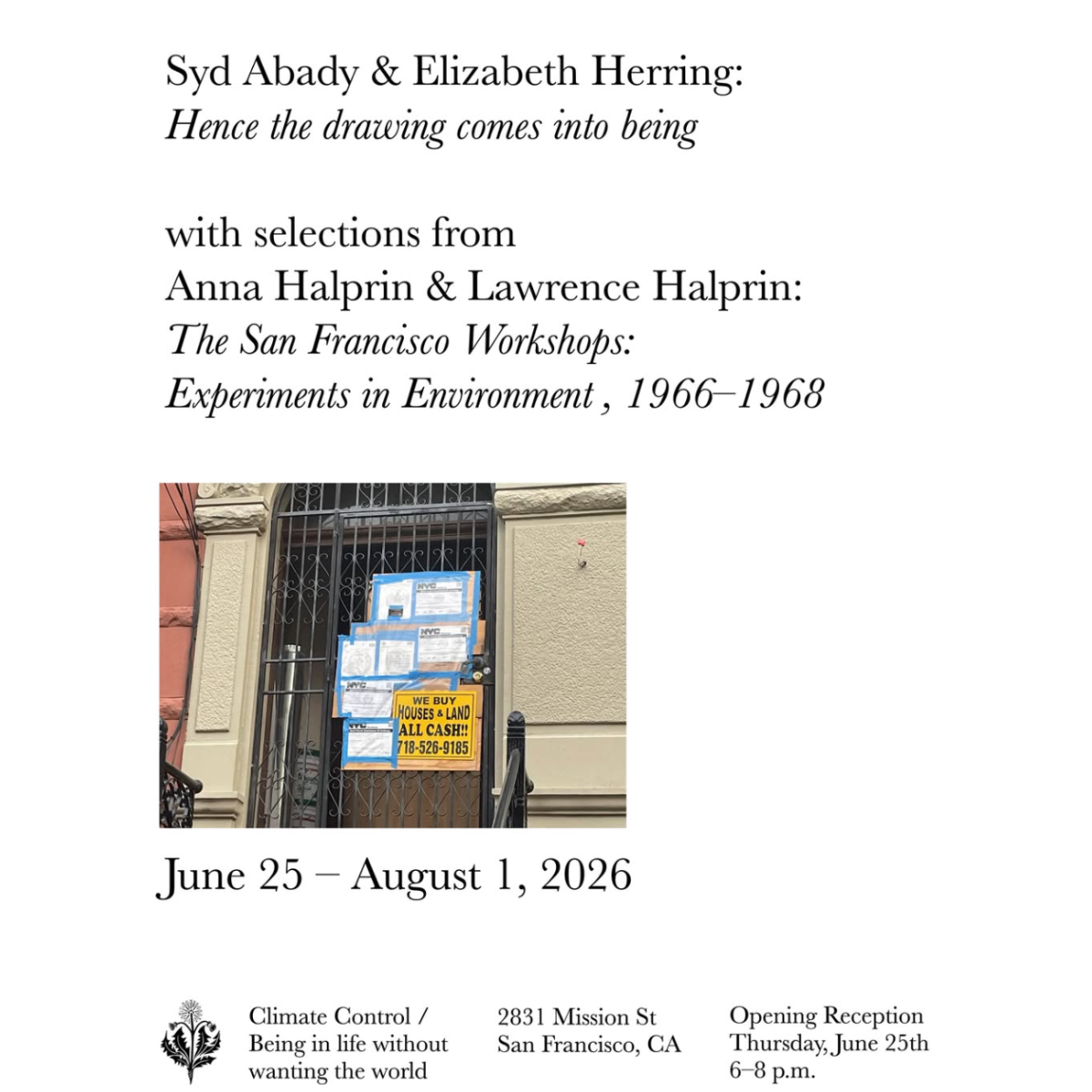
Syd Abady & Elizabeth Herring: Hence the drawing comes into being @ Climate Control
Climate Control presents, Hence the drawing comes into being, a two-person exhibition of works by artists Syd Abady and Elizabeth Herring and selected images from Anna Halprin and Lawrence Halprin’s San Francisco Workshops: Experiments in Environment, 1966–1968.
“Hence the drawing comes into being” is a phrase I found a week ago on some didactic material at the MAAT museum in Portugal. I have taken it directly off that label, which spoke to the work of artist Helena Almeida. It described her investigations in the 1960s, into the formation and signification of authorship–its entanglements, its commands, and its naturalization. In this exhibition, Abady’s and Herring’s works begin inversely: from the position of that which has been authored already, listlessly, critically, and playfully looking for origin. Their work looks out from the already-naturalized, to understand how it came into being, and how it moves us, today. This is both artists' first presentation with the gallery.
Syd Abady’s cross-stitches and cross-stitch embroideries trace the blue tape used to adhere building permit notices onto apartments, ubiquitous across New York City where she lives and works. Blue tape is unpretentious, always available and it sustains the ordinance of thousands of homes. The tape is made anew in textile form. Textiles slow the world around us. They, like analog photography, demand time in their production. The textile is moveable, malleable, warming, and the photograph is replicable, responsive, and observant. Elizabeth Herring’s series of silver gelatin prints closely read the landscape of California’s central coast. She hand-tints her prints with oils, illustrating red arrows across the flora and fauna of the region. The red arrow is a speculative bargain, a possibility. It is pervasive and universal. It is an indicator of sale and it asks us to attend, to visit, and to look. Its choreographic device separates us–viewers–from what is indicated–land.
Abady and Herring reach for the literal sign in this exhibition, interrogating the construction of ‘home’ through the signage used in denoting private property: its jurisdiction, management, habitation, and documentation. Both artists are interested in a concept of habitability; of looking at how we make the world habitable to ourselves, and how the systems we live within at present resist our own habitations through alienating neoliberal orders. The artists use mediums of repetition, of return, and replication. Their generative practice is like a ritual. (Syd embroiders in public spaces–on the train for instance–recording her return to various sites through a text app, also on projected view in the gallery) Ritual is an un-alienating process, meaning that, as one returns to something again and again, discovery and comprehension of the world become more familiar, more regular, and less irrational. They situate, they make us at home in the world. In the artist's pursuit of the literal sign, an attachment to life is found.
Signs can be warnings, but those picked here are also optimistic. Being in life without wanting the world, the final chapter of Lauren Berlant’s On the Inconvenience of Other People, and the very chapter that gives our gallery one of its three names, is broadly about a kind of dissociation prompted by the oversaturation and demands upon the subject of life in modernity today. She says that this happens when the world becomes overclose, “it is what happens after a sensual circuit breaker trips and dislodges confidence in anchoring, world-propping objects.” (133). The signs these artists look to, like Berlant’s world-propping objects, are things that are both indicators of and disrupters to home. We see a kind of overcloseness observed in bittersweet desire; reaching for a home-site while acknowledging its entrapment in broader systems of inequality and extraction. These works mostly, formally, reproduce the signs they examine. The arrow and the post–these can denote possibilities, or at least we would like them to. We would like each arrow to indicate progression, to signal to every thing and person and all natural orders, creatures, and delights in the world that they have what being at home might promise.
The Bay Area is full of signs I do not understand. Billboards line our roads with acronyms about businesses conducting businesses without human input. I can’t identify with them, I don’t know when and where they come into being, and they change too often for me to catch up. I do know that they block out patches of the city I yearn to see when I sit in traffic on the 101, I do know that they disrupt my ritual, communing in commuting. They estrange me from a place I demand is my home. They are overclose.
In relay with the works in the front gallery, on view in our backroom, is a rotating projection of slides from the late Anna and Lawrence Halprin's, San Francisco Workshops: Experiments in Environment, courtesy of the University of Pennsylvania Architectural Archives. Anna and Lawrence Halprin moved to the Bay Area in the 1940s following the end of WWII where they had profound and lasting effects on the region and on the arts internationally. In the late 1960s they habitually organized a series of six-week cross-disciplinary workshops in San Francisco and up the California coast. Dancers, architects, environmental designers, artists, and the like engaged in movement sessions, blindfolded walks, collective building projects, and observational journeys through beaches, city streets, the couple’s Sea Ranch cabin, and Anna’s Dance Deck at their home in Kentfield, Marin County, fostering collaboration and group creativity. Through “scores” that specified when and where–but not exactly how–to perform exercises designed to engender and encode participants within an environmental awareness, these workshops led to the Halprin’s creative process of notating movement called “motation” and to a system for collaborative movement building titled the “RSVP" Cycles” (Resources/Scores/Valuaction/Performance).
These workshops rendered the environment both strange and familiar, exploring it, describing it, responding to it–finding ways of making community at home in the world. Throughout our exhibition’s run time, artists including Ishan Clemenco, Pilar Herrera Land, and Clare Hu will be adding pieces responding to the concepts of desiring and reorienting oneself within environment, and such the world. In their context, the exhibition is inspired by the Halprins’ experimental approach, like being drawn or drawing into being.
–Emily
--
Syd Abady (b. 1996, Los Angeles, lives and works in New York) is a textile artist whose practice examines the varying social, economic, and civic conditions and constructions of “home.” She obtained a BFA from the Rhode Island School of Design in 2018 and was a Fulbright scholar in 2024 in Chile. She has exhibited work at MoMA (New York, NY 2025); A-Z West (Joshua Tree, CA 2024); The Bronx Museum (New York, NY 2024); Ojai Arts Initiative (Ojai, CA 2022); and LAMOCA (Los Angeles, CA 2014). She has participated in residencies at the Bronx Museum, Museum of Arts and Design (MAD), Penland School of Crafts, Haystack Mountain School of Craft, and Andrea Zittel’s Work-Trade at A-Z West.
Elizabeth Herring (b. 1991, Los Angeles, lives and works in Ojai) is an artist working in photography, sculpture, and installation living in Ojai, California. Herring's practice often touches on social networks and community organization. From 2023-2025, Herring co-operated Spore Space, a project space for emerging artists in Ojai. Herring holds an MFA from The California Institute of the Arts, certification from the International Center of Photography, and a BA from NYU Gallatin. Her work has been exhibited at Curveline Space, Los Angeles, The School for Rural Culture and Creativity, Matfield Green, KS, The Basic Premise Ojai, CA, Cashmere Radio, Berlin DE, and Helen's Costume, Portland, OR. Additionally, Herring’s photographs have been published in The Editorial Magazine, Zweikommasieben, Sleek Magazine, Esquire, and Vice.
--
Anna Halprin (1920-2021) was a dancer, choreographer, and pioneer of avant-garde dance. She founded the San Francisco Dancer's Workshop in 1955 and the Tamalpa Institute in 1978. Anna created 150 full-length performance works, including Trance Dance, City Dance (1965-78); Parades and Changes (1965-67); Circle the Earth (1981); and Planetary Dance: A Call for Peace (1987). She is the author of three books on her own work and contributed to Taking Part: A Workshop Approach to Collective Creativity (1975) and The RSVP Cycles: Creative Processes in the Human Environment (1969). She was awarded a Guggenheim Fellowship for Creative Arts (1970); the Samuel H. Scripps/American Dance Festival’s Lifetime Achievement Award (1997); a National Endowment for the Arts “American Masterpieces” award (2008); and the Doris Duke Impact Award (2014), among others. Halprin’s work was included in the 2011 exhibition, West of Center: Art and the Countercultural Experiment, 1965-1977, at the Museum of Contemporary Art, Denver, Colorado. In 2014, she performed Festival d’Automne à Paris at the Centre Pompidou, Paris, France. Her work is included in the collections of the San Francisco Museum of Modern Art and the Museum of Performance and Design.
Lawrence Halprin (1916-2009) was a leading figure in American landscape architecture, urban design, and environmental planning during the second-half of the twentieth century. Halprin’s best known works include Lovejoy Plaza, Portland, Oregon (1961-67); Ghirardelli Square, San Francisco (1962-68); Sea Ranch, Sonoma County, California (1962-67); Skyline Park, Denver, Colorado (1970-74); the Franklin Delano Roosevelt Memorial, Washington, D.C. (1976-1997); and Lower Yosemite Falls (2005), among others. He was awarded the AIA Medal for Allied Professions (1964); a presidential appointment to the first National Council on the Arts (1966); the ASLA Gold Medal (1978); and the National Medal of the Arts (2002), among others. Halprin’s publications include Cities (1963); The RSVP Cycles: creative processes in the human environment (1969); Notebooks: 1959-1971 (1972); Taking Part: A Workshop Approach to Collective Creativity (with Jim Burns, 1974); and A Life Spent Changing Place (2011), among others. Lawrence Halprin’s archives are located at The Architectural Archives of the University of Pennsylvania, and his work is included in the collection of the San Francisco Museum of Modern Art.