
Out at Sea @ Sarah Shepard Gallery
A group show featuring Lauren Bartone, Dora Somosi, Lena Wolff & Diane DallasKidd
Sarah Shepard Gallery is pleased to announce Out at Sea, a group show featuring works by Lauren Bartone, Diane DallasKidd, Dora Somosi, and Lena Wolff. The diverse pieces included in Out at Sea span from photography to textile work, brought together by a shared interest in handwork and a reverence for botanical materials. While Bartone, DallasKidd, and Wolff are local to the San Francisco Bay Area—Marin and Berkeley, respectively—Somosi joins from the East Coast, living and working in Brooklyn, NY. These four artists draw inspiration from quiltmaking, weaving, and the land, nimbly displayed in Bartone’s hand-dyed and sewn linen and cotton canvases, DallasKidd’s thread-bound works, Somosi’s embroidered cyanotypes, and Wolff’s hand-cut collage. A shared love of blue hues also threads through the works included in Out at Sea: they compliment each in their material structure, offering a measured antidote to aimlessness.
Three of Somosi’s hand-embroidered cyanotypes, Mending Sugar and Mending Kamani 1 and 2, are featured in Out at Sea. These embroidered works were born out of Somosi’s By Her Side series, a collection of cyanotypes of trees from the homes and studios of influential women artists and thinkers. The Mending pieces put an enchanting spotlight on the branches and vegetation of the trees with their moon-like framing and embroidered embellishments, which take on a tint from botanical dyes, such as madder root, which Somosi uses to hand-dye thread. As a Hungarian-American artist, Somosi’s use of embroidery, integral to Mending, reflects a tradition deeply rooted in Hungarian folk art where women expressed creativity, identity, and connection through embroidery. These layers of history unfold in Somosi’s images, interrupted and heightened by her embroidered additions.
Bartone’s textile-inspired canvases also highlight the meeting point between botanicals and histories, creating stories in the seams. Bartone’s work is informed by her concurrent pursuit of a doctorate in Italian Studies, through which she considers narratives of Italian national identity and cultural exchange. These histories—and the histories of craft and creativity, particularly within domestic settings—shape her patchwork canvases, January and Weave and Dodge. Bartone uses dyes such as indigo, weld, walnut, and kermes to color the cotton and linen swatches, which are sewn and hand-stretched. Somewhere between painting and textile, these structured canvases weave together history, color, practice, and material.
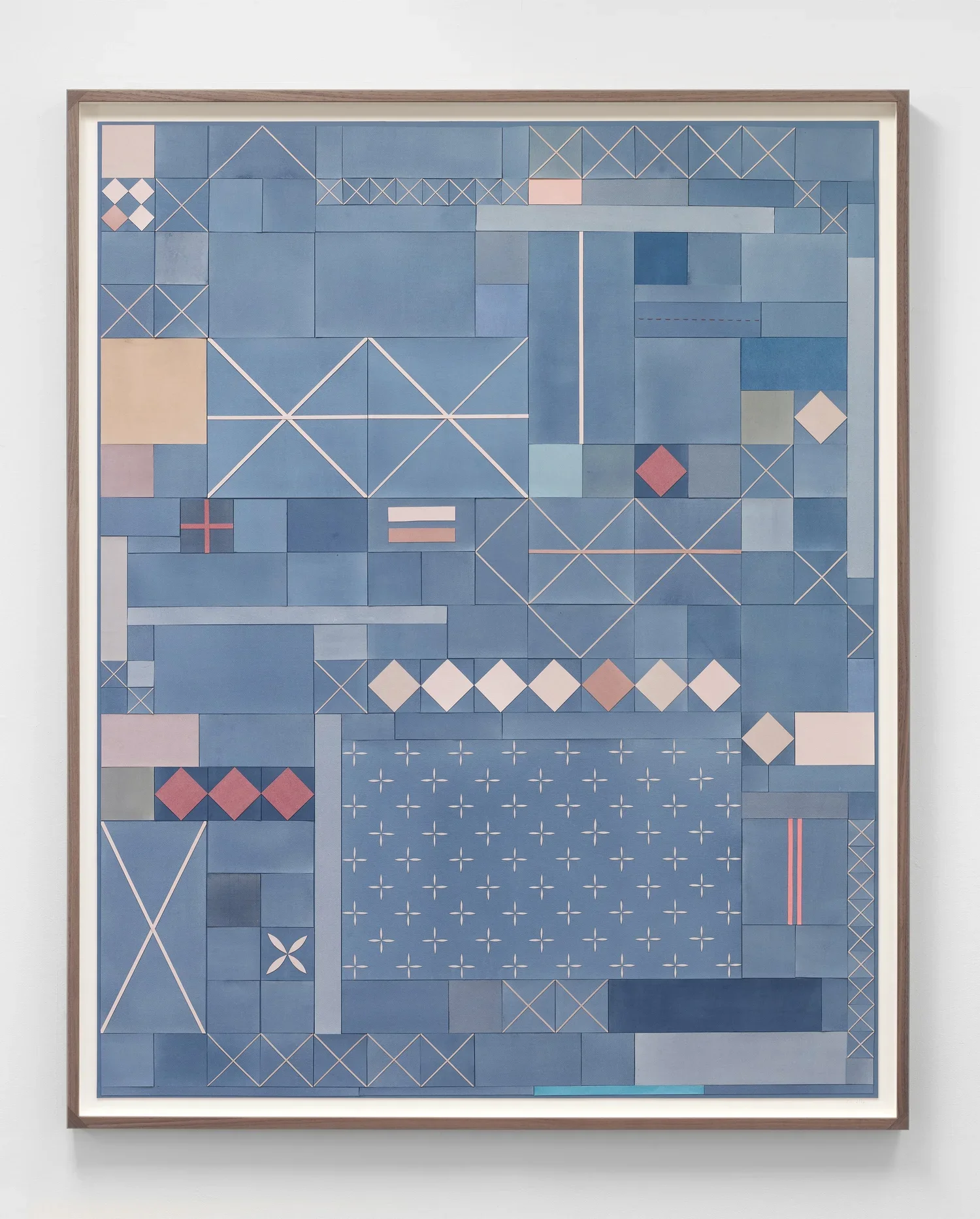
In harmony with Bartone and Somosi’s pieces, Wolff’s nearly 5x4 foot hand-cut paper collage, Landscape (Eames Ranch), returns to her distinctive lexicon, strongly rooted in aesthetic and practice of American quiltmaking: geometric forms, radiating shapes, and cross-stitches bound by the grids. This momentous piece was completed during the inaugural Ranch Studio Artist Residency at the Eames Institute’s Petaluma ranch. Through the support of the Institute’s agricultural program, Wolff had the opportunity to engage in foraging and dye-making, a process in parallel with both Bartone and Somosi’s practice. The patchwork of periwinkle squares in Landscape pulls out the vibrant prussian blue of Somosi’s cyanotypes and the earth-tones of Bartone’s canvases.
DallasKidd’s practice shares an interest in both craft and natural dye processes, taking inspiration from Japanese textile techniques. Traditional dye and textile methods provide a foundation for DallasKidd’s cloth and fiber-based work, which explores the boundaries and seams of craft and contemporary art. Constellation, included in Out at Sea, uses linen threads and acrylic paint to make a textured web of indigo, dotted with strobe-like stars of white.
Wayfinding icons—stars, moons, and grids—appear across the works in Out at Sea, which are anything but adrift. Bound by blue hues, a shared appreciation for handcraft, and a dedication to material structure, these pieces evoke progression and sureness, suggesting ways to navigate the seemingly current, constant, and collective feeling of losing one’s bearings.
Lauren Bartone is a Bay Area-based artist who works in an interdisciplinary balance between studio-based work, archival research, and public engagement. She initially studied painting in Florence, Italy, followed by a BA in fine art from UCLA in 2002. Bartone also received an MA in Education from UC Berkeley in 2005 and an MFA at Vermont College of Fine Arts in 2012. She is a current PhD candidate in the Italian Studies Department at UC Berkeley, with a designated emphasis in folklore. Her research focuses on the visual and material culture of Sicily and the Southern Italian diaspora. Bartone’s community-based and collaborative projects include two mapping series: A City in Maps (2015) produced as the artist in residence at the deYoung Museum of Art in San Francisco; and Paradise, A Map for the Centennial of the Panama Pacific International Exposition and SF New City Atlas for the Art on Market Street poster series with the San Francisco Arts Council. Additional artist residencies include Kala and Art Works Downtown in the Bay Area, and at the Orto Botanico of Palermo, in Sicily. Solo exhibitions include 16 Tons (2018) at the College of Marin Gallery and De Rerum Natura at Park Life Gallery (2022). Her work has been generously supported with grants by the Pirkle Jones Foundation, the Marin Arts Council, the VCFA Levin/Lutz Award, the Center for Interdisciplinary Critical Inquiry, and Global, International and Area Studies at the University of California, Berkeley.
Diane DallasKidd is a San Francisco native. DallasKidd graduated from San Francisco State University with a BFA in Textile Art. Her work addresses the boundaries of craft and contemporary art. DallasKidd traveled to Japan to study under Tsuyoshi Kuno, a fourth generation master dyer who has adapted centuries-old techniques to create new materials. Her work has been shown in galleries nationally and throughout the Bay Area, including recent exhibits at the Minnesota Street Project and Root Division in San Francisco and the Marin Museum of Contemporary Art.
Dora Somosi is a Hungarian-American lens-based artist living and working in Brooklyn and upstate New York. Her work has been shown widely at such venues as Klompching Gallery, Sarah Shepard Gallery, Carrie Haddad Gallery, The International Center of Photography (ICP), Center for Contemporary Printmaking, Penumbra Foundation, Bolinas Art Museum, and the School of the Museum of Fine Arts, Boston. Her photographs have been published in The Atlantic, The New York Times, T Magazine, and elsewhere. Somosi’s works are part of collections of notable New York and Los Angeles collectors and interior designers, including Trustees of the Brooklyn Museum, BRiC Arts, and the Brooklyn International Studio and Curatorial Program.
Lena Wolff is an artist, craftswoman, and activist for civic engagement. She was born in Larkspur in 1972, and spent her childhood living semi-communally with her family at the Zen Center of Los Angeles, later living in Paris and outside of Amsterdam. She has been based in the San Francisco Bay Area since the early 1990s. Wolff received a BA in English and Creative Writing from Mills College (1995) and an MFA in Printmaking from San Francisco State University (2003). Wolff pursues a range of disciplines, including drawing, collage, sculpture, murals, text-based pieces, and public art, and is inspired by American folk-art traditions, minimalism, geometric abstraction, and Op art. Her work has been presented in galleries and museums across the US and collected by ONE National Lesbian and Gay Archives, San Francisco Museum of Modern Art, Oakland Museum of California, the San Francisco History Collection at San Francisco Public Library, San Francisco Arts Commission, Alameda County Arts Commission, Cleveland Clinic, University of Iowa Museum and the Zuckerman Museum of Art,