
Nancy Friedemann-Sánchez: Arcane Appetites @ Rebecca Camacho Presents
Rebecca Camacho Presents is pleased to announce Arcane Appetites, Colombian-American artist Nancy Friedemann-Sánchez’s first solo exhibition at the gallery. Engaging a research-based, interdisciplinary practice that investigates the complex intersections of migration, identity, gender, cultural memory, and the effects of colonization, Friedemann-Sánchez’s installation fills both the gallery’s main exhibition space and Project Room.
Growing up in Bogotá as the child of a Colombian and a United States citizen, Friedemann-Sánchez emigrated to the US in early adulthood, as political unrest enveloped her native country in the mid-1980s. After 21 years in New York City, Friedemann-Sánchez settled in Lincoln, Nebraska in 2011, where she continues to live and work. Informed by her own migrant experience, Friedemann-Sánchez’s practice centers the syncretism and hybridization of cultures resulting from the conquest and colonization of the Americas. Her powerful large-scale paintings allude to Baroque maximalism and the pattern and decoration movement while also exploring personal heritage and connectivity through works that combine Colombia’s material culture, history, and natural world.
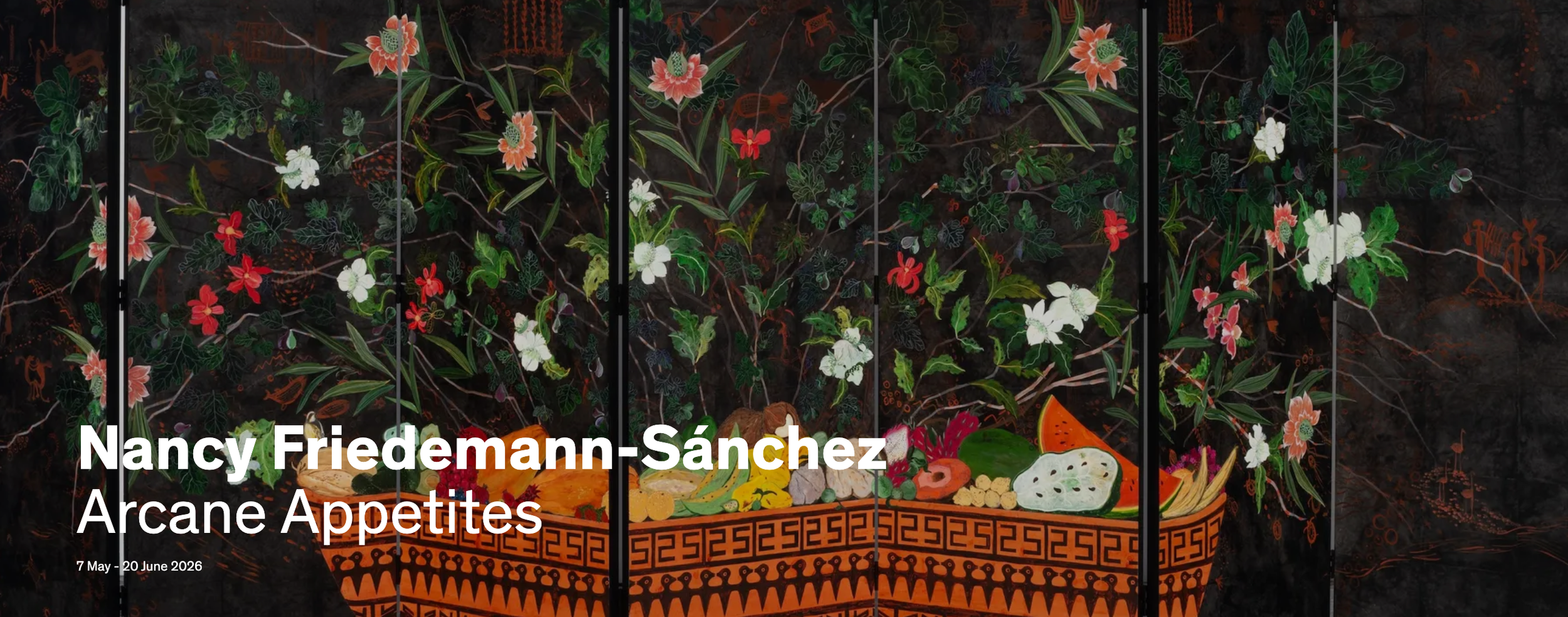
The exhibition is rooted in Friedemann-Sánchez’s ongoing Dream Map and Cornucopia series; ornate collage still-lifes created by reinterpreting Barníz de Pasto, also known as Mopa Mopa, a millennia-old craft process utilizing a natural resin, from the Mopa Mopa tree indigenous to the Putumayo basin in Colombia, to mimic Chinese lacquer.
Comprised of pieced Tyvek, an oil-derivative paper that stands as metaphor for the continued extraction of land and people, and ink, Dream Map and Cornucopia works investigate the colonial roots of still-life as a painting genre and the intermingling of pre-contact artforms, Spanish colonial aesthetics, and Asian decorative practices that came together during increased global commerce in the colonial era. Each Dream Map and Cornucopia collage begins with an image of a ceramic vessel that speaks to the complex history of Latin America and its diaspora. Friedemann-Sánchez then transforms that vessel into a bountiful cornucopia, bursting with flora and fauna evoking Colombia’s rich ecosystems. The collaged ornaments, animals, and flowers that populate each work are researched, interpreted, painted, cut, and glued in reference to Barníz de Pasto. In concert with the collage, Friedemann-Sánchez paints referential imagery throughout the Tyvek background, resulting in a deep historical palimpsest of cultural memory; telling stories of colonization, abundance, and extraction via imagery that is layered, tactile, luscious and monumental.
A seven-panel free-standing screen, or biombo, titled Batea with Figs holds the center of the gallery. The word biombo is a Hispanization of the Japanese byobu, which can be translated as “protection from wind.” The first byobu arrived in Mexico City as early as 1614 via the Manila Galleon trade and quickly became highly sought after luxury items. These screens, originally imported from China to Japan in the eighth century and made of separate folding panels hinged together, were used within homes to divide or enclose interior spaces. Japanese screens typically featured landscapes with people or animals, but biombo made in Latin America featured secular subjects set within a city or landscape. The content in Friedemann-Sánchez’s Batea with Figs is a cross-pollination of personally significant imagery, including magnolias from a tree outside of her Lincoln studio; figs from a tree in her childhood garden; orchids, the national flower of Colombia; and a Meadowlark, the state bird of Nebraska. The screen verso features multiple sets of small eyes, talisman of protection and peace.
In the Project Room, Friedemann-Sánchez installs a suite of smaller, detail-focused Cornucopia works, allowing intimate inspection of select vessels and their bounty.