
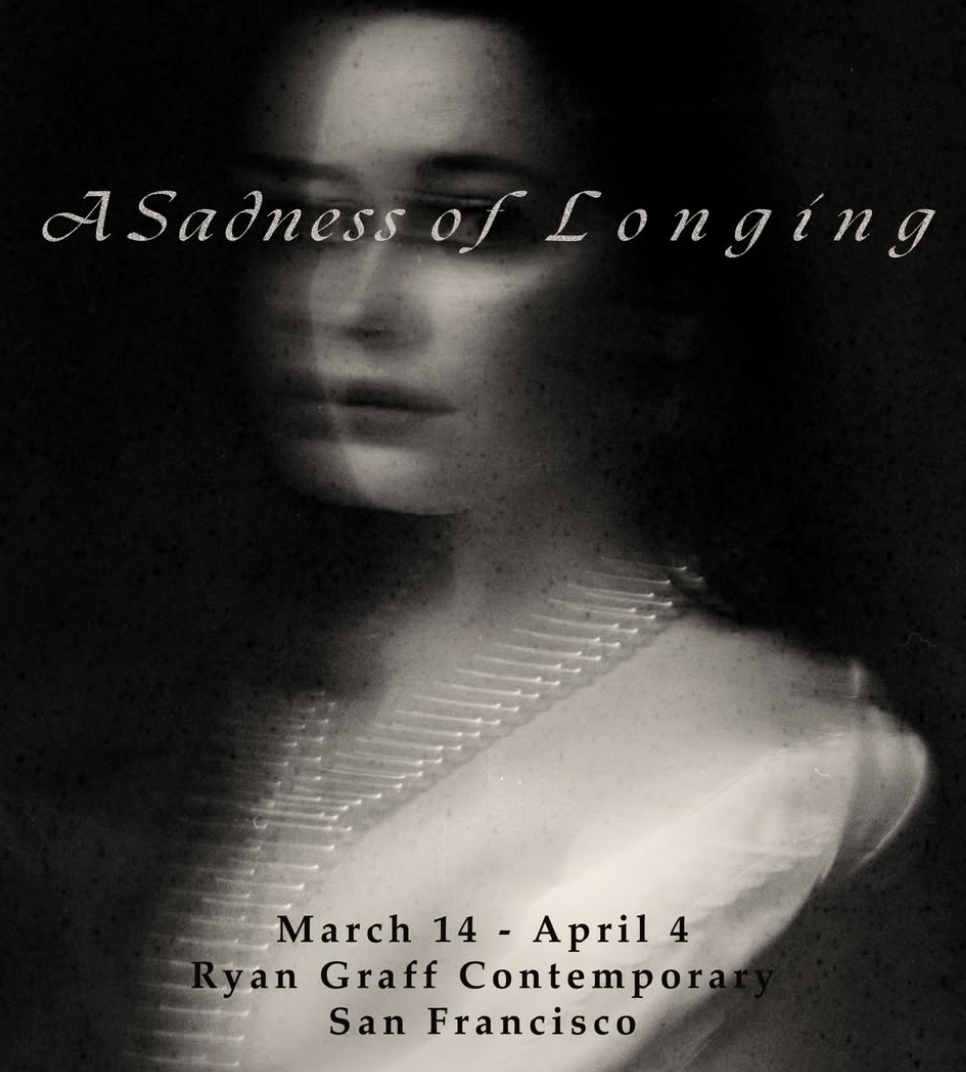
Michael Ash Smith: A Sadness of Longing @ Ryan Graff Contemporary
We’re delighted to open our very first exhibition with Michael Ash Smith, featuring an evocative series of works inspired by Brazilian novelist Clarice Lispector.
Smith employs an ink transfer process, during which flaws and imperfections are organically introduced into the foundation image, creating a unique work. This work is then further modified using oil paint and charcoal before being sealed with barite.
“It wasn’t a difficult sadness. It was more like a sadness of longing. She was alone. With eternity in front of and behind her. The human is alone.”
–Clarice Lispector
In three books by author Clarice Lispector—An Apprenticeship or the Book of Pleasures, Agua Viva, and A Breath of Life—longing is not a problem, it’s a reason to be alive. Lispector doesn’t always give her characters clear answers or resolutions. Instead, they linger inside questions, often uncomfortably. They lie in wait. They sit in the space between what is felt and what is said. She leaves the interpretation up to you, the reader. In An Apprenticeship, longing is a slow learning. Love is approached very carefully, in a way, fearfully, as something that requires patience and self-awareness. In Agua Viva, longing shifts inward. The narrator reaches for the present moment itself, trying to capture something that can easily disappear. In A Breath of Life, longing appears as separation. A creator and her creation revolve around each other, suggesting that even within the self there is division. To exist is to feel that split.
This exhibition brings these tensions together. It explores the spaces Lispector returns to again and again: between self and other, word and silence, presence and absence. Longing becomes both an ache, and awareness. It reveals how deeply we want to connect, to touch, and to converse, with another person, while recognizing that complete unity may be impossible. The sadness in this longing is not despair. It should be seen as clarity. It is the understanding that desire arises from distance, from what we cannot have, and that distance shapes who we are. In remaining available and open to that space—rather than trying to close it—we encounter something honest and enduring.