
By appointment only, book appointment here.
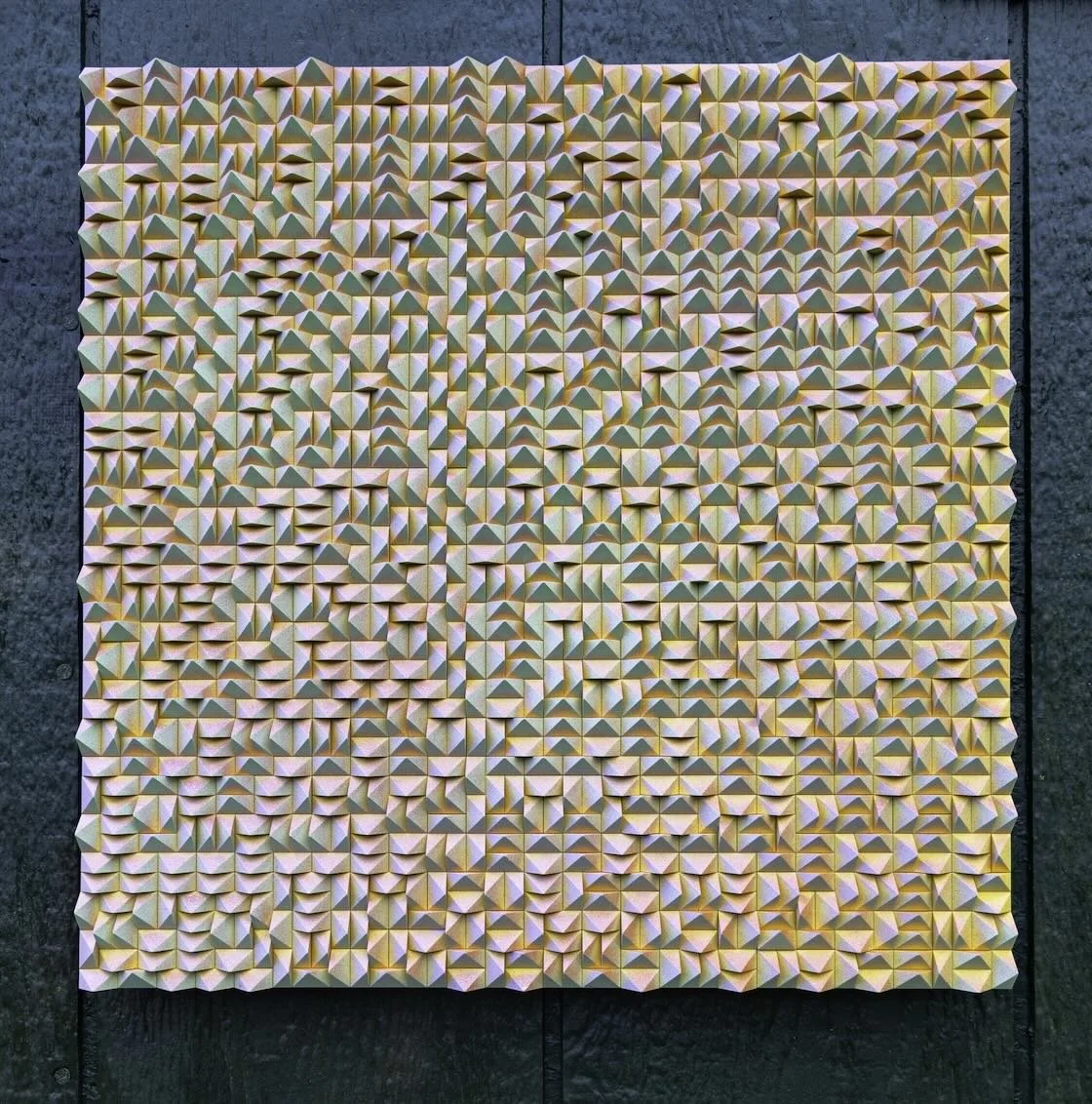
Heron Arts is pleased to announce Grid Memories, a group exhibition featuring Alexis Arnold, Gina Borg, Katherine Duclos, and Kim Bennett. Each artist featured in Grid Memories employs the process of repetition and the utilization of structured foundations, transforming their creative practice into a shared fabric of memory. They use their unique perspective to unravel and reweave color relationships, spatial awareness, the passage of time, and shifting art history to uplift the underappreciated aesthetic of textile work.
Together, the works trace how grids and bricks — often symbols of order and stability — can also be porous, playful, and generative. By reworking the meaning of these forms to carry memory forward, Grid Memories highlights the creation of new visual languages out of familiar structures. The manipulation of materials, e.g. pulp and pigment, Lego bricks, thread, and paint, can transform not only the surfaces we see but also the ways we remember, imagine, and engage with space and each other.
ARTIST BIOS
Alexis Arnold is a mixed media visual artist in Oakland, CA. Her artwork has been exhibited nationally and internationally, including the Crystal Bridges Museum of American Art, Aspen Art Museum, the Contemporary Jewish Museum, Napa Valley Museum, Whatcom Museum, Beaux-Arts Mons Belgium, Atlanta Airport, Bergdorf Goodman, di Rosa, The NY Hall of Science. Alexis’ work is included in the collections of SFMOMA, Meta, VCU, MediaMath, Costa Cruises, University of Pittsburgh, and others, and has received review in The SF Chronicle, The Wall Street Journal, boingboing, designboom, Colossal, Hi-Fructose, and more. She holds an MFA in sculpture from the San Francisco Art Institute, as well as BA in art from Kenyon College in Ohio.
Gina Borg is a painter who lives and works in Oakland, California. Born in 1973 in Sacramento, California, she received her BA in Fine Art from the University of California, Santa Cruz. Her work has been shown in solo shows in Los Angeles and San Francisco, and has been included in many group exhibitions. Recently, her work has been shown at the de Young Museum in San Francisco, Park Place Gallery and 1GAP Gallery in Brooklyn, NY, George Lawson Gallery in Emeryville, CA, and Sarah Shepard Gallery in Larkspur, CA. Her work is included in the collections of the Alameda County Arts Commission, UCSF Medical Center, Kaiser Permanente, and numerous private collections. In 2017 she was awarded a residency at Willapa Bay Artists Residency and in 2020 she was awarded the Oakland CARES Fund for
Artists Grant. Her work is engaged with color and light relationships through the medium of paint.
Katherine Duclos (b. 1980, Massachusetts) received her MFA in Painting and Drawing from Pratt Institute in 2011 in Brooklyn, NY. She moved from New York City to Vancouver, BC in late 2017 with her family, where she maintains an active multi-media studio practice delving into concepts of motherhood, identity, neurodivergence, materiality, and more. Her work is a reflection of her engagement with her family, environment and her experience as a gifted and disabled Autistic woman and mother.
Katherine’s work has been featured in Colassal, Design Milk, School Arts Magazine, Design Boom, LABEL Magazine, CBC Arts and Radio, The Globe and Mail, etc. At any given time, Katherine’s work can be found at a number of galleries across North America, but she is locally represented by The Rental and Sales Showroom at The Vancouver Art Gallery in Vancouver, BC. She has also worked as a teaching artist and artist in residence for Studio in a School in New York City, The Philadelphia Art Museum, and the Richmond Art Gallery. Her next solo exhibition is set to open on January 24th at The ACT Gallery in Mapleridge, BC and will run for 3 months.
Kim Bennett has a B.F.A from the Cooper Union and an M.F.A. From California College of the Arts, where she is an Adjunct Professor. She has exhibited her work in the Bay Area at Gallery 16, Stephen Wirtz Gallery, pied-à-terre and Interface Gallery, as well as Transmitter Gallery in New York and Conduit Gallery in Dallas. She is the recipient of a Creative Time commission, a Toby Devan Lewis Fellowship, and a Kala Parent Artist Fellowship. She lives in Berkeley, California with her husband, son and small dog.
ARTIST STATEMENTS
Alexis Arnold
My mixed media two-dimensional, sculpture, and installation work explores the subjective perception and experience of color, pattern, light, space, time, and material. I use and transform a variety of analog materials and processes to create stationary works that alter optically, appear kinetic through the movement of light or viewers, or seem digitally produced. I provide playful, optical works to inspire viewers to think about modes of visual perception, the physics of light and color, optical effects found in the everyday, and how visual and personal experiences may differ with context or from person to person. I’m interested in transforming the recognizable, recontextualizing the commonplace, and highlighting the possibilities of the material and processes I use in my work.
My work often references Op Art and Light and Space movements and uses pattern, grids, and color theory to explore perception across several media. I enjoy slight variations in patterns, color, texture, and repetitive gesture creating very different outcomes. I am drawn to grids as methods to organize space and play with perception. I enjoy that grids and patterns are repetitive while also offering endless options, and abstract while remaining organized.
Gina Borg
The perception of color is relative to any given color’s neighbors. I use paint to explore relationships between colors and light. I want to understand why color has the effect on our psyches that it does. I employ shifts of warm and cool tones within a limited palette, with subtle incremental changes that occur across the canvas. I layer and adjust repetitive marks until I recognize the parts cohering into a whole. Subtle tonal and temperature shifts in color create vibrations in the eye, weaving a tapestry of visual thrumming.
Katherine Duclos
My need to respond to the color and light and texture I see in the world is almost non stop. I am overwhelmed all the time when outside of my controlled environments because there is an almost compulsive desire to notice, collect, and rearrange all the colours I see. This first manifested as a need to document through photography, but the collection of images was not regulating enough and eventually became a source of overwhelm. Painting alone cannot solve this, nor can collage, because each comes with its own material dysregulations and limits. Discovering Lego is merely plastic modular color and does not need to be used to create 3D models of recognizable objects was a huge ah-ha moment for me in 2021, and thanks to my autistic son, who was 4 when he handed me 4 flat squares put together and said, “I thought you’d like these colours next to each other.” Lego was his special interest and how he demanded we spend all our time, but our capacities vary greatly for following the instructions - my brain cannot rotate images so I get lost and make mistakes, which would dysregulate him. Finding a way to work next to him, in my own way, was what our family needed. Several years later, this body of work has evolved to be a mainstay of my practice and life and keeps me regulated through dry repetitive action that offers me autonomy through infinite color arrangements.
Kim Bennett
I operate within a reimagined art history—as if women’s work had always been considered important and need not be revised. This fictive history provides a jumping-off point for my textile-based practice, in which I explore female creative production through embroidery.
In my imaginary art history, painting and textiles have always been on equal footing. My embroideries in this context refer equally to the history of stitching and to the history of painting. The history of embroidery is full of plans and patterns, many of which are adaptations or copies of paintings. My embroideries use pattern but also run loose and unplanned. Pattern offers a promise of merging with one’s environment: an endless generative potential.
At the same time, allowing pattern to go wrong, off-track, offers a jumping-off point between numbing coziness and terrifying infinity—a minute to think. I work at the place where the pattern or plan runs into the chance and mess of the material. I combine deliberate patterned stitches with less predictable fabric dyeing and sensitivity to the weave of the fabric.
In the process, I engage with and evoke a porous notion of self. In textile works, people across times and cultures have combined ideas and authorship to undermine patriarchal myths of authority. No one has the “right” answer. No outcome is certain. In my practice, incompleteness feels more human. People, in my experience, don’t add up. I work towards something lifelike and therefore contradictory.