
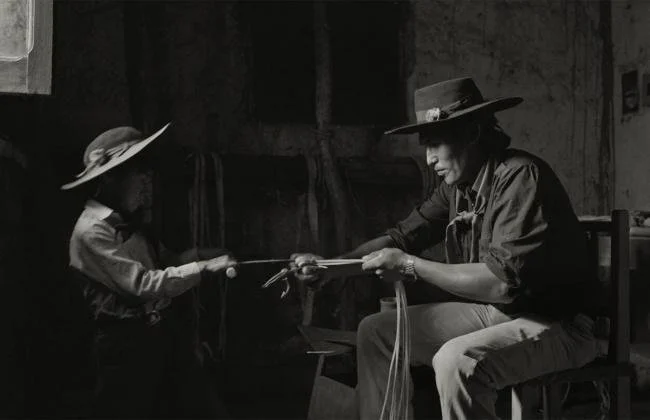
BAMPFA’s annual Documentary Voices series returns in February with a selection of classic and contemporary nonfiction films from around the world. The series begins with four programs that highlight compelling approaches to documenting different kinds of labor. Bay Area filmmaker Amy Reid presents her 2020 film Long Haulers, an exploration into the lives and labor of three women truck drivers, which plays with Katarina Jazbec’s investigation into the labor of lashers, who in the heavily automated environment of the port of Rotterdam, physically secure cargo. The great documentarian Frederick Wiseman’s 1980 film Model depicts the action around Zoli, a bustling New York modeling agency. A staple of fiction filmmaking since the birth of the medium, the skill and labor of contemporary cowboys and cowgirls is depicted in Gaucho Gaucho, which chronicles the everyday life of Argentine cowhands, and Ten Five in the Grass, which captures the preparations for a calf roping event on the Black rodeo circuit. The perilous work of journalism in a war zone has become even more deadly since the start of Israel’s bombardment of Gaza. Iranian filmmaker Sepideh Farsi’s Put Your Soul on Your Hand and Walk is a moving portrait of one of the hundreds of reporters killed there, photojournalist and poet Fatma Hassona.
Documentary Voices continues this spring with films about war and resistance. Jeffrey Skoller presents his latest portrait of a nonagenarian neighbor recounting his wartime experiences, along with Želimir Žilnik’s 1973 film made with survivors of the Nazi occupation of a town in former Yugoslavia. A program of films by Harun Farocki, Jill Godmilow, and Joyce Wieland offers thoughtful approaches to documenting war—in this case, the American war in Vietnam. Les Blank’s generous, humane approach to filmmaking, and his dedication to documenting traditional American cultures, is reflected in the works of Reid Davenport, the creator of award-winning films about the experience of being disabled, and BAMPFA’s 2026 Les Blank Lecturer. Davenport’s latest film, Life After, asks, why it is acceptable to give disabled people the means to die, before supporting them in the chance to live. The human, environmental, and cultural impacts of colonialism are addressed in different ways by Sammy Baloji’s The Tree of Authenticity, Jessica Beshir’s Faya dayi, and Lucrecia Martel’s Our Land/Nuestra Tierra. The series wraps up with Arthur Jafa’s 2013 essay film Dreams Are Colder Than Death, in which contemporary Black thinkers reflect on the legacy of Dr. Martin Luther King Jr.’s “I Have a Dream” speech.
—Kate MacKay, Film Curator
The Les Blank Lecture is presented with support of the Les Blank Fund. Hortense Spillers’s visit is in conjunction with her Una’s Lecture and supported by the Townsend Center for the Humanities. Lucrecia Martel’s and Ernesto de Carvalho’s visits are supported by the Center for Latin American and Caribbean Studies and UC Berkeley’s Department of Film & Media. Thanks to Brett Kashmere, Zachary Epcar, Canyon Cinema; Antje Ehmann, Harun Farocki GbR; Colleen Cassingham, Multitude Films; Rosa Spaliviero, Marek Szponik, Twenty Nine Studio & Production; and Sarita Žilnik.