
Editor’s Pick
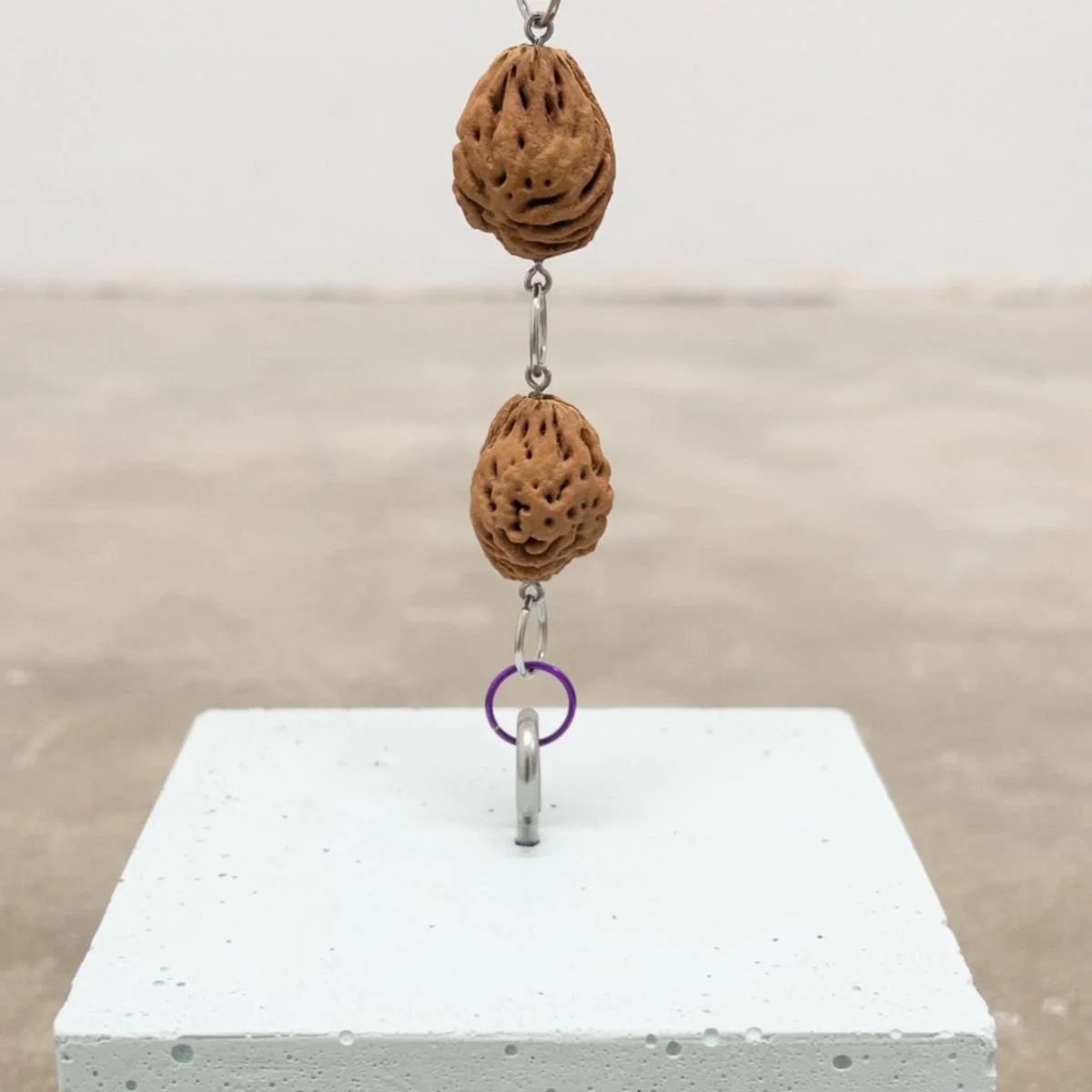
“Constellations imagine such wondrously simple lines across the vastness of space. And though geometry and angled abstractions can help us decipher the universe, the messy, often irregular rhythms of life draw their own cosmologies. The tambour of a heart, the tidal fluidity of bodies over time and through generations, and the plump potential of seed pods ready to burst also hold this rogue universe together. Claire Nereim's ‘Dust in the Door’ at SAFEMART is as much meditative essay (threading together Chicago architect Louis Sullivan and French physicist Jean Perrin) as it is elegant abstractions. The exhibition is appointment-only at a secretish location (a minor hassle), but trust us, it’s worth the simple line you draw to see it.”
-Andrew Berardini
About the Exhibition
“Sometimes, especially when I’m tired, looking into my newborn’s eyes feels like interspecies communication, underwater even. I often think about Z as a liquid creature. Recently, I suppose, she was.
The ocean is full of cetacean vocalization and clicking. Z will have no words for almost a year to come.
While I’m nursing around the clock and recovering from surgery in the summer heat I’ve been reading a lot to M (4) who has to sit next to me instead of on my sutured lap. We learn about the waggle dance bees use to communicate with the hive about the direction and distance of a rich flower feast.
“Remember the seed-germ,” Louis Sullivan wrote in A System of Architectural Ornament. This reminder is centered under a diagram on Plate 2, and appears again on Plate 5. “Remember the seed-germ.”
In Kindergarten Chats, when Sullivan wrote about his wish to harness the creative potential of nature, or “man’s instinct for reproduction,” meaning art-making, he did, specifically, mean men. In his writing, “nature” is coded as femme. The seed pod is kind of like a house full of energy, or maybe it’s more like a reproductive organ. It’s an object of desire. Spit out the pit. It’s compost.
This autumn the transitional kindergarten class talked about litter and Z (now 4) knows that everything ends up in the ocean. In the footnotes of a children’s book about the Atlantic, M (8) read about Panthalassa, the great global ocean before Pangaea split apart. When peaches are the school fruit snack my children save the pits and bring them home. Do the teachers think we are planting an orchard?
Behind my childhood home in Chicago lived two peach trees planted as grafted seedlings by the previous occupants. Nearby stands a small storefront with a terracotta façade designed by Louis Sullivan. A pale green jewel box, it is covered with sinuous lines, psychedelic seed pods and radiating near-fractal floral motifs.
Fractals are self-similar and incorporate chance. They can be curves, areas, surfaces, curdles. Some are better described as dusts. Sweep after breakfast, sweep after lunch, sweep after snack, sweep after dinner. Keep the rhythm going and it’s like a heartbeat.”
-Claire Nereim